
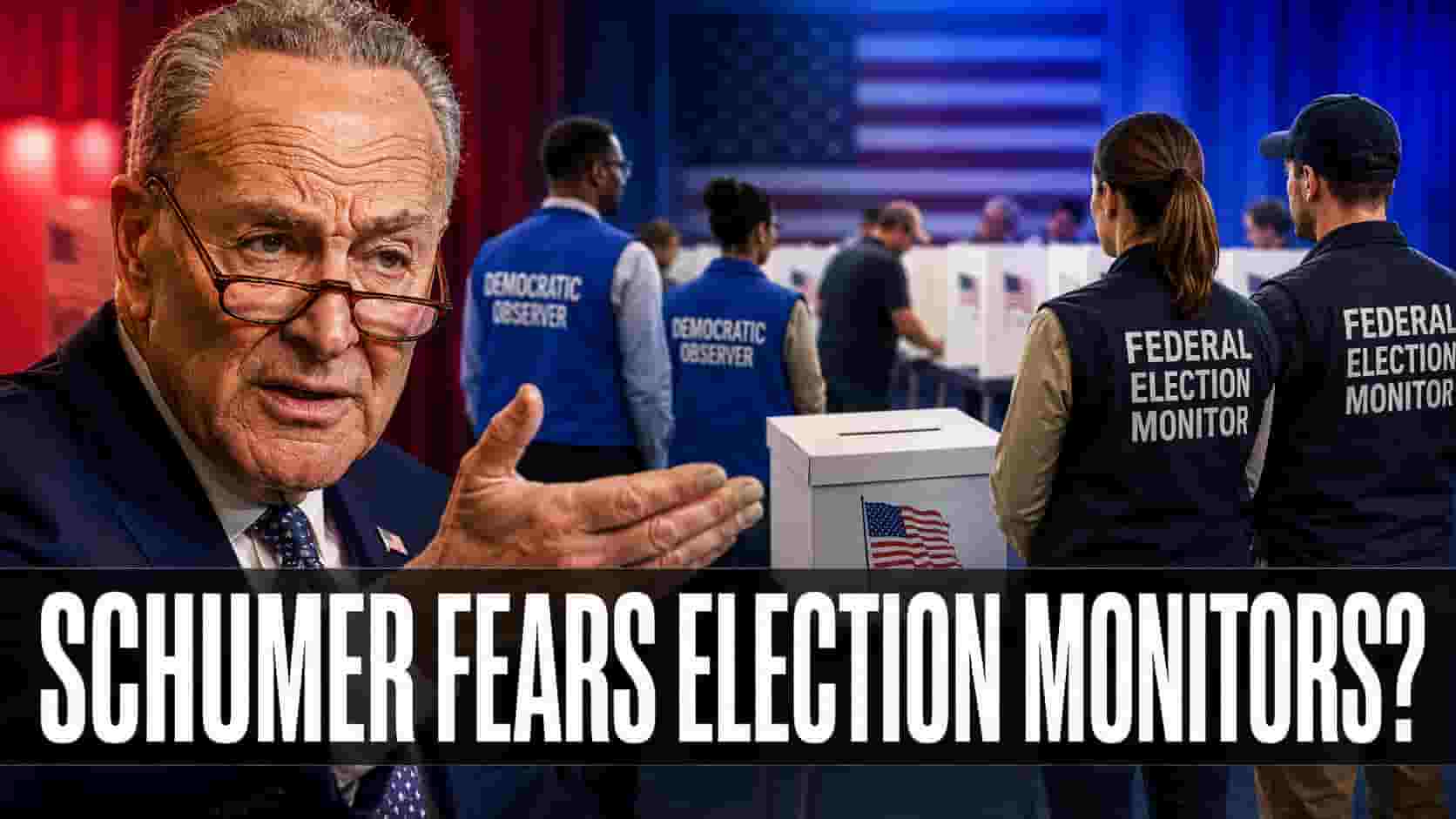
The Senate Democratic leader describes possible federal election monitoring as a threat to democracy, even as his own caucus launches a congressional observer program for the 2026 midterms.
Senate Democratic Leader Chuck Schumer is accusing President Donald Trump’s administration of preparing to use the Department of Justice to interfere with the 2026 midterm elections.
In a post on his official Facebook page, Schumer wrote that the DOJ was “0–23 in court” in attempts to obtain voter data and now plans to deploy 1,000 election “monitors.” He characterized the reported plan as an effort to subvert the election and the will of American voters.
But Schumer’s warning raises an obvious question: Why should election observers sent by one side be treated as an inherent threat when Senate Democrats are organizing an observer program of their own?
Democrats Have Launched Their Own Observer Program
On June 25, 2026, Schumer and Senator Alex Padilla announced the Senate Democrats’ first Election Observer Program. According to the official Senate Democratic leadership announcement, trained Senate staff will observe voting, post-election canvassing and certification during the 2026 midterms.
The announcement says the congressional observers will be nonpartisan and noninterfering. They will not advocate for candidates, handle ballots or election equipment, participate in counting, or attempt to influence results. Their stated role is to document possible voter interference, threats against election workers, and other disruptions.
In other words, Schumer does not oppose election observation in principle. He considers his caucus’s observers a source of transparency while warning that monitors associated with the opposing administration could become an instrument of interference.
That concern may be examined, but it cannot be treated as proven solely on the basis of political affiliation.
Does the DOJ Have Authority to Monitor Elections?
Federal election observation did not begin with the Trump administration. It has long existed under federal law, particularly as an enforcement mechanism of the Voting Rights Act.
The federal voting statutes published by the Justice Department’s Civil Rights Division describe the historic deployment of federal observers to monitor elections in covered jurisdictions and protect voting rights.
Official DOJ court filings also show that federal observers may gather information and observe aspects of voting where their presence is legally authorized. For example, a federal consent decree involving Pawtucket, Rhode Island, expressly recognizes federal observers’ authority under 52 U.S.C. § 10305.
Therefore, the presence of a federal observer does not by itself establish an attempt to seize or manipulate an election. The relevant legal questions are why observers were sent, what authority they possess, what they do at polling locations, and whether they remain within statutory and constitutional limits.
Is the Number 1,000 Officially Confirmed?
The figure appears in Schumer’s public statements on Facebook and X. However, at the time of publication, Midtown Tribune did not locate a publicly available DOJ document confirming a finalized deployment of exactly 1,000 personnel, identifying all participating jurisdictions, and explaining the legal authority and operational duties involved.
The accurate formulation is therefore that Schumer says the DOJ plans to deploy 1,000 monitors. Until the Department releases a detailed plan or another official record confirms it, the number should not be presented as an independently established DOJ fact.
The same caution applies to Schumer’s “0–23” claim. His short post does not provide a list of all 23 cases, docket numbers, rulings, or the precise voter-data demand litigated in each proceeding. Without that record, readers cannot determine whether all 23 matters involved equivalent claims or whether every ruling was a final loss on the merits.
Observation Is Not the Same as Intimidation
There is a clear legal and practical difference between observing an election and interfering with one.
A lawful observer may document procedures and report suspected violations within the limits of the observer’s authority. An observer should not campaign, obstruct access to ballots, interrogate voters without legal authority, handle voting equipment, or create an intimidating environment.
If federal personnel exceed their authority, state officials and affected parties may challenge those actions using specific evidence and applicable law. But calling every federal monitoring effort “election subversion” before misconduct is demonstrated is a political conclusion, not a proven legal finding.
Why Transparency Matters
The debate arrives as election procedures in several states continue to raise legitimate questions about registration, identification, and safeguards against impersonation.
For example, an undercover test of Minnesota’s voter-vouching rules drew attention to a state law that permits one registered voter to vouch for the residence of as many as eight Election Day registrants. Vouching verifies residence rather than citizenship, and a universal photo-ID requirement does not apply in every voting situation.
That procedure does not prove mass voter fraud. It does demonstrate why clear rules, verifiable safeguards, and lawful observation matter regardless of which party controls the White House.
What Is Confirmed
- Schumer publicly claimed that the DOJ plans to deploy 1,000 election monitors.
- Senate Democrats created their own congressional Election Observer Program for the 2026 midterms.
- Federal election observation has a longstanding basis in the Voting Rights Act and related court orders.
- A federal observer’s presence alone is not proof of unlawful election interference.
What Has Not Been Established
- Midtown Tribune did not locate a public DOJ document confirming a finalized force of exactly 1,000 monitors.
- Schumer’s social-media post does not provide the underlying list of 23 voter-data cases.
- No evidence cited in the post proves that DOJ observers have already intimidated voters or altered election results in the 2026 midterms.
Editorial Analysis
Schumer is entitled to demand that the Trump administration refrain from using federal authority to pressure voters or local election officials. Any actual abuse should be documented and challenged.
But the argument becomes less persuasive when prospective DOJ observers are treated as inherently dangerous while observers organized by Senate Democrats are presented as defenders of democracy.
The same standard should apply to both sides: lawful observation is legitimate, partisan interference is not, and every lawful vote should be counted once.
If an election is secure and transparent, professional observation should not destroy public confidence. Properly limited and conducted, it should help demonstrate that the rules were followed.
Official Sources
- Senator Chuck Schumer — official Facebook post
- Senator Chuck Schumer — official X post
- Senate Democrats — Election Observer Program
- U.S. Department of Justice — federal voting statutes
- U.S. Department of Justice — federal observer consent decree
Ask Midtown Tribune about this story
Answers are grounded first in this article. Search all Midtown Tribune reporting from the main AI Search page.
AI-generated summary. Verify important details in the linked original articles.