
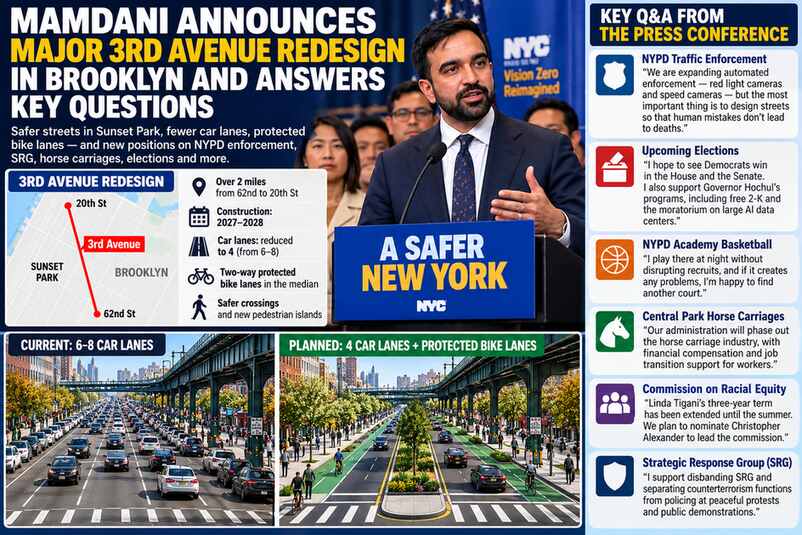
Mayor announces a major Third Avenue redesign in Sunset Park, but reporters press him on policing, public resources, political endorsements, and controversial policy changes.
NEW YORK — October 28, 2026. Mayor Zohran Mamdani used a press conference in Brooklyn’s Sunset Park neighborhood to announce a major redesign of Third Avenue, but the questions from journalists extended well beyond traffic safety.
During the question-and-answer session, the mayor addressed declining traffic enforcement by NYPD officers, the future of the Strategic Response Group (SRG), his use of a police academy basketball court, the proposed elimination of Central Park horse-drawn carriages, leadership changes at the city’s racial equity commission, and the upcoming elections.
His responses raised questions about how the administration intends to balance public safety, government resources, and its broader policy priorities.
1. NYPD Traffic Enforcement: Can Street Design Replace Police Action?
One of the questions concerned a reported decline in traffic summonses issued by NYPD officers.
Mamdani emphasized automated enforcement technology, including speed cameras and red-light cameras. He also argued that safer street design is essential because infrastructure should reduce the likelihood that ordinary mistakes result in fatalities.
The distinction matters.
Street redesign can reduce opportunities for dangerous driving, but police enforcement addresses individual violations, including reckless driving, illegal turns, and other conduct that automated systems may not capture.
The administration’s approach raises several questions:
- How many traffic summonses have NYPD officers issued in 2026 compared with previous years?
- Which categories of moving violations have increased or decreased?
- Will automated cameras supplement traditional police enforcement or replace part of it?
- How will the city measure whether infrastructure changes reduce serious crashes?
Those questions require NYPD enforcement statistics and collision data, not simply announcements about new construction.
2. Strategic Response Group: Mamdani Reaffirms Position on Disbanding SRG
Another significant exchange concerned the NYPD’s Strategic Response Group, a specialized unit whose responsibilities have included responding to major incidents, providing security during large events, and policing demonstrations.
According to the account of the press conference, Mamdani reaffirmed his position that the SRG should be disbanded and that counterterrorism responsibilities should be separated from policing peaceful protests.
The proposal creates important operational questions.
If the unit is dissolved, which NYPD commands will assume its responsibilities? How will officers be reassigned? Will the department retain the same rapid-response capabilities during emergencies, terrorism threats, or major public events?
There is also a distinction between announcing a policy objective and implementing an operational reorganization. The city has not established in the material reviewed for this article that the proposed restructuring has been completed.
Any final plan should be evaluated against the department’s staffing, training, deployment, and emergency-response requirements.
3. Basketball at the NYPD Academy: Questions About Use of Police Facilities
Journalists also asked Mamdani about playing basketball at the NYPD Police Academy in Queens during nighttime hours.
According to the supplied account, the mayor said his games did not interfere with police recruits’ activities and indicated that he would use another facility if the arrangement caused problems.
The issue is not basketball itself. It is the use of a government facility by an elected official.
Relevant questions include whether the mayor’s access follows established NYPD rules, whether other officials have comparable access, whether additional personnel or security resources are required, and whether any public expenses are associated with the visits.
The account of the press conference does not establish that any rules were violated or that the games generated improper costs.
4. Central Park Horse Carriages: Administration Plans an Industry Phaseout
The future of horse-drawn carriages in Central Park was another subject raised by reporters.
Mamdani reiterated his administration’s intention to phase out the industry while providing financial compensation and employment-transition assistance to affected workers.
The proposal has implications for carriage drivers, stable operators, tourism businesses, and animal welfare.
Important unresolved questions include the amount and eligibility rules for compensation, the funding source, and whether alternative employment opportunities would provide comparable earnings.
The New York City Council has separately considered legislation addressing the future of the carriage industry.
5. Elections and Governor Hochul: Mayor Discusses Political Priorities
Questions about upcoming elections prompted Mamdani to express support for Democratic candidates in congressional races and for Governor Kathy Hochul.
According to the press-conference account, he also referenced the governor’s early-childhood education initiatives and proposals concerning large artificial intelligence data centers.
These comments highlight the mayor’s participation in state and national political debates alongside his municipal responsibilities.
The practical questions for New Yorkers concern the cost, eligibility, implementation timelines, and measurable outcomes of the programs being discussed.
6. Commission on Racial Equity: Leadership Transition Discussed
Mamdani was also asked about leadership at the New York City Commission on Racial Equity.
According to the supplied summary, he discussed the continuation of Linda Tigani’s service and the administration’s intention to nominate Christopher Alexander for a future leadership role.
The legal terms of commission appointments, the applicable nomination process, and any final appointment should be confirmed against official city records.
The commission’s role makes transparency about leadership and institutional independence particularly important.
7. Third Avenue Redesign: Six to Eight Vehicle Lanes Reduced to Four
The central announcement of the press conference concerned a 2.1-mile section of Third Avenue in Sunset Park, between 62nd Street and 20th Street.
The NYC Department of Transportation plans to reduce the existing six to eight vehicle lanes to four while adding protected bicycle lanes, pedestrian refuge islands, and shorter street crossings.
Parking along both sides of the corridor is expected to remain.
The first phase, from 62nd Street to 43rd Street, is scheduled for 2027. Work on the northern section, from 43rd Street to 20th Street, is expected to begin in 2028.
City transportation officials report that 17 people have died in crashes along the corridor over the past decade.
The proposed changes are intended to reduce the risk of serious collisions. At the same time, the reduction in vehicle lanes warrants public examination of traffic congestion, freight deliveries, emergency access, construction disruption, and project costs.
An independently verified final project budget was not established in the material reviewed for this article.
Public Accountability Extends Beyond the Press Conference
Mamdani’s Sunset Park appearance illustrated how a local infrastructure announcement can become a broader examination of city government.
The mayor described an administration focused on safer street design, automated traffic enforcement, changes to police operations, and other policy initiatives.
The next stage is determining how those commitments translate into specific decisions.
For NYPD, that means publicly available enforcement statistics and a detailed plan for any SRG reorganization. For the horse-carriage industry, it means transparent compensation and transition arrangements. For government facilities, it means clear rules governing official access and public expenditures.
For Third Avenue, it means a documented budget, a realistic construction schedule, and measurable safety results.
New Yorkers can evaluate these policies most effectively when the administration makes the underlying data, costs, and implementation plans publicly accessible.
Official Sources and Primary Materials
- NYC Mayor’s Office — Official Announcements and Press Releases
- NYC Department of Transportation — Current Projects
- NYPD — TrafficStat
- NYC Open Data — Motor Vehicle Collisions
- NYC Mayor’s Office — Brooklyn-Queens Expressway Improvements and Third Avenue Safety Plans
- New York City Council — Official Legislative and Press Information
- Video — Mayor Mamdani’s October 28, 2026 Press Conference
Editorial note: The descriptions of the mayor’s question-and-answer responses are based on a supplied summary of the press conference, not a verified verbatim transcript. They are paraphrased rather than presented as direct quotations. The Third Avenue project has been independently corroborated through published reporting and earlier official city announcements.
Midtown Tribune | New York City News and Analysis
Midtown Tribune Independent USA news from New York
Ask Midtown Tribune about this story
Answers are grounded first in this article. Search all Midtown Tribune reporting from the main AI Search page.
AI-generated summary. Verify important details in the linked original articles.