
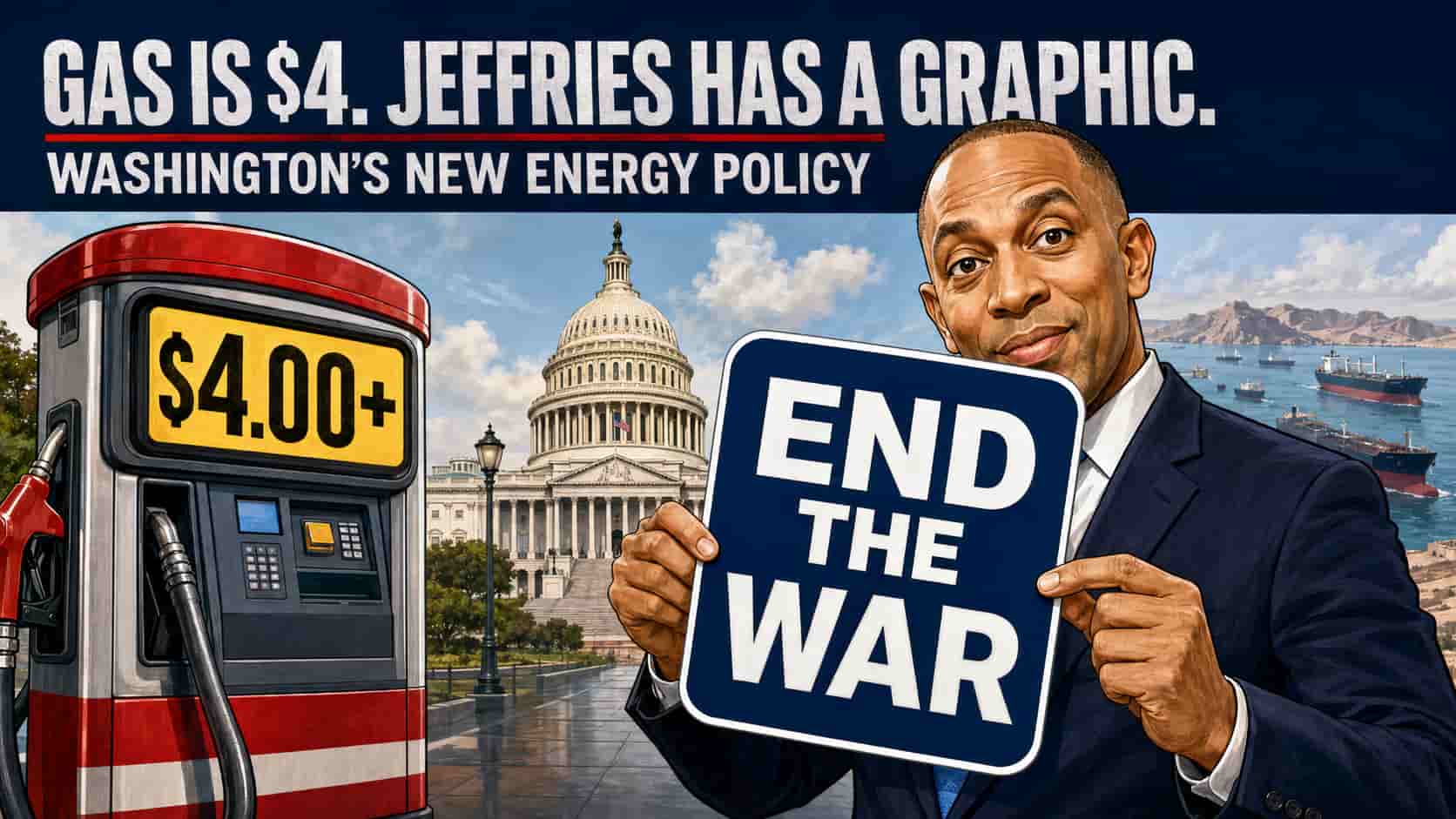
Apparently, reopening the Strait of Hormuz requires neither diplomacy nor military strategy—only large white letters on a navy-blue background.
Satirical Commentary — Midtown Tribune
House Democratic Leader Hakeem Jeffries has unveiled Washington’s newest energy policy.
It is not increased domestic production.
It is not reopening international shipping routes.
It is not negotiations with Iran.
It is not protecting commercial vessels in the Strait of Hormuz.
It is a Facebook graphic.
“Gas Prices are back over $4 per gallon. End the War,” the graphic announced, followed by Jeffries’ declaration that House Democrats would “strongly oppose the GOP scheme to fund Trump’s war machine.”
There it is. Global energy policy, military strategy and congressional budgeting—all solved before the graphic designer’s lunch break.
The gas price is real. The explanation is slightly more complicated.
The national average price of regular gasoline did climb above $4 per gallon, reaching approximately $4.003 on July 20.
But gasoline did not become expensive because a Republican congressman pressed the “war machine” button in the Capitol basement.
Prices rose amid renewed fighting between the United States and Iran, disruptions to energy shipments through the Strait of Hormuz, reduced refining capacity and low American fuel inventories. Before the conflict, roughly 20 percent of the world’s oil supply traveled through the strait. Reuters
That may be inconvenient for a campaign graphic, where there is only enough room for three ideas:
- Gas expensive.
- Trump bad.
- Vote Democrat.
The actual situation requires considerably smaller print.
What is the “war machine”?
House Republicans are advancing a broader $95 billion package. Approximately $60 billion would go to the Pentagon, $13 billion to other national-security programs, $12 billion to agricultural assistance and $10 billion to election-administration measures connected to the SAVE America Act.
Jeffries describes the military portion as funding “Trump’s war machine.”
The Pentagon describes it as money needed to pay service members, replenish weapons and equipment, and continue military operations.
Defense Secretary Pete Hegseth told senators that the Iran conflict had already cost approximately $37.5 billion. The administration is seeking nearly $88 billion in supplemental funding, with as much as $67.1 billion connected to the Iran operation. The Guardian
Those are enormous numbers, and Congress absolutely should demand a clear accounting, a defined military objective and an explanation of how the conflict ends.
But Jeffries’ Facebook post does not provide those things.
It provides a stop sign emoji.
The missing Democratic plan
If Democrats believe the war must end immediately, they should explain what happens next.
Who protects American troops already in the region?
Who protects commercial vessels?
How does the United States prevent Iran from controlling or repeatedly disrupting the Strait of Hormuz?
What happens to Iran’s nuclear and missile programs?
Is Jeffries proposing negotiations, withdrawal, additional sanctions, an international naval coalition—or simply hoping Tehran sees his Facebook graphic and becomes cooperative?
“End the war” is a desirable objective. It is not, by itself, a strategy.
It is approximately as useful as telling the MTA to “End the Delays,” telling criminals to “End the Crime,” or telling New York landlords to “End the Rent.”
Thank you, Congressman. Why did nobody think of that before?
Jeffries has legitimate questions—and avoids answering the difficult ones
Jeffries is correct that Congress must examine the legality, purpose and cost of the conflict. He has argued that the administration lacks a coherent strategy and that military operations should receive explicit congressional authorization. Those are serious constitutional questions. Office of Democratic Leader Hakeem Jeffries
Unfortunately, his social-media message replaces those serious questions with partisan advertising.
If Republicans approve every dollar without oversight, they are neglecting their constitutional responsibility.
If Democrats simply vote against the funding without presenting a workable security and diplomatic alternative, they are doing the same thing from the opposite side of the aisle.
The United States cannot conduct foreign policy through slogans—and it cannot reopen the world’s most important energy corridor by refusing to pay the people and equipment already deployed there.
Washington’s latest miracle
Gas prices are painful. The war is expensive. Americans have every right to demand answers from the Trump administration.
They should also demand more from the Democratic leader than a professionally designed complaint.
Jeffries’ graphic tells voters whom to blame. It does not tell them what he would do differently on Monday morning.
But perhaps that is the true bipartisan tradition in Washington:
Republicans produce a $95 billion bill.
Democrats produce a $95 Facebook graphic.
And American motorists continue to pay at the pump—paying, in part, for the military that acted when Iran was reportedly only weeks away from producing enough weapons-grade material for a nuclear bomb, preventing that rapidly growing threat from becoming a weapon that could one day be aimed at America. For that, Americans can thank not only President Trump, who stood behind the armed forces, but also Congressman Hakeem Jeffries—who, fortunately, failed to throw a wrench into the gears of his own country’s “terrible war machine” before it could carry out its mission.
This article is satirical commentary. Factual descriptions of gasoline prices, proposed spending and official statements are based on publicly available reporting and government materials.
Official Documents and Primary Sources
Readers can review the original post, government statements, budget materials and fuel-price data:
- Original Facebook post by Congressman Hakeem Jeffries
- Hakeem Jeffries: Official statement opposing the Republican budget resolution — Office of the House Democratic Leader
- Jeffries’ official statement on the Iran-war supplemental funding request — Office of the House Democratic Leader
- House Budget Committee advances the FY2027 budget resolution — U.S. House Committee on the Budget
- President’s $87.6 billion supplemental funding request — White House Office of Management and Budget, PDF
- Senate hearing on the supplemental funding request — U.S. Senate Committee on Appropriations
- Official U.S. gasoline and diesel price data — U.S. Energy Information Administration
Links were accessed on July 22, 2026. Government positions may differ; readers are encouraged to examine the primary documents directly.
Ask Midtown Tribune about this story
Answers are grounded first in this article. Search all Midtown Tribune reporting from the main AI Search page.
AI-generated summary. Verify important details in the linked original articles.