
Video: Madiba's Legacy.
To the world today, Nelson Mandela is a hero exalted as a legend. But to the people of South African who he liberated, he was Madiba, a leader who fought for justice even when the tides of the present were turned swiftly against it. To honor Madiba’s legacy is to fight injustice before history rewrites itself.
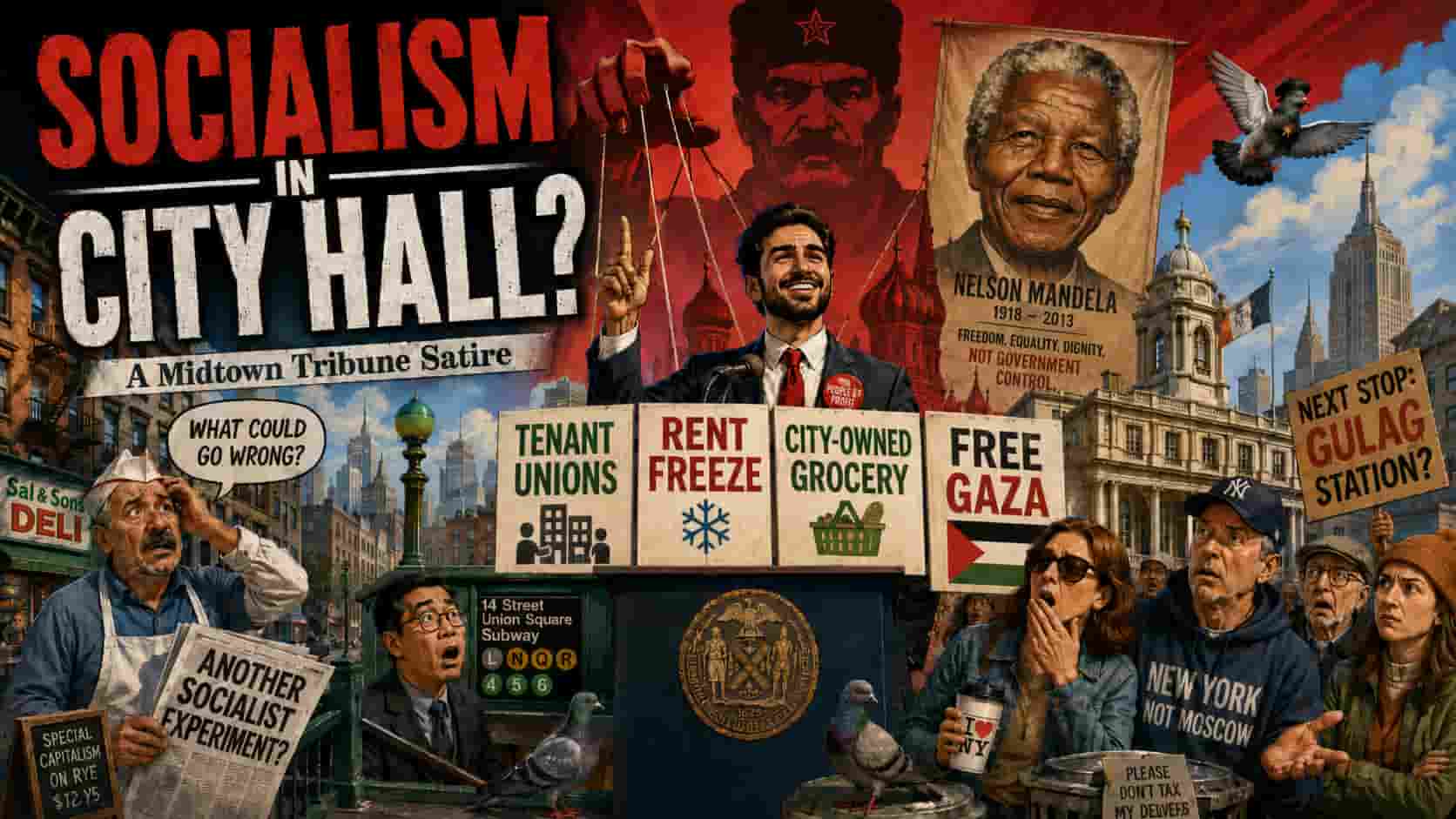
From Mandela to Mamdani: Why the Kremlin Is Again Applauding a Socialist Experiment — This Time in New York City
An opinion column for Midtown Tribune
At the Nelson Mandela Global Leadership Forum, New York City Mayor Zohran Mamdani did more than honor the memory of Nelson Mandela. He presented “Madiba” as a political model for a new generation of activists.
Mamdani argued that Mandela’s legacy lives on in protest movements, labor struggles, immigrant campaigns and international causes. He told future leaders, in effect: You, too, can become Madiba.
To an audience unfamiliar with Cold War history, this may sound like another uplifting speech about courage, solidarity and justice.
To anyone who remembers how Moscow promoted revolutionary movements throughout Africa, however, the production looks remarkably familiar.
The actors have changed. The slogans have been updated. The propaganda now arrives through social media instead of shortwave radio.
But the script is still sitting on the same Kremlin bookshelf.
Mandela Was More Than a Harmless Symbol
The popular Western image of Nelson Mandela is that of a kindly grandfather who emerged from prison, forgave everyone and immediately began smiling for commemorative posters.
That image is incomplete.
Mandela helped establish Umkhonto we Sizwe, the armed wing associated with the African National Congress. He acknowledged participating in the planning of sabotage against government and infrastructure targets. The ANC’s armed struggle later included bombings and other attacks, some of which killed civilians.
The Soviet Union did not merely send Mandela encouraging greeting cards.
Moscow supported the ANC and its armed structures with political backing, military training, weapons, organizational assistance and international propaganda. The South African Communist Party provided another important connection between the ANC and the Soviet bloc.
The purpose was larger than ending a particular set of discriminatory laws. Soviet strategy sought to make the ANC the internationally recognized representative of South Africa’s Black population while marginalizing moderate or anti-communist alternatives.
First, one movement is elevated into the sole moral voice of an oppressed population.
Then its leaders are transformed into sacred historical figures.
Finally, anyone who asks uncomfortable questions about communist alliances or political violence is accused of defending injustice.
It was an efficient system. It also saved tremendous time on public debate.
The Mayor Edited Out the Inconvenient Chapters
In his speech, Mamdani recalled Mandela’s 1990 television appearance with ABC News journalist Ted Koppel.
Mamdani portrayed the program as an ambush in which Mandela was condescended to, called an extremist and pressured to abandon his allies. He particularly praised Mandela for refusing to retreat from his support for the Palestinian cause.
What Mamdani did not explain was why journalists were asking about communism, armed struggle and hostile foreign governments in the first place.
He did not remind the audience that the ANC had close organizational ties to communists, that its military wing had carried out sabotage, or that the Soviet Union had treated the movement as an important geopolitical asset.
The difficult history disappeared. In its place remained a perfectly polished moral icon ready for reuse in today’s political campaigns.
Mandela became a bridge connecting Mamdani’s municipal administration to Palestine, immigration enforcement, labor militancy, colonialism and global revolution.
Potholes apparently did not make the guest list.
Moscow Discovers Another Promising Socialist
Several decades later, Russia’s methods have changed less than its technology.
RT and other Russian state media presented Mamdani as a young, charismatic socialist confronting Donald Trump, wealthy interests, Republicans and the Democratic establishment. His proposals were promoted as bold assistance for working people:
- rent freezes;
- fare-free public transportation;
- government-supported housing;
- municipal grocery stores;
- expanded public benefits;
- higher taxes on corporations and wealthy residents.
In American political debate, these proposals raise obvious questions about cost, legality, implementation and unintended consequences.
In Russian state media, they were often presented more like the menu at a revolutionary brunch.
After Mamdani’s political success, a senior Russian Communist Party official described him as a possible “partner” and noted similarities between Mamdani’s agenda and the Russian Communist program.
That was unusually direct.
Russian state media praised the socialist. Russian communists welcomed the socialist. The Kremlin, meanwhile, could preserve its traditional expression of complete innocence.
Apparently everyone arrived at the same enthusiasm independently.
Moscow Does Not Need to Recruit Everyone It Amplifies
There is no publicly available document showing Vladimir Putin issuing instructions to Zohran Mamdani.
That is not how modern influence operations necessarily work.
The Kremlin does not need every useful Western politician to be a recruited agent. It can simply amplify political forces that already weaken institutions, intensify social conflict and turn ordinary policy disagreements into existential warfare.
From Moscow’s perspective, Mamdani can be useful without taking a single instruction from Russia.
His political rise may help:
- strengthen socialist factions inside American politics;
- deepen conflict between New York City and the federal government;
- intensify disputes involving Israel, immigration and policing;
- divide ethnic, religious and economic groups;
- turn municipal government into a platform for international ideological campaigns;
- demonstrate that America’s financial capital is willing to experiment with socialism voluntarily.
For the Kremlin, this is an economical arrangement.
Why build a revolutionary movement from scratch when an American city may elect one, provide it with offices and pay for the press conferences?
The claim that Moscow actively hopes Mamdani will destroy New York remains an inference, not an established intelligence finding.
But Russian state media have made clear which aspects of his political project they find useful.
The Family Department of Decolonization
The story becomes almost too perfectly satirical when one considers Mamdani’s father, Mahmood Mamdani, a highly paid Columbia University professor whose academic work focuses on Africa, colonialism, anti-colonialism, decolonization, political violence and the modern state.
The university does not publicly list his precise salary, so no responsible publication should invent a number.
Still, the arrangement offers an impressive example of American capitalism at work.
One of the world’s most expensive private universities pays distinguished scholars to explain the evils of colonial structures, while tuition-paying families finance the entire conversation.
The father develops theories of decolonization inside an elite Manhattan institution.
The son carries the vocabulary of global liberation into City Hall.
New Yorkers, meanwhile, continue waiting for someone to decolonize the subway delays.
Mamdani’s political language repeatedly asks residents to view New York through the framework of African liberation movements, colonialism, Palestine and international solidarity.
That may be intellectually exciting in a university seminar.
But New Yorkers might reasonably ask what it has to do with violent crime, sanitation, commercial vacancies, housing construction, taxes, failing infrastructure and the survival of small businesses.
The city elected a mayor.
It may have received an adjunct professor of global revolution.
From African Socialism to the Five Boroughs
South Africa in the twentieth century and New York City today are obviously not identical.
The political systems are different. The historical conditions are different. The institutions are different.
The pattern of outside propaganda, however, deserves examination.
In South Africa, the Soviet Union supported an African movement connected to communists and armed struggle. Moscow helped elevate that movement internationally and portray it as the principal moral representative of an entire population.
In New York, Russian state media promoted an African-born socialist politician as a champion of workers, immigrants and ordinary people against Trump, wealthy interests and the American establishment.
Then Russian communist officials openly welcomed him as a potential political partner.
In the twentieth century, the Soviet toolkit included weapons, military training, party structures, intelligence services and international front organizations.
Today’s toolkit includes television networks, viral videos, algorithmic amplification, proxy websites, activist networks and the respectable academic vocabulary of “decolonization.”
It is cheaper, faster and considerably easier to deny.
The Revolution Now Comes With Municipal Grocery Stores
Mamdani concluded his Mandela speech with the famous idea that something always seems impossible until it is done.
New Yorkers should perhaps take that statement seriously.
The decline of a successful city also appears impossible—until ideology replaces administration, taxpayers become ideological enemies, policing becomes a seminar topic and every local problem is explained through a global revolutionary struggle.
Mandela was once promoted by Moscow as part of a larger contest for influence in Africa.
Today, Kremlin media celebrate Mamdani as a socialist challenge inside America’s largest city.
One project involved South Africa.
The new experiment comes with subway cards, rent regulations and a City Hall communications department.
For anyone who has followed a century of Soviet and Russian influence operations, the stitching on this hybrid campaign is not merely white.
It is practically fluorescent.
Sources and Further Reading
Official Statements and Primary Records
- NYC Mayor’s Office: Mayor Mamdani’s Address at the Nelson Mandela Global Leadership Forum
- National Archives of South Africa: Rivonia Trial Archive
- National Archives of South Africa: State v. Nelson Mandela and Others — Dr. Percy Yutar Papers
- National Archives of South Africa: Rivonia Indictment, Annexures and Prosecution’s Opening Address
- National Archives of South Africa: Rivonia Trial Sound Recordings and Exhibits
- South African Department of Justice: Truth and Reconciliation Commission Final Report
- Truth and Reconciliation Commission: Final Report, Volume Two
Declassified U.S. Government Records
- CIA Reading Room: South Africa — The Soviet “Legitimate Representative” Strategy
- CIA Reading Room: The African National Congress of South Africa
- CIA Reading Room: Soviet Policies in Southern Africa
- U.S. Department of State, Office of the Historian: The End of Apartheid
U.S. Government Records on Russian Influence Operations
- U.S. Treasury: Russian Foreign Malign Influence Operations and RT
- U.S. Treasury: Russian Influence Networks, Including RT and Doppelgänger
Russian State Media Coverage of Zohran Mamdani
- RT Commentary: “What Does a ‘Socialist’ in Charge of New York Really Mean?”
- RT: Russian Communists Hail Victory of “Partner” Mamdani
- RT: Uganda-Born Socialist Zohran Mamdani Elected New York City Mayor
- RT: Trump Attacks “Communist Lunatic” New York Mayoral Candidate
- RT: Trump Threatens New York Mayoral Frontrunner With Arrest
- RT: New York City Mayor Promises a Democratic Socialist “New Era”
Mamdani’s Political Platform and Socialist Support
- NYC Democratic Socialists of America: Zohran Mamdani for Mayor
- NYC-DSA: “Socialism Wins” — Statement Celebrating Mamdani’s Victory
- NYC-DSA: Mamdani Wins the Democratic Nomination on a Socialist Platform
Academic Background
Editorial note: Links to RT and socialist organizations are included as primary evidence of how those organizations described Mamdani and his political program. Their inclusion does not constitute an endorsement.
Ask Midtown Tribune about this story
Answers are grounded first in this article. Search all Midtown Tribune reporting from the main AI Search page.
AI-generated summary. Verify important details in the linked original articles.