
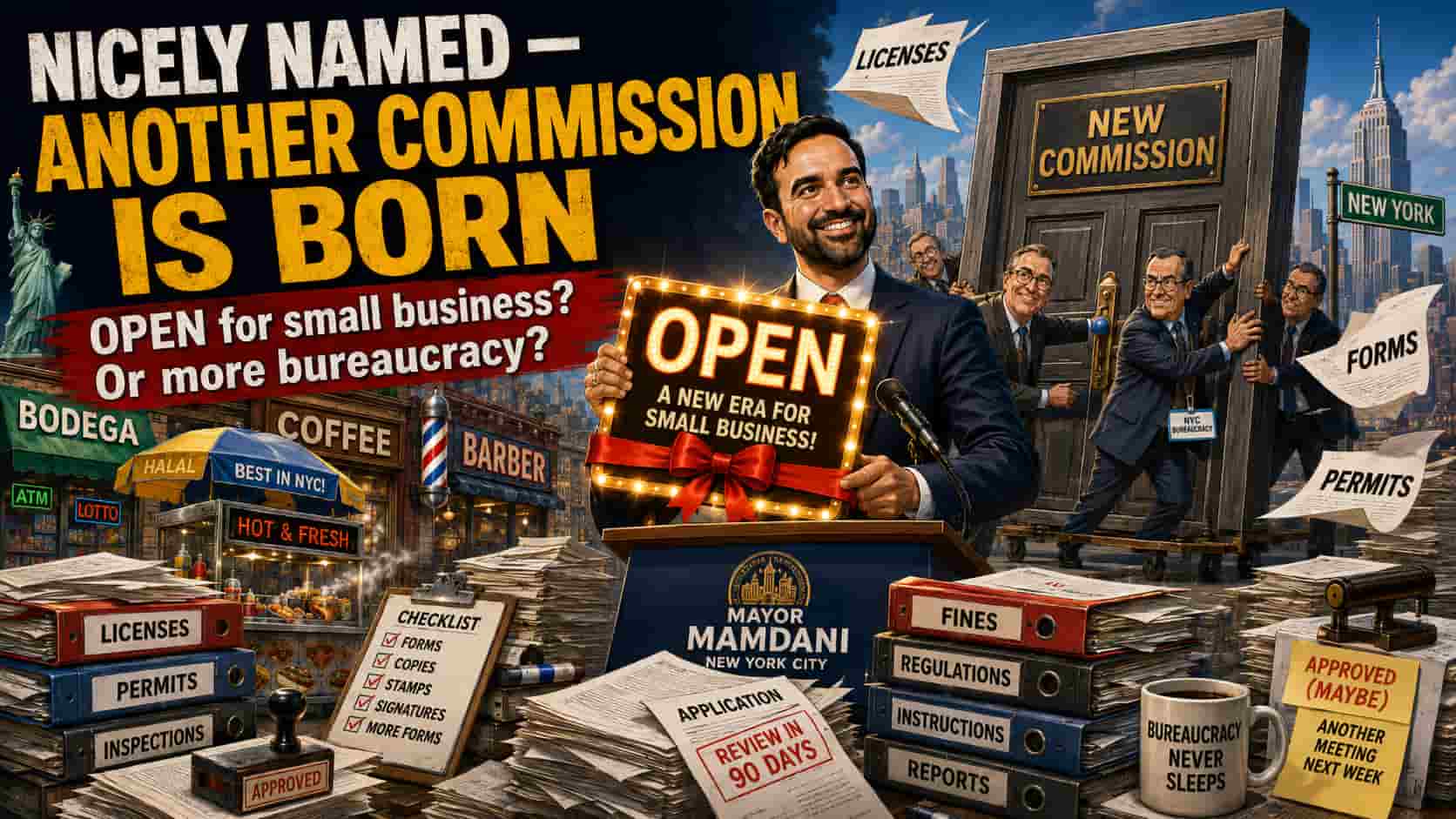
It began beautifully.
Mayor Zohran Mamdani gathered deputy mayors, commissioners, City Council members, agency officials, advocates, and small-business owners to announce what sounded like a historic assault on New York City bureaucracy.
The initiative was not given an ordinary name such as “Removing a Few Unnecessary Forms.”
That would have lacked sufficient grandeur.
Instead, City Hall called it OPEN for Small Business.
OPEN stands for Overhauling Procedures and Expanding Navigation.
The name suggests that New York is finally throwing open the gates for entrepreneurs—that City Hall is clearing away mountains of licenses, fees, inspections, forms, stamps, and contradictory agency requirements.
But after the speeches, applause, slogans, and ceremonial signing of an executive order, one central result emerged:
New York City created another permanent interagency task force.
In other words, to reduce the number of government structures confronting small businesses, City Hall created one more government structure.
It will hold meetings.
It will consult stakeholders.
It will study regulations.
It will prepare recommendations.
And, naturally, it will produce annual reports explaining how the city may someday reduce paperwork and regulatory burdens.
From OPEN to Another Committee
The Mamdani administration says the OPEN package includes more than 50 reforms affecting restaurants, bodegas, barbershops, food vendors, child care providers, transportation companies, retailers, nonprofit organizations, and other small businesses.
Some changes are concrete and potentially useful.
Others are proposals that still require rulemaking, legislation, cooperation from Albany, or additional study.
And the executive order makes OPEN a permanent body responsible for identifying future reforms throughout the year.
Translated from administrative language into ordinary English:
To reduce the administrative machinery, City Hall is creating an additional administrative mechanism.
Somewhere, a deputy assistant commissioner for interagency coordination is smiling.
The Socialist Tradition: When in Doubt, Form a Committee
Socialist governments have long demonstrated a special institutional instinct.
When a problem cannot be solved, form a commission.
When the commission fails, make it permanent.
When the permanent commission becomes overwhelmed, establish an interagency working group to coordinate the commission.
Then publish a report recommending better coordination.
Under Lenin and Stalin, the Soviet state repeatedly expanded its bureaucracy while officially campaigning against bureaucratism. Each new effort to control the administrative apparatus required more administrators, more oversight bodies, more instructions, and more reporting.
Modern New York is not the Soviet Union, and an interagency business task force is not a Stalinist commissariat.
But the bureaucratic reflex is familiar:
The bureaucracy discovered that there was too much bureaucracy and assigned the bureaucracy to report annually on reducing bureaucracy.
What Will Actually Improve?
To be fair, the OPEN package contains several practical reforms.
One Less Approval for Sidewalk Cafés
The city plans to eliminate a separate mayoral approval step for sidewalk café applications.
That is a genuine reduction in procedure.
It may save restaurant owners some time, although it does not eliminate the costs of commercial rent, insurance, payroll, sanitation compliance, construction requirements, or the rest of New York’s regulatory structure.
Still, one signature is one signature.
In New York City, that apparently qualifies as a historic breakthrough.
A Bodega May No Longer Need Two Licenses for the Same Products
City Hall proposes eliminating an additional license that can be required when a bodega sells fruit, flowers, or beverages directly outside its entrance—even though the same store is already licensed to sell the same products inside.
That reform makes sense.
The difficulty is that “proposes to eliminate” is not always the same as “eliminated as of today.”
The owner should probably wait before framing the old license and hanging it on the wall as a relic of the bureaucratic age.
Food Vendors May Stop Carrying a Paper the City Already Has
Food carts and trucks may no longer be required to carry a physical copy of a commissary agreement when the city already possesses the document electronically.
This is unquestionably progress.
In 2026, New York City has officially discovered that a document stored in a government database may not also need to travel beside the mustard and hot sauce.
Some Fees and Fines Will Be Reduced
Certain registration fees involving food-service equipment and mobile food vendors are scheduled to be reduced to zero for 12 months.
The temporary nature matters.
This is not necessarily the permanent abolition of a fee. It may simply be a one-year vacation before the fee returns refreshed and ready to serve the public.
The maximum penalty for three common food-safety violations will also be reduced from $600 to $500.
The violation remains.
The inspection remains.
The fine remains.
But the small-business owner receives $100 worth of freedom.
Two Posters Will Become One
The administration plans to combine two overlapping allergy-notice requirements into one poster.
This is sensible.
Restaurant walls across New York may soon recover approximately one sheet of paper.
Some Licenses Will Last Longer
Certain business licenses will receive longer renewal periods.
That means the licensing requirement itself remains, but the owner may have to repeat the process less frequently.
It is the regulatory equivalent of being allowed to visit the dentist every two years instead of every year.
Business Owners May Receive a Case Manager
The city plans to expand NYC BEST and assign some entrepreneurs a personal contact who can guide them through permits, inspections, agency requirements, and compliance procedures.
This could be genuinely useful.
It also reveals the real condition of the system.
The rules are so numerous and confusing that, rather than eliminating most of them, the city proposes assigning the entrepreneur a specially trained guide.
The maze will remain.
City Hall will provide a tour guide.
What Is Still Only a Promise?
Several of the most publicized reforms cannot be completed by the mayor alone.
The administration wants to work with New York State to eliminate a separate permit for restaurants selling frozen desserts such as ice cream.
That permit has not yet vanished. City Hall is promising to discuss its disappearance with Albany.
The same applies to simplifying licensing requirements for barbers and barbershops.
The mayor described a system involving multiple licenses, but did not announce that a specific state license had already been abolished on a specific date.
So the OPEN package contains several different things:
- rules being changed now;
- rules that may be changed later;
- rules the city wants Albany to change;
- fines being reduced rather than eliminated;
- fees being suspended temporarily;
- instructions being rewritten;
- inspectors being retrained;
- businesses receiving case managers;
- and a permanent task force being created to continue studying the subject.
All of this is grouped under the label “more than 50 reforms.”
Fifty Reforms Out of More Than 6,000 Rules
Earlier in 2026, the administration said small businesses in New York City face more than 6,000 rules and regulatory requirements.
Now City Hall is promoting a package of more than 50 reforms.
Even if all 50 were complete eliminations—which they are not—the arithmetic would be:
50 divided by 6,000 equals approximately 0.83 percent.
Less than one percent.
And that figure exaggerates the scale of actual deregulation because many of the 50 items are not eliminated rules.
They include:
- training programs;
- case-management services;
- informational materials;
- relocation of a food-safety training center;
- annual reviews;
- recommendations;
- negotiations with the state;
- temporary fee reductions;
- reduced penalties;
- and the establishment of the permanent OPEN Taskforce.
The percentage of the city’s regulatory structure that will actually disappear immediately is therefore well below 0.83 percent.
The precise figure cannot be calculated because City Hall has not published a simple accounting showing:
- how many requirements existed;
- how many have been fully repealed;
- which forms no longer need to be filed;
- which fees no longer need to be paid;
- when every change takes effect;
- and how much money the typical business will save.
Small Businesses Will Continue Filling Out Forms and Paying
After OPEN, New York businesses will still have to:
- register legal entities;
- obtain industry-specific licenses;
- secure permits;
- satisfy zoning rules;
- comply with Department of Buildings requirements;
- comply with FDNY regulations;
- pass health and safety inspections;
- pay commercial rent;
- purchase insurance;
- pay utility bills;
- pay federal, state, and city taxes;
- pay payroll taxes;
- comply with employment laws;
- maintain required records;
- renew most licenses;
- and pay most existing fees and penalties.
The administration has acknowledged that commercial rent, insurance, utilities, and other operating costs are among the largest burdens facing small businesses.
But on those major expenses, the current package largely promises further study and future recommendations.
And who will examine those recommendations?
The administration.
The agencies.
And the new task force.
New York Has Seen This Before
The city has launched previous initiatives to reduce small-business burdens.
Under the Adams administration, Small Business Forward assembled multiple agencies to examine hundreds of rules and propose changes to fines and enforcement.
That initiative was later relaunched as Small Business Forward 2.0.
Mamdani then issued another executive order directing agencies to review fees, fines, and regulatory burdens.
Now comes OPEN, together with a permanent interagency task force.
The sequence resembles an old central-planning model:
First reform program.
Improved reform program.
New executive order.
Permanent committee to improve the reform process.
New York has not yet eliminated the bureaucratic cycle.
It has simply rebranded it.
Previous Reform Efforts Lacked Measurable Results
A review by the New York City Comptroller criticized the earlier Small Business Forward program for failing to establish clear performance measures and collect sufficient data to determine whether the reforms meaningfully reduced violations or enforcement burdens.
The review also found that many of the rules selected for reform had rarely been enforced before the initiative began.
That distinction is important.
City Hall can announce the reform of dozens of obscure regulations while leaving untouched the requirements that business owners encounter every week.
The number of reforms sounds impressive.
The impact depends on which rules are actually removed.
The Great Paper-Copy Revolution
Perhaps the perfect symbol of OPEN is the decision to stop requiring a food vendor to carry a paper copy of a document already available to the city electronically.
It is useful.
It is rational.
It should have happened years ago.
But when the government of America’s largest city presents the removal of one redundant sheet of paper as part of a major mayoral announcement, a question arises:
How enormous must the bureaucracy be when permission not to carry a duplicate paper becomes a political achievement?
Perhaps the next reform will allow a business owner to complete one form in blue ink instead of completing two forms in black ink.
An oversight subcommittee can then study the economic consequences.
What a Real OPEN Program Would Measure
A genuine regulatory-opening program should publish clear results:
- the number of licenses fully abolished;
- the number of forms eliminated;
- the number of fees permanently removed;
- the number of inspections consolidated;
- the reduction in average opening time for a restaurant, store, barbershop, or child care center;
- the annual dollar savings for a typical small business;
- the number of city administrative positions or costs reduced;
- and the exact effective date of every reform.
Instead, OPEN currently resembles a new information desk placed at the entrance to the old maze.
The city will provide a map.
It may provide a guide.
It will explain the business owner’s rights.
It will survey the owner about the quality of the guidance.
But most of the maze will remain standing.
And Another Commission Was Born
Mayor Mamdani promised a new relationship between City Hall and small business.
He gave the program a polished name: OPEN.
He spoke about opportunity, trust, dignity, fairness, and the American dream of entrepreneurship.
Onstage, regulations were symbolically shredded.
But after the ceremony, the practical picture was less revolutionary:
- only a limited number of requirements are being eliminated;
- some fines are merely being reduced;
- some fees are suspended temporarily;
- several reforms require cooperation from Albany;
- many initiatives involve guidance rather than deregulation;
- less than one percent of the city’s reported 6,000 rules are even nominally touched;
- and a permanent interagency task force will continue studying the problem.
The mountain of political rhetoric labored, held meetings, consulted stakeholders, and signed executive orders.
And finally, it gave birth to a mouse.
More precisely:
Another commission was born.
It will now report annually on New York City’s progress in reducing commissions, reports, forms, permits, licenses, and annual reporting requirements.
Midtown Tribune Sarcasm
Official Sources and Documents
- NYC Mayor’s Office: Mayor Mamdani Announces “OPEN for Small Business” — the administration’s official announcement describing more than 50 proposed reforms, fee reductions, licensing changes, business assistance programs, and the permanent OPEN task force.
- Official Transcript: Mayor Mamdani Announces OPEN for Small Business — the complete transcript of the mayor’s press conference, including statements by city officials and small-business representatives.
- NYC Mayor’s Office: Full Video of the OPEN for Small Business Announcement — the complete official video of the press conference and executive-order signing.
- Executive Order No. 11: Reducing Fees and Civil Penalties for Small Business — the January 2026 order directing city agencies to inventory fees, fines, and regulatory burdens affecting businesses.
- NYC Mayor’s Office: Mamdani Orders Review of Small-Business Fines and Fees — the original City Hall announcement that preceded the OPEN initiative.
- NYC Comptroller: Review of the Small Business Forward Initiative — the official audit examining whether the city’s earlier regulatory-reform program produced measurable reductions in fines and red tape.
- NYC Comptroller: Small Business Forward Failed to Significantly Cut Red Tape or Fines — the Comptroller’s official summary of findings concerning weak benchmarks, limited measurable impact, and inadequate tracking.
- NYC Business Portal — official city information on business licenses, permits, regulations, inspections, and assistance programs.
Editor’s note: This article is a satirical opinion column. Its factual references to executive orders, regulatory proposals, fines, fees, business-assistance programs, and prior audits are based on official New York City government documents.