
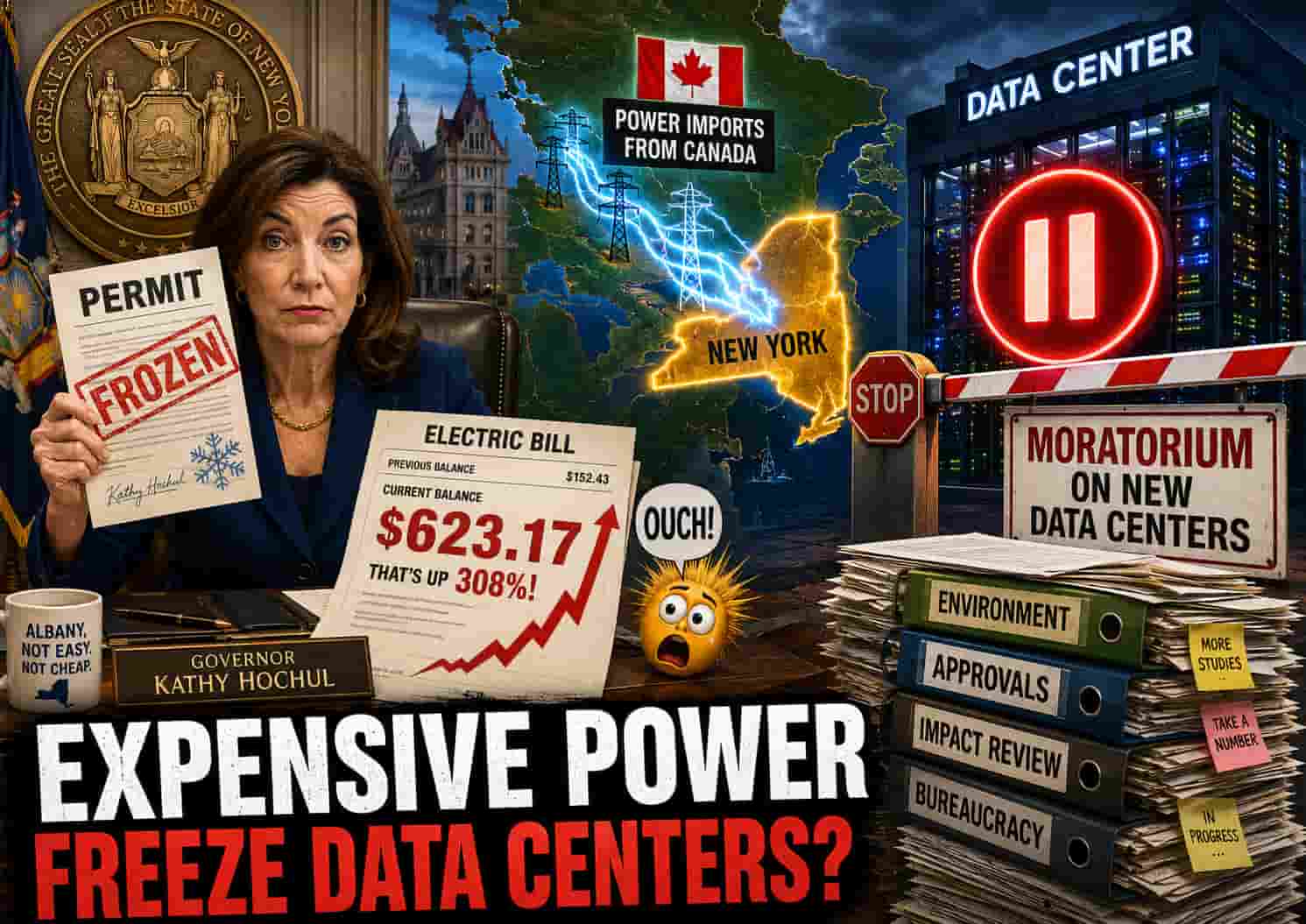
Governor Hochul says she is protecting ratepayers. Her new system may also create New York’s most valuable renewable resource: political permission.
New York has expensive electricity, an aging grid and a long line of technology companies looking to invest billions of dollars in data centers.
Under ordinary economic logic, this would be an excellent time to produce more electricity.
Under Albany logic, it is an excellent time to stop construction and develop a framework for eventually discussing the possibility of producing more electricity.
Governor Kathy Hochul has imposed a temporary moratorium on certain state environmental permits for new hyperscale data centers. The pause may last up to one year while New York develops new standards governing electricity, water, noise, labor and community benefits.
The official explanation is reasonable: data centers consume enormous amounts of power, can strain the grid and should not force families and small businesses to pay for infrastructure built for trillion-dollar technology companies.
The less comfortable question is this:
Does New York need a temporary moratorium to protect residents—or does Albany want to control who receives permission, which contractors receive the work and where the money is distributed?
There is no public evidence that Hochul created the moratorium for personal or criminal gain. But the system being designed contains nearly every ingredient required for political favoritism: discretionary permits, negotiated payments, public funds, tax incentives, union agreements and government-selected energy projects.
In New York, that is not proof of corruption.
It is merely the traditional starter kit.
The electricity is expensive before the AI even arrives
In April 2026, residential customers in New York paid an average of 29.45 cents per kilowatt-hour, according to the U.S. Energy Information Administration. That was far above the national average.
One clarification is important: residential electricity is generally exempt from New York State sales tax, although some local jurisdictions impose local taxes on residential energy. High bills therefore cannot honestly be blamed on one simple “Hochul electricity tax.” They reflect generation costs, transmission, distribution, local taxes, infrastructure spending and the broader regulatory system. Our report on New York’s nuclear-policy reversal examines the same electricity-cost pressure from another policy angle.
Still, the customer does not care which line on the bill achieved bipartisan cooperation in emptying the bank account.
The customer sees only the final number.
And that number is already high.
Canada produces the power. Albany produces the paperwork.
In May 2026, the Champlain Hudson Power Express began commercial operation. The 339-mile transmission project carries hydroelectric power from Hydro-Québec in Canada directly into New York City.
NYSERDA says the line can deliver approximately 10.4 terawatt-hours annually—enough to meet up to 20 percent of New York City’s electricity demand.
That may improve reliability and reduce dependence on older fossil-fuel plants. But the electricity is generated in Quebec, not New York.
The resulting energy-independence formula is impressive:
- the customer is in New York;
- the power plant is in Canada;
- the transmission contract is supported by the state;
- and the permission to build competing American generation remains in Albany.
New York has therefore successfully separated every part of the electricity business by an international border and several regulatory agencies.
The alternative already exists
At the federal level, major technology companies signed the Ratepayer Protection Pledge in March 2026.
The principle is known as “build, bring or buy.” Companies developing major data centers agreed to secure the new generation required by their facilities, pay for grid upgrades and avoid shifting those expenses onto ordinary households. They also agreed to pay for reserved power infrastructure even when they use less electricity than expected.
This is not a love letter to any politician. It is simply a useful economic principle:
If a private company creates the demand, the private company should finance the supply.
Hochul’s stated objective is not fundamentally different. Her administration also says data centers should finance their own burden on the grid.
The contradiction is in the method.
The federal approach says: build new power and pay for it.
The Albany approach says: stop, negotiate, contribute to several funds, meet with several agencies and await the ceremonial appearance of a permit.
One approach produces megawatts.
The other produces meetings about megawatts.
The moratorium’s first valuable product: an exemption
Executive Order No. 62 does not stop every data-center project. Projects that already obtained permits can continue, and applications deemed complete before the order may avoid the pause.
That makes one administrative detail extraordinarily valuable:
When was an application officially declared complete?
A project on one side of the deadline may proceed. A competing project on the other side may lose a year.
For investors, that difference could be worth millions of dollars.
To prevent favoritism, the state should publish:
- every application covered by the order;
- every project exempted from the pause;
- the date each application was submitted;
- the date each application was declared complete;
- the officials responsible for those determinations;
- every meeting with applicants and their lobbyists.
Without that disclosure, the public is expected to trust that everyone reached the regulatory lifeboat in precisely the correct order.
New Yorkers have seen enough government contracting to know that lifeboats occasionally have reserved seating.
Community benefits—or a political gift registry?
Hochul has directed Empire State Development to create a Community Investment Framework. Local governments could use it to negotiate infrastructure improvements, childcare investments and direct financial support from large data-center developers.
In principle, this makes sense. A community hosting an enormous industrial facility should receive tangible benefits.
But the details will determine whether this is public policy or political patronage.
Who calculates the payment?
Who chooses the recipients?
Can private nonprofit organizations receive the money?
Must every beneficiary disclose political relationships?
Will all agreements be published before approval?
Without a uniform formula, a “community benefit” can become a polite name for money distributed to organizations selected by officials who control the permit.
The permit applicant contributes to the community.
The community organization praises the elected official.
The elected official approves the permit.
Everyone insists these events are completely unrelated and is deeply offended that anyone noticed the calendar.
A new fund requires new guardians
The administration has also directed regulators to consider a New York Grid Acceleration Fund, financed by data centers and used for grid infrastructure and energy needs.
Again, the concept is defensible. The danger lies in discretionary selection.
Who chooses the funded power projects?
Which developer receives state backing?
Which landowners benefit?
Which engineering and construction firms win the contracts?
Which technology is declared “clean enough” to qualify?
A transparent auction with published scoring criteria can reduce abuse.
Closed negotiations conducted by political appointees can create an energy policy measured not in megawatts, but in campaign introductions.
Labor protections—and a protected market
Hochul’s order also emphasizes prevailing wages, project labor agreements and organized labor’s role in future development.
Workers should be paid fairly. That is not corruption.
But rules must not be written so narrowly that billion-dollar projects are effectively reserved for a politically connected circle of unions, contractors and consultants.
The corruption risk arises when access to public policy and access to construction work begin traveling through the same relationships.
New York does not need cheaper labor.
It needs cheaper electricity and open competition among qualified American builders.
Tax incentives: abolished publicly, negotiated privately
Hochul has proposed ending certain sales-tax benefits for the largest data centers.
That may be justified. But New York also has a large system of Industrial Development Agencies that can grant private companies property-tax exemptions and other incentives. The state comptroller reports that IDAs provided approximately $1.1 billion in net tax exemptions in the most recent reporting year.
The state must therefore avoid a familiar maneuver:
- Announce that a general tax benefit is ending.
- Create a more complicated discretionary benefit.
- Negotiate it privately with selected companies.
- Hold a press conference announcing that government has courageously solved the problem government redesigned.
Uniform rules reduce political leverage.
Individual deals increase it.
What New Yorkers actually need
The public’s requirements are not complicated:
- more reliable electricity;
- lower and more predictable bills;
- additional generation built in the United States;
- companies paying for the infrastructure they require;
- environmental rules published in advance;
- equal treatment for competing investors;
- full disclosure of lobbying, contributions and contracts.
If a data center proposes to finance a new American power plant, transmission equipment, storage and reserve capacity without charging residential customers, the state should explain exactly why that project needs to be frozen for a year.
Water, noise and environmental impacts must be reviewed.
But measurable environmental standards are different from a system of individually negotiated political permission.
The real question
New York already has at least 48 large-load projects representing more than 11 gigawatts in the NYISO interconnection queue. That potential demand is a legitimate challenge for the grid.
Hochul is therefore correct about one central issue: residents should not subsidize the electricity consumption of AI corporations.
But the state’s answer should be more American energy—not more political scarcity.
There is currently no proof that the moratorium is corrupt.
There is, however, a serious risk that it will create a system in which Albany decides:
- which company may build;
- which project receives grid access;
- which fund receives the company’s money;
- which community organizations benefit;
- which unions and contractors obtain the work;
- which energy developers receive state support.
That is not corruption by itself.
It is simply a remarkably comfortable environment in which corruption could eventually unpack its luggage.
New Yorkers need affordable electricity generated in America.
What they are currently being offered is Canadian power, New York prices and Albany permission.
Apparently, every jurisdiction contributes the product it produces best.
Official Sources and Public Records
The following government documents provide the factual basis for this article. They establish what New York has paused, what data-center operators may be required to finance, how Canadian hydropower enters New York City, and where the public can examine subsidies, lobbying activity and political contributions.
New York’s Data-Center Moratorium
-
Executive Order No. 62: Temporary Moratorium on Data Centers
The full executive order establishing the temporary pause, defining affected projects and directing state agencies to develop new standards. -
Governor Hochul Announces the Statewide Moratorium
The Governor’s official explanation of the moratorium, proposed community benefits, labor conditions, grid payments and environmental review. -
Official Transcript of Hochul’s Moratorium Announcement
Video, audio and rush transcript of the Governor’s remarks announcing the policy. -
Governor Hochul’s Capital Tonight Interview
Hochul discusses energy shortages, Indian Point, Canadian hydropower, nuclear generation and the conditions she wants data centers to meet.
Data Centers and Grid Costs
-
New York PSC Proceeding on Large Data-Center Loads
New York’s official proceeding on interconnection costs, grid upgrades, electricity tariffs and large energy users. -
Public Service Commission Order on Large Loads
The underlying PSC order cites approximately 11.9 gigawatts of proposed large-load demand in the NYISO system as of February 2026. -
New York PSC Case 26-E-0045
The public case docket containing filings, comments and regulatory documents concerning interconnection reforms for data centers and other large loads.
Federal Ratepayer Protection Policy
-
White House Ratepayer Protection Pledge
Technology companies commit to paying for new generation, transmission, substations and other infrastructure required by their data centers. -
White House Fact Sheet on Energy Affordability
The administration’s explanation of the “build, bring or buy” model and its goal of preventing data-center costs from being transferred to households. -
Presidential Proclamation on the Ratepayer Protection Pledge
The proclamation recognizing the pledge as national policy and recording the participating technology companies. -
Federal Permitting Policy for Data Centers and Energy Infrastructure
The federal policy supporting faster permitting for data centers, power-generation facilities and related infrastructure.
Canadian Hydropower for New York City
-
NYSERDA: Completion of the Champlain Hudson Power Express
NYSERDA states that the Canadian hydropower project can supply up to 20 percent of New York City’s electricity demand. -
NYSERDA Tier 4 Program
Details of the renewable-energy certificate program supporting delivery of Hydro-Québec electricity into New York City. -
Hochul’s Official Remarks at the CHPE Launch
The Governor’s transcript describing the Canadian transmission project and its role in New York City’s energy supply.
Electricity Prices and Taxes
-
U.S. EIA: Monthly Residential Electricity Prices by State
Federal data comparing New York residential electricity prices with prices in other states and the national average. -
U.S. Energy Information Administration: Electric Power Monthly
The federal government’s complete monthly electricity price, generation, sales and consumption data. -
New York Tax Department: Residential Energy
Explains the New York State sales-tax treatment of residential electricity, natural gas, heating fuel and related services. -
Local Sales-Tax Rates on Residential Energy
The official list of local jurisdictions that impose taxes on residential electricity and other household energy services.
Tax Incentives, Lobbying and Political Contributions
-
New York State Comptroller: Industrial Development Agencies
Official data on IDA projects, property-tax exemptions, PILOT agreements, subsidies and reported economic results. -
State Comptroller’s 2026 Annual IDA Report
Reports approximately $1.1 billion in net tax exemptions after PILOT payments in the latest reporting period. -
New York Commission on Ethics and Lobbying: Public Data
Official access to lobbying registrations, clients, expenditures, financial disclosures and enforcement information. -
New York Lobbying Public Search
Search lobbyists, corporate clients, public corporations and reported efforts to influence legislation, regulations and government procurement. -
New York State Board of Elections: Contributions by Contributor
Search campaign contributions by company executive, developer, contractor, lobbyist or other contributor. -
New York State Board of Elections: Contributions by Recipient
Search contributions received by candidates, campaign committees and political organizations.
Editorial note: A political contribution, lobbying filing, tax exemption, union agreement or government contract does not by itself prove corruption. Establishing misconduct requires evidence connecting money, access or political support to a specific official action. These public databases allow readers and journalists to examine whether such connections exist.
Ask Midtown Tribune about this story
Answers are grounded first in this article. Search all Midtown Tribune reporting from the main AI Search page.
AI-generated summary. Verify important details in the linked original articles.