
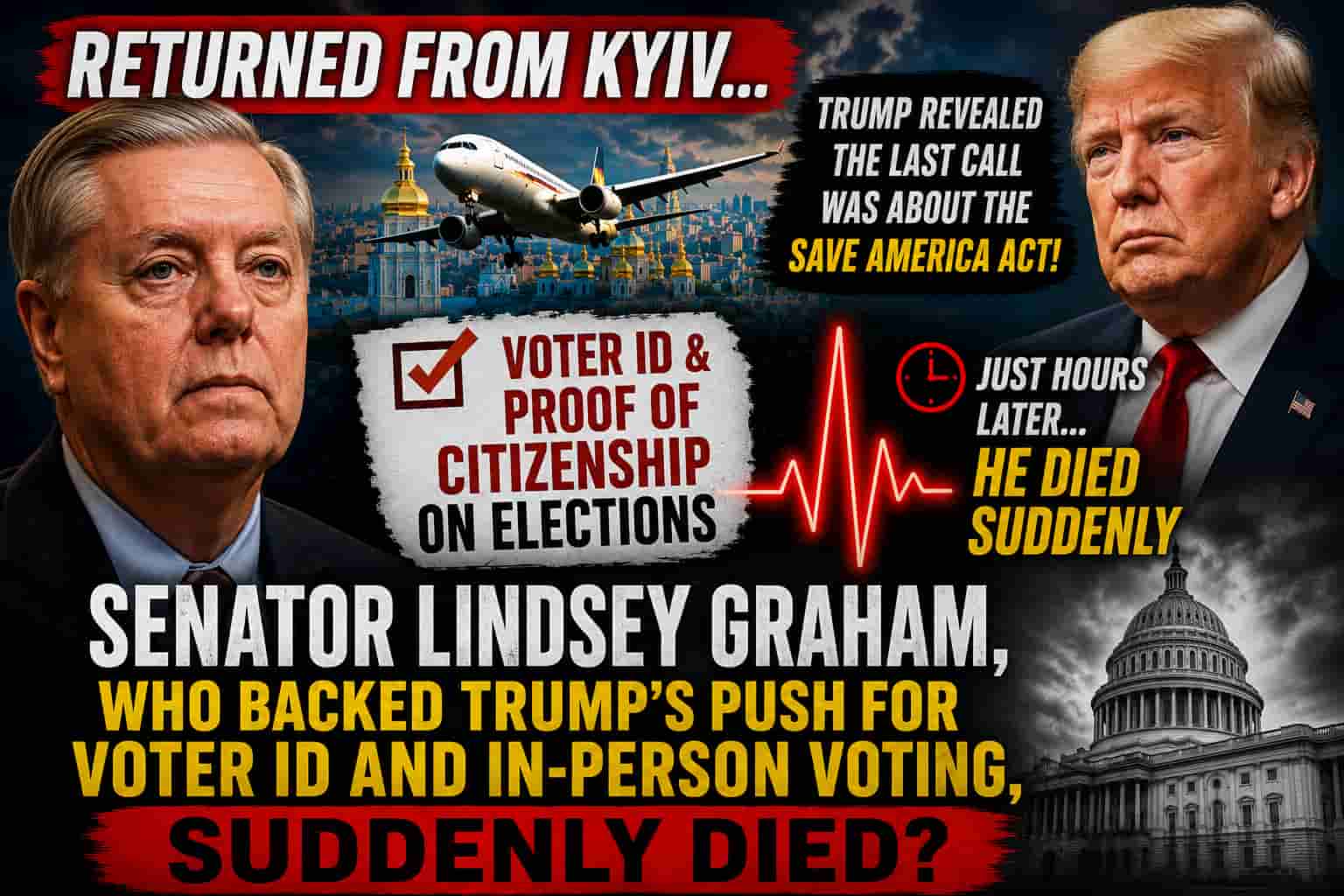
U.S. Senator Lindsey Graham, one of President Donald Trump’s closest allies in the Senate and a leading supporter of stricter election-security requirements, died suddenly after returning from a trip to Kyiv.
The South Carolina Republican was 71.
According to Graham’s office, the senator died following a “brief and sudden illness.” Major news organizations reported that he had suffered a sudden heart attack at his Capitol Hill residence only hours after returning from Ukraine.
His unexpected death has attracted particular attention because of what President Trump says may have been one of Graham’s final telephone conversations.
According to Trump, Graham called him after landing in the United States and spoke about advancing the SAVE America Act—a major Republican election bill requiring documentary proof of U.S. citizenship for voter registration and photo identification for voting in federal elections.
Trump said Graham told him:
“We’re all set for the SAVE America Act.”
The president said Graham sounded tired after the long trip but otherwise sounded normal and remained focused on passing the legislation. Trump indicated that the two men expected to meet soon, possibly the following day.
Hours later, Trump was informed that Graham had died.
Benny Johnson Raises Questions About the Timing
In a video released after Graham’s death, conservative commentator Benny Johnson focused on the extraordinary sequence of events.
Graham had just completed an international trip. He had met Ukrainian President Volodymyr Zelensky in Kyiv, participated in public appearances and press events, and was reportedly scheduled to appear on NBC’s Meet the Press the following morning.
Johnson argues that Graham did not publicly appear to be seriously ill. He had been traveling, holding meetings, speaking to reporters and discussing major legislation with the president.
Then, only hours after speaking with Trump about the SAVE America Act, Graham was found unresponsive at his residence.
The video cites emergency-radio traffic that reportedly described first responders forcing their way into the residence and beginning cardiopulmonary resuscitation. Graham was later pronounced dead.
Johnson repeatedly asks how a senator who had been publicly active only hours earlier could have died so suddenly. He also emphasizes that Graham had powerful foreign enemies because of his aggressive positions toward Iran and Russia.
However, the video does not present evidence proving that Graham was murdered, poisoned or targeted because of the election legislation. Its argument is based primarily on timing, unanswered medical questions and Graham’s prominent political role.
What Graham Was Trying to Pass
Graham officially became a co-sponsor of the SAVE America Act in February 2026.
His Senate office described the legislation as an expanded version of the earlier SAVE Act. It would require voters to provide photo identification in federal elections and require applicants to demonstrate U.S. citizenship before being registered to vote.
The legislation’s principal requirements included:
- documentary proof of United States citizenship when registering for federal elections;
- valid photo identification when casting a federal ballot;
- tighter verification of voter-registration records;
- procedures intended to prevent noncitizens from being added to voter rolls.
The House-approved text required certain applicants to present citizenship documents in person to election officials, although it also contained procedures for different registration situations.
Supporters described the bill as a basic election-integrity measure: only citizens should register, and voters should prove their identity before casting a ballot.
Opponents argued that the documentation rules could make registration more difficult for eligible citizens who do not have passports, birth certificates matching their current names or other qualifying records.
Did the SAVE America Act Require All Voting to Be Conducted in Person?
Not exactly.
The SAVE America Act itself focused primarily on proof of citizenship for registration and photo identification for voting. It did not simply abolish all absentee or mail-in voting nationwide.
President Trump separately called for much stronger restrictions on mail voting and promoted a return to predominantly in-person voting, with limited exceptions. Those demands went beyond the central citizenship and voter-identification provisions of the SAVE America Act.
Therefore, the most accurate description is that Graham supported Trump’s broader campaign for stricter election rules while directly co-sponsoring legislation requiring proof of citizenship and voter identification.
Was Graham Essential to Passing the Bill?
Benny Johnson portrays Graham as a crucial Senate negotiator who might have helped move the legislation across the finish line.
That argument is plausible because Graham had decades of Senate experience, maintained a close personal relationship with Trump and was known for negotiating with both Republicans and Democrats.
The House passed the SAVE America Act in February 2026, but the legislation faced a major procedural obstacle in the Senate. Republicans did not have the 60 votes normally needed to overcome a filibuster.
Trump said Graham was becoming increasingly supportive not only of the legislation but possibly of changing or eliminating the filibuster in order to advance the president’s election agenda.
According to the account presented in Johnson’s video, Graham’s final political message to Trump was that the SAVE America Act could be passed.
His sudden death therefore removed one of Trump’s most experienced and influential Senate allies at a critical moment.
A Sudden Death After a Politically Sensitive Trip
Graham had returned from Kyiv shortly before his death. During the visit, he met with Zelensky and continued advocating American support for Ukraine and tougher pressure against Russia.
He was also one of Washington’s most outspoken supporters of military pressure against Iran.
Johnson notes that Graham had received threats and had been publicly condemned by hostile foreign governments and media outlets. He uses those facts to argue that investigators should examine every possible explanation.
But a history of threats does not establish that any foreign state was involved in Graham’s death.
At the time of publication, publicly available reporting described the cause as a sudden medical emergency. No verified evidence had been released proving assassination, poisoning or political involvement.
What Is Known—and What Remains Unproven
The confirmed facts are dramatic enough:
Lindsey Graham returned from a high-profile trip to Ukraine.
He spoke with President Trump about passing major election legislation.
He was publicly active and expected to appear on national television.
He then suffered a sudden medical emergency and died within hours.
What has not been proven is equally important.
There is currently no public evidence establishing that Graham’s death was caused by his trip to Kyiv, his support for the SAVE America Act, his positions on Iran or Russia, or his relationship with President Trump.
The timing naturally raises questions. It does not, by itself, answer them.
Benny Johnson’s video should therefore be understood as a political commentary built around suspicious timing and unanswered questions—not as proof of a criminal conspiracy.
Still, given Graham’s position, his international activities and his apparent conversation with the president shortly before his death, the American public is entitled to a complete and transparent explanation of what happened.
The central confirmed fact is that Lindsey Graham supported legislation aimed at restoring basic safeguards to federal elections — requiring documentary proof of citizenship when registering to vote and identification when casting a ballot.
He also supported limiting mass mail-in voting and restoring in-person voting at polling places as the central method of participation in the American electoral system — reforms that the leadership of the Democratic Party continues to strongly oppose.
Official Sources: Mail Voting, Voter Identification and Foreign Actions Against Lindsey Graham
Federal Election Law and the Role of the States
-
U.S. Election Assistance Commission: Help America Vote Act of 2002
Official federal information on HAVA, including identification requirements for certain first-time voters who registered by mail. HAVA did not create a nationwide requirement that every voter present photo identification.
“`
-
National Conference of State Legislatures: Voter ID Laws
A state-by-state overview showing that 36 states request or require some form of identification at the polls, while 14 states and the District of Columbia use other methods of voter verification. -
NCSL: Voter Verification Without Identification Documents
Explains how states that do not require voters to present an identification document attempt to verify identity through signatures, personal information or other records. -
NCSL: Absentee, Mail and Early Voting Systems
A national overview distinguishing traditional absentee voting, no-excuse absentee voting and elections in which ballots are automatically mailed to registered voters.
“`
Expansion of Automatic Mail-Ballot Distribution
-
California Governor Gavin Newsom: Executive Order Mailing Every Registered Voter a Ballot
On May 8, 2020, Governor Newsom ordered election officials to mail a ballot to every registered California voter for the November 2020 election, citing the COVID-19 emergency.
“`
-
California Executive Order N-64-20 — Official Text
The original executive order establishing automatic distribution of mail ballots to California voters for the 2020 general election. -
California Secretary of State: Vote by Mail in the November 2020 Election
The official election page confirming that every registered voter received a mail ballot and did not have to submit an application. -
California: AB 37 Makes Automatic Mail Ballots Permanent
On September 27, 2021, Governor Newsom signed AB 37, permanently requiring a vote-by-mail ballot to be sent to every active registered voter. -
Oregon Secretary of State: Official Vote-by-Mail Timeline
Oregon experimented with mail elections for years, approved statewide vote-by-mail in 1998 and conducted its first presidential general election entirely by mail in 2000. -
Oregon Secretary of State: How Oregon Vote-by-Mail Works
Official information confirming that ballots are mailed automatically to active registered voters before statewide elections. -
NCSL: Evolution of Absentee and Mail-Voting Laws, 2020–2022
Documents how the COVID-19 pandemic led states to temporarily or permanently expand mail voting, ballot distribution, drop boxes and absentee-voting eligibility.
“`
Proof of Citizenship and Voter Identification
-
Senator Lindsey Graham: Graham Cosponsors the SAVE America Act
Graham’s official Senate office states that the proposal would require documentary proof of citizenship for voter registration and identification when voting in federal elections.
“`
-
U.S. House Committee on Rules: SAVE America Act
Official legislative materials, bill text, amendments and congressional proceedings concerning the proposed federal citizenship and voter-identification requirements. -
NCSL: Voter Registration and Citizenship Verification
Explains that registration generally requires an affirmation of citizenship, while only a limited number of states currently require documentary proof.
“`
Official Russian Actions Against Lindsey Graham
-
Senator Graham’s Official Response to the Russian Arrest Warrant
Graham’s Senate office confirmed on May 29, 2023, that Russia’s Interior Ministry had issued a warrant for his arrest.
“`
-
Russian Foreign Ministry: Graham Designated a Terrorist and Extremist in Russia
In an official March 2024 briefing, the Russian Foreign Ministry referred to Graham as a person designated as a terrorist and extremist in Russia. -
Russian Foreign Ministry Statement Concerning Graham’s Ukraine Remarks
An official Russian government statement attacking Graham over remarks attributed to him following his meeting with Ukrainian President Volodymyr Zelenskyy.
“`
Official Iranian Statements Concerning Graham
-
Permanent Mission of Iran: Accusations Concerning Lindsey Graham’s Statements
Iran’s official mission accused Graham of encouraging violence, regime change and military action. The statement does not formally designate him as an “enemy of the state,” terrorist or wanted person.
Accuracy note: Nancy Pelosi did not enact a federal law establishing universal automatic mail-ballot distribution throughout the United States. Election procedures were changed primarily through state legislation, gubernatorial executive orders and state election regulations. Russia is the only country identified in these official sources as having issued an arrest warrant and formally designated Lindsey Graham as a terrorist and extremist. Other governments strongly criticized him, but criticism is not the same as an official legal designation.
Ask Midtown Tribune about this story
Answers are grounded first in this article. Search all Midtown Tribune reporting from the main AI Search page.
AI-generated summary. Verify important details in the linked original articles.