
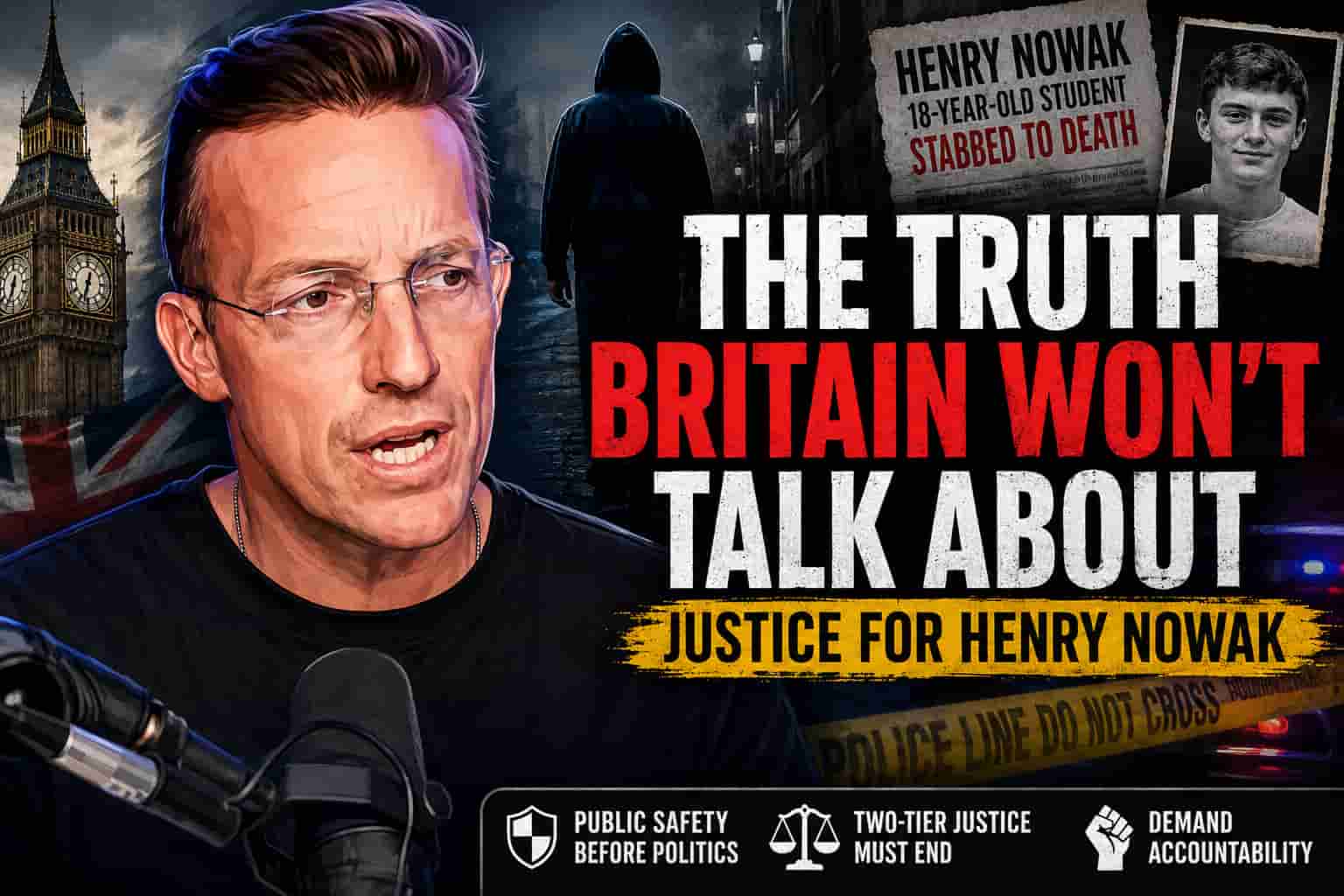
Henry Nowak Case Ignites Outrage in Britain Over Policing, Justice, and Public Safety
By Midtown Tribune News Desk
The death of 18-year-old Henry Nowak has become one of the most disturbing public-safety cases in Britain, raising urgent questions about policing, knife crime, immigration politics, racial double standards, and whether Western governments are still capable of protecting law-abiding citizens.
Nowak, a University of Southampton student, was fatally stabbed in December 2025 by 23-year-old Vickrum Digwa. According to court reporting, Digwa falsely claimed that Nowak had racially abused and attacked him. Police bodycam footage later released to the public showed officers handcuffing Nowak as he lay seriously wounded and pleading that he had been stabbed.
Digwa has now been sentenced to life in prison with a minimum term of 21 years. But for many people in Britain and beyond, the sentence is only one part of the story. The larger issue is what happened before Nowak died: why officers appeared to accept the attacker’s version of events, why the wounded victim was treated as a suspect, and why the public response has become so politically charged.
A Case That Became a National Flashpoint
The video commentary that brought renewed attention to the case argues that Henry Nowak’s death reflects a deeper crisis in Western society: governments that prioritize ideology over public safety, police systems fearful of racial accusations, and political elites who react differently depending on the identity of the victim and the accused.
The comparison many commentators are now making is direct and uncomfortable. When George Floyd died in the United States, British institutions held moments of silence and joined global demonstrations. But when Henry Nowak died in Britain after being stabbed and then handcuffed by police, there was no comparable national campaign, no unified institutional mourning, and no immediate mass movement from official Britain.
That contrast has fueled accusations of a “two-tier” moral system — one in which some victims receive instant national recognition while others are ignored, minimized, or treated as politically inconvenient.
Police Conduct Under Scrutiny
The most shocking part of the case is not only the stabbing itself, but the police response. The bodycam footage reportedly shows Nowak telling officers that he had been stabbed and could not breathe. Instead of immediately treating him as a critically injured victim, officers placed him in handcuffs after Digwa claimed he had acted in self-defense.
Hampshire Police has apologized, and the case has been referred to the police watchdog. Public pressure is now growing for full accountability, including answers about training, decision-making, and whether officers allowed fear of being accused of racial bias to override basic emergency judgment.
This is the central question now confronting British authorities: Did political sensitivity interfere with the most basic duty of law enforcement — saving the life of a dying young man?
A Debate Over Justice and Deterrence
The case has also revived debate over sentencing and the death penalty. Some British public figures and online commentators argue that life imprisonment with a 21-year minimum is not enough for a case involving a fatal stabbing, an alleged cover-up, and a false accusation that changed how police handled the scene.
Others warn that the public anger must not turn into vigilante threats or collective blame. Government officials have urged calm, while critics argue that calls for calm often sound like an excuse to avoid deeper reform.
The political tension is clear: one side wants restraint and institutional review; the other side believes institutions have already failed and that only severe punishment, public pressure, and a radical change in law enforcement culture can restore public trust.
Why This Case Matters Beyond Britain
For Americans, the Henry Nowak case is not merely a foreign news story. It touches the same issues that dominate public debate in the United States: crime, policing, border policy, racial politics, media double standards, and the ability of the state to protect ordinary citizens.
The central lesson is simple: when law enforcement becomes confused by ideology, innocent people suffer. When governments hesitate to confront violence honestly, public trust collapses. And when victims are treated differently depending on political convenience, citizens lose faith in justice itself.
Henry Nowak’s death should not be reduced to a slogan. It should become a turning point — a demand for equal justice, competent policing, and a public safety system that protects victims first.
Benny Johnson video : Elon Musk and U.K. Politicians Demand DEATH PENALTY For Migrant
Ask Midtown Tribune about this story
Answers are grounded first in this article. Search all Midtown Tribune reporting from the main AI Search page.
AI-generated summary. Verify important details in the linked original articles.