
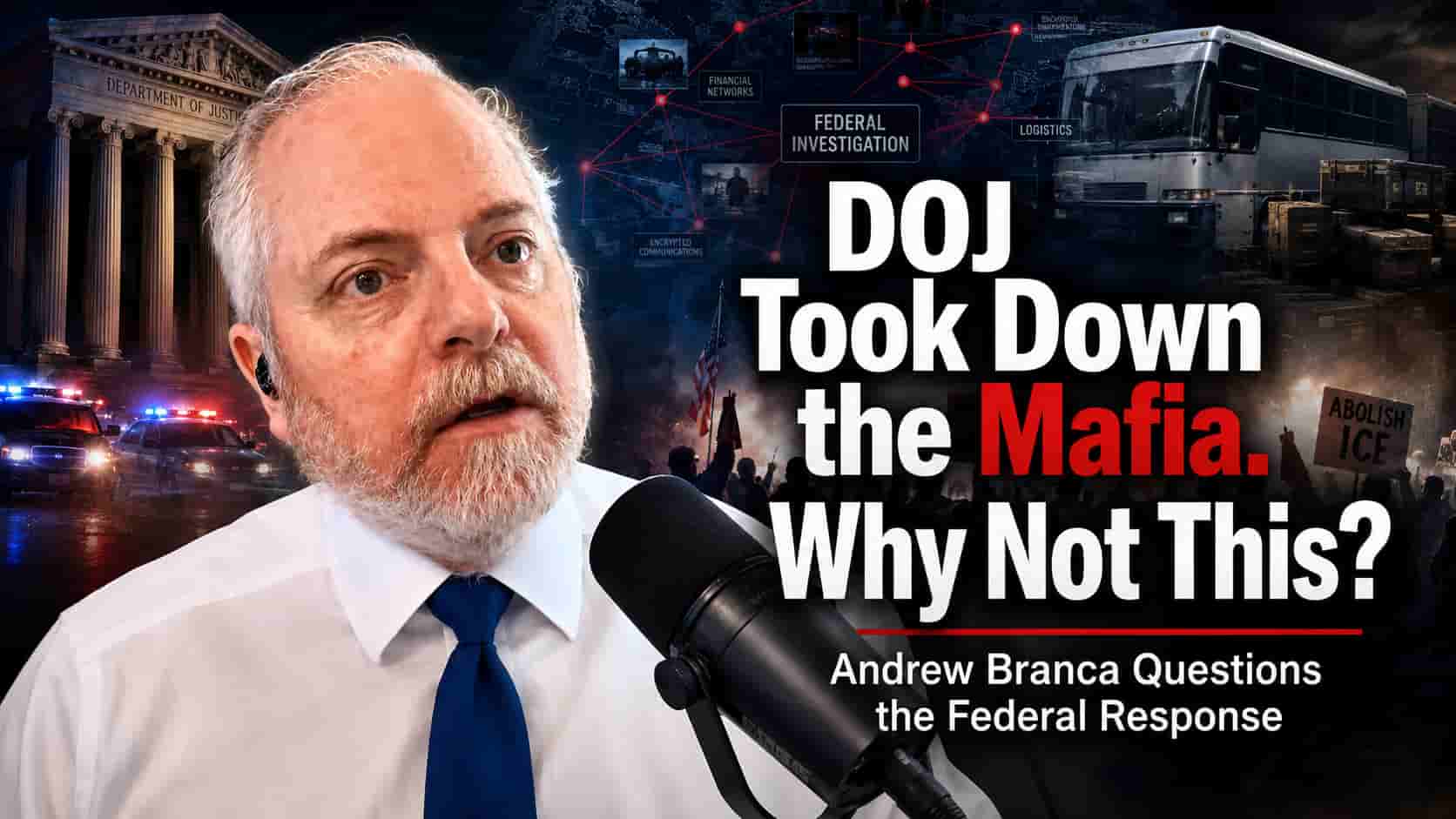
Andrew Branca says the DOJ and FBI should investigate whether repeated anti-ICE confrontations are being coordinated by professional activist networks. He compares the issue to federal efforts against the Mafia and KKK and asks why similar conspiracy tools are not being used today.
By Midtown Tribune Staff
June 2, 2026
Attorney and commentator Andrew Branca used a new episode of The Andrew Branca Show to ask a direct question about federal law enforcement: if the Department of Justice and FBI once had the tools, patience, and political will to dismantle organizations like the Mafia and the Ku Klux Klan, why are similar long-term conspiracy investigations not being used against networks Branca says are organizing repeated confrontations with federal immigration officers?
In the June 2 video, titled “DOJ Took Down the Mafia. Why Not This?”, Branca argues that recent anti-ICE disturbances should not be viewed merely as spontaneous protests. Instead, he says the pattern points to logistics, funding, transportation, equipment distribution, and professional activist infrastructure.
Branca opens the discussion by referencing violent scenes involving protesters and law enforcement, including an incident involving a police horse. He then highlights reports that several arrested protesters were from outside the state where the confrontation occurred. For Branca, that detail raises a larger question: who is coordinating the movement of people, supplies, and money?
“This is the normie view,” Branca argues, referring to the idea that protesters simply leave their ordinary lives for days or weeks at a time to demonstrate. His counterargument is that many of these activists appear to operate as professionals, not ordinary citizens spontaneously exercising First Amendment rights for a few hours.
The central point of Branca’s argument is legal and organizational. He says federal authorities should focus less on the street-level confrontation and more on the infrastructure behind it. In his view, the real story is not only the person throwing a rock or attacking an officer, but the network that may have supplied transportation, messaging, materials, funding, and operational support.
Branca compares the situation to earlier federal campaigns against organized crime and extremist organizations. He says that when the federal government wanted to go after the Mafia or the KKK, it used long-term investigations, conspiracy theories, communications evidence, informants, and organizational mapping. Today, he argues, digital communications and modern data tools should make it easier, not harder, to identify coordinated networks.
The episode also includes a comparison to January 6. Branca argues that January 6 lasted only hours, while anti-ICE confrontations can continue for days or weeks because, in his view, the people involved are supported by activist infrastructure. He says January 6 defendants were pursued aggressively by federal authorities, and he asks why violent anti-ICE actors and their organizers should not face similar scrutiny.
Branca’s broader criticism is political. He argues that Democrats, establishment Republicans, and federal agencies have incentives not to expose or dismantle left-wing activist networks. He also ties the issue to the MAGA movement, saying that President Donald J. Trump remains essential but cannot act alone. According to Branca, more MAGA-aligned officials are needed in Congress and throughout government to force decisive action.
The strongest claim in Branca’s video is not simply that some protesters committed crimes. His larger claim is that the federal government should investigate whether these incidents are part of a coordinated operation. He calls for prosecutors to look at funding, planning, transportation, equipment, communications, and organizational leadership — the same type of structure federal investigators examine in organized crime cases.
Supporters of Branca’s view will see the video as a demand for equal enforcement: if federal law can be used aggressively against one political movement, it should also be used against another when violence, intimidation, or attacks on law enforcement occur.
Critics will likely argue that protest activity, even when angry or disruptive, is protected unless prosecutors can prove specific criminal conduct, intent, and coordination. That distinction is important. The First Amendment protects peaceful protest and political organizing; it does not protect assault, vandalism, obstruction, or conspiracy to commit crimes.
Branca’s question, however, is not going away: when protest becomes organized confrontation, and when activists appear to arrive with transportation, supplies, and strategic support, where does free speech end and criminal conspiracy begin?
That is the legal and political battle Branca says America should be having — not only at the barricades, but inside the networks that make repeated confrontations possible.
Sources: Official video The Andrew Branca Show
Midtown Tribune Independent USA news from New York
Ask Midtown Tribune about this story
Answers are grounded first in this article. Search all Midtown Tribune reporting from the main AI Search page.
AI-generated summary. Verify important details in the linked original articles.