
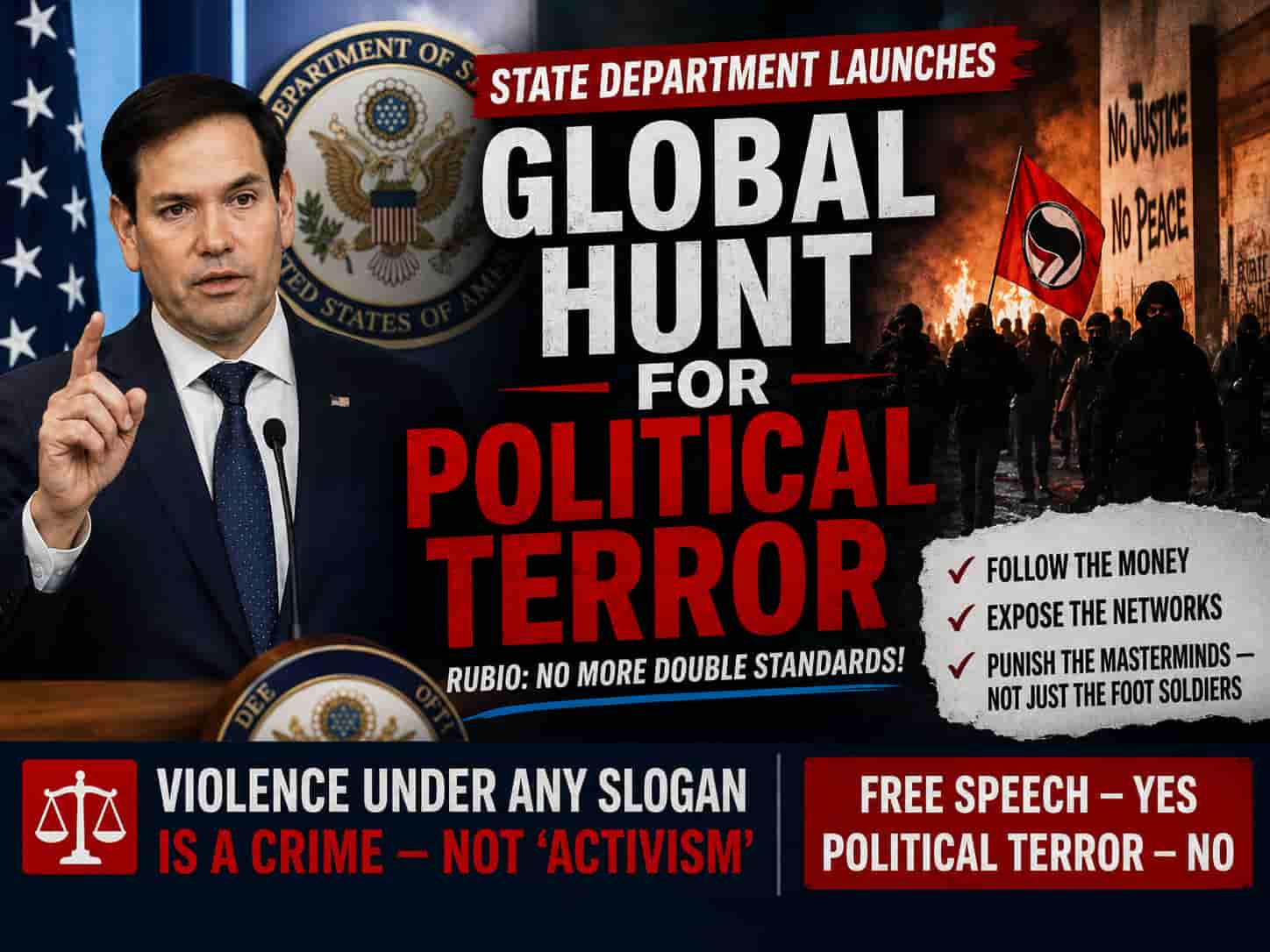
At a State Department ministerial convened by Secretary of State Marco Rubio, the Trump administration laid out a broader strategy against transnational political violence: follow the organizers, trace the money, expose the networks and stop pretending that terrorism becomes “activism” when the slogans are fashionable.
On July 16, 2026, Secretary of State Marco Rubio opened the Ministerial on the Resurgence of Political Terrorism at the U.S. Department of State.
The gathering brought together foreign officials and senior members of the Trump administration, including Treasury Secretary Scott Bessent and White House Homeland Security Adviser Stephen Miller.
The central message was not especially complicated, although Washington has spent years pretending that it was.
Political violence is political violence.
A bomb does not become a peaceful protest because the person carrying it has an impressive vocabulary. An assault on a federal officer does not become “community resistance” because someone printed a professionally designed banner. And an organized campaign of intimidation does not become civic engagement merely because several nonprofit organizations issued statements about it afterward.
That distinction appears to be the foundation of the Trump administration’s new campaign against political terrorism.
Rubio Identifies the Blind Spot
Rubio argued that Western governments have developed a dangerous blind spot when confronting ideological violence.
Governments, intelligence agencies and media institutions have generally had little difficulty identifying terrorism associated with jihadist organizations, ethnic extremism or the radical right. But when violence comes from the far left, the terminology often becomes remarkably creative.
Riots become “mostly peaceful.”
Organized intimidation becomes “direct action.”
Attacks on government institutions become “an expression of frustration.”
And anyone asking who organized or financed the activity is informed that asking questions is somehow the real threat to democracy.
The administration’s position is that this double standard has allowed radical networks to grow across national borders while presenting themselves as spontaneous collections of unusually coordinated individuals who all happened to arrive at the same location wearing similar clothing and carrying identical equipment.
Rubio described the threat as transnational: activists, organizers and affiliated groups can exchange information, identify targets, communicate through encrypted channels and move resources across borders.
The administration is therefore treating the problem not as a collection of isolated street incidents, but as an organized security challenge.
Trump Changes the Question
For years, the government’s response to political violence often began and ended with the person arrested at the scene.
The Trump administration is asking a larger set of questions:
Who trained the participants?
Who paid for transportation, legal assistance and equipment?
Who selected the targets?
Who operated the communications networks?
Which organizations provided money or institutional cover?
And which supposedly charitable structures may have been used to move funds?
That is the significance of President Donald Trump’s broader policy on organized political violence. Rather than merely prosecuting individual offenders after an attack, the administration wants federal law enforcement and intelligence agencies to investigate the infrastructure that makes repeated violence possible.
During the ministerial, Stephen Miller said the United States had formally recognized left-wing violence as a form of political terrorism and a direct threat to national security and the country’s republican system of government. He said Trump’s NSPM-7 directive instructed federal law enforcement and intelligence agencies to coordinate efforts to identify, disrupt, defund and prosecute political terrorist networks.
The concept is familiar from the fight against international terrorism: arresting one operative is useful, but dismantling the organization behind him is more effective.
Apparently, this principle becomes controversial only when the organizational website includes the words “justice,” “equity” or “collective.”
Follow the Money
Treasury Secretary Scott Bessent focused on the financial architecture behind political violence.
The Treasury Department has decades of experience targeting terrorist financing through the Office of Foreign Assets Control, the Financial Crimes Enforcement Network and IRS Criminal Investigation.
Now the administration intends to apply similar financial tools to networks that support political terrorism at home and abroad.
Bessent warned that legitimate charitable and nonprofit structures can be exploited to conceal illicit financing, foreign influence operations or support for violence. He said Treasury would examine cases in which tax-exempt organizations may have served as financial conduits for extremist activity.
This does not mean that every charity is suspicious. Most nonprofits perform lawful and often valuable work.
But “nonprofit” is a tax classification, not a sacrament.
An organization does not become immune from scrutiny because its annual report contains photographs of smiling volunteers. If money is being diverted toward political violence, intimidation or terrorist activity, the government has a responsibility to investigate.
According to Bessent, the Treasury Department would follow the evidence and hold organizations, officers and directors accountable when charitable structures are abused.
His remarks also included a crucial legal distinction: enforcement must be based on suspected unlawful conduct, not merely on beliefs or ideology. He emphasized that the government must continue respecting constitutional protections for freedom of speech, association and assembly.
That distinction matters.
The government has no authority to prosecute someone for being a socialist, an anarchist, a progressive or a person with an unusually emotional relationship with a Che Guevara T-shirt.
But it does have the authority to prosecute assault, arson, conspiracy, terrorism, illegal financing and threats against public officials.
Protest Is Protected. Violence Is Not.
The First Amendment protects political opposition.
Americans are free to criticize Trump, organize demonstrations, advocate socialism, condemn immigration enforcement and publish arguments against the administration.
They may carry signs, chant slogans and describe the president using whatever dramatic vocabulary remains available on social media.
What they may not lawfully do is attack police officers, firebomb government property, threaten judges, terrorize political opponents or use coordinated violence to override the results of elections.
That is not dissent. It is coercion.
The Trump administration’s strongest argument is therefore not that radical left-wing ideas should be banned. It is that politically motivated violence should be treated consistently, regardless of the ideology of the perpetrator.
The same legal standard should apply to everyone.
A right-wing attacker does not receive immunity because he claims to defend the nation.
A religious extremist does not receive immunity because he claims to serve God.
And a left-wing extremist should not receive immunity because he claims to be “on the right side of history.”
History, after all, has not appointed him district attorney.
Why This Matters in New York
The issue is especially relevant to New York City, where legitimate political demonstrations can sometimes be overtaken by small groups interested less in persuasion than disruption.
Blocking traffic, occupying buildings, damaging public property and attacking officers are frequently presented as extensions of protest rather than violations of law.
That approach weakens democratic government.
A city cannot remain genuinely free when a determined minority believes it has the right to cancel laws, court decisions or election results through intimidation.
Freedom requires the protection of dissenters. It also requires the protection of ordinary citizens who want to walk home, operate a business, attend a public meeting or perform government duties without being threatened by masked political enforcers.
New Yorkers who came to America from the Soviet Union and other authoritarian systems may recognize the underlying danger.
Political terror rarely introduces itself by saying, “We are here to build a dictatorship.”
It usually arrives speaking about justice, historical necessity and the moral superiority of those who have appointed themselves guardians of everyone else.
The uniforms and vocabulary change. The appetite for power does not.
The Left’s Convenient Conversion to Civil Liberties
The administration’s campaign will predictably face accusations that it threatens civil liberties.
Some criticism will be legitimate. Government power must always be limited by the Constitution, evidence and judicial review.
But some of the outrage will also be difficult to take seriously.
Political activists who spent years demanding censorship, institutional blacklists, frozen accounts and aggressive prosecution of their opponents may now emerge as passionate defenders of procedural restraint.
It will be an inspiring transformation.
One can almost hear the American Civil Liberties Union membership applications printing themselves.
Still, the constitutional issue is not complicated. Investigations should target unlawful conduct, financing and organization—not protected speech.
That is the standard the administration must maintain if it wants this campaign to survive legal scrutiny and public debate.
From Rhetoric to an International Strategy
The July 16 ministerial demonstrated that the Trump administration is trying to move beyond speeches and individual prosecutions.
Officials discussed international intelligence cooperation, financial investigations and coordination between governments facing related extremist networks.
Miller argued that Antifa-linked movements and other radical groups operate across multiple countries, sharing funding, organizational methods and information. He called for law enforcement and intelligence agencies to cooperate in identifying and dismantling those networks.
Bessent described the financial system as a central battlefield. Violent organizations require money, intermediaries and institutions willing—knowingly or otherwise—to provide cover.
The administration’s strategy is therefore straightforward:
Protect lawful speech.
Protect peaceful protest.
Investigate organized violence.
Follow the money.
And stop granting political exemptions to people who believe that their ideology transforms criminal conduct into moral heroism.
Trump Is Closing the Excuse Factory
The most important point made at Rubio’s ministerial was that terrorism should be defined by conduct and purpose—not by whether the attacker’s political message receives favorable coverage.
President Trump is correct to challenge the habit of treating left-wing political violence as an unfortunate but understandable side effect of passionate activism.
Violence intended to frighten the public, intimidate officials or force political change is not activism.
It is political terrorism.
A democratic government that refuses to confront it does not become more tolerant. It becomes weaker.
The administration must remain within constitutional limits, apply the law consistently and present evidence for every enforcement action.
But the era in which organized political violence could hide behind fashionable rhetoric, nonprofit branding and sympathetic headlines may finally be coming to an end.
For some activists, that will be deeply upsetting.
For everyone else, it may simply be called the rule of law.
Watch the official State Department video:
Secretary Rubio Delivers Opening Remarks at the Ministerial on the Resurgence of Political Terrorism
Official Government Sources
-
“`
-
U.S. Department of State Video: Secretary Marco Rubio Opens the Ministerial on the Resurgence of Political Terrorism
Official government video distributed through the Defense Visual Information Distribution Service, July 16, 2026. -
White House: Trump Administration Launches Global Campaign Against Radical Left Terrorism
The White House summary of the international ministerial and the administration’s policy, July 16, 2026. -
U.S. Treasury: Secretary Scott Bessent’s Remarks Before the Ministerial
Official remarks on terrorist financing, nonprofit structures, financial networks and constitutional protections. -
White House: NSPM-7 — Countering Domestic Terrorism and Organized Political Violence
The presidential memorandum directing federal agencies to investigate organized political violence, financing and supporting networks. -
White House Fact Sheet: Strategy to Counter Domestic Terrorism and Organized Political Violence
A concise official explanation of the federal strategy established under NSPM-7.
“`
All links above lead to official United States government resources.
Ask Midtown Tribune about this story
Answers are grounded first in this article. Search all Midtown Tribune reporting from the main AI Search page.
AI-generated summary. Verify important details in the linked original articles.