
Mayor Mamdani Expands Taxpayer-Funded Trucking Program for Rikers Detainees and New Yorkers on Probation
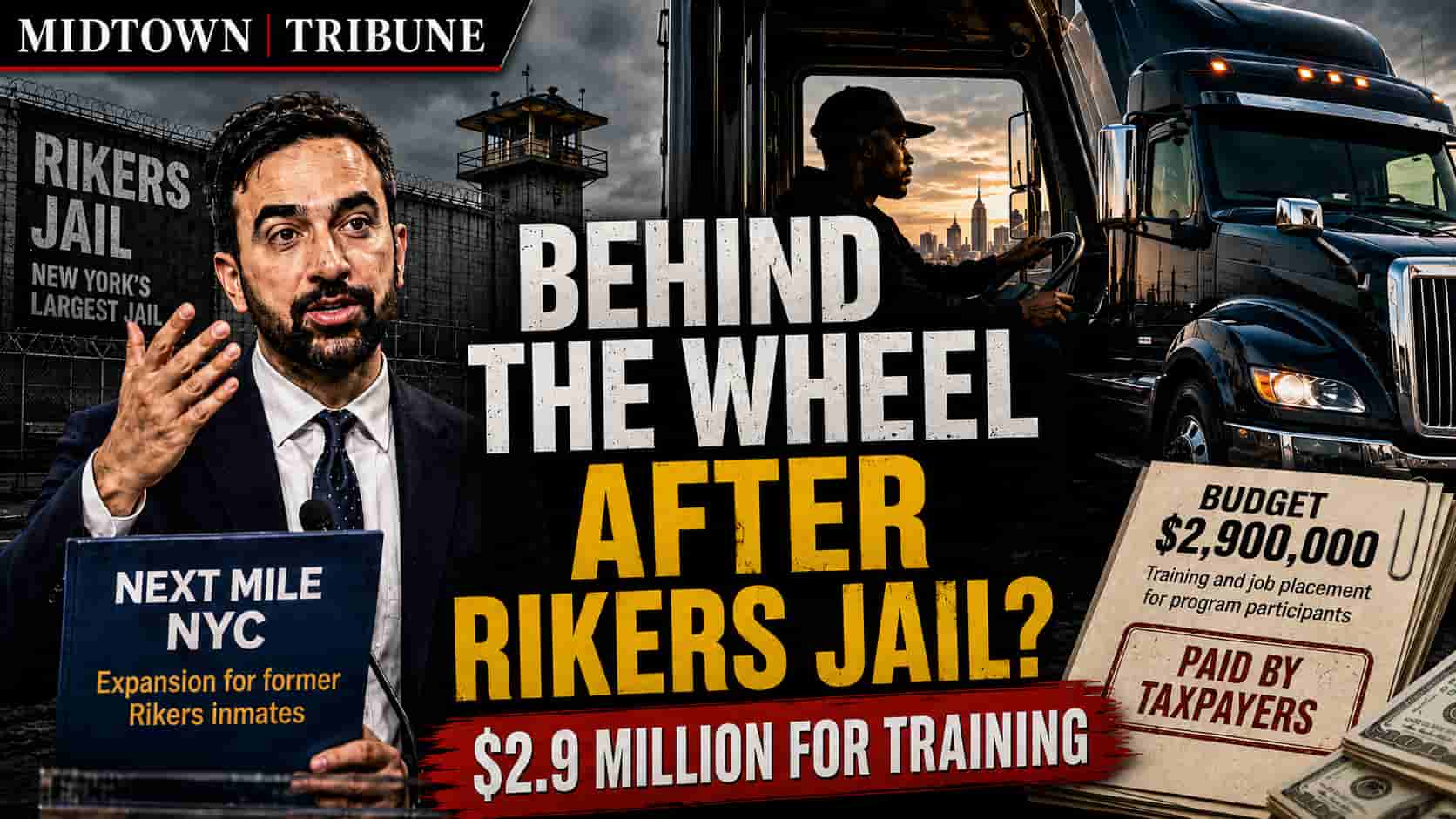
New York City is spending nearly $3 million to expand a commercial driver’s license training program for people in custody on Rikers Island.
Mayor Zohran Mamdani’s administration presents Next Mile NYC as a public-safety investment: train people before release, connect them with employers, and reduce the likelihood that they return to crime.
The idea is not irrational. Stable employment can help former inmates rebuild their lives. A person leaving jail without income, housing or marketable skills is more likely to fail than someone leaving with a license and a job offer.
But the program raises a question City Hall has not adequately answered:
Why does contact with the criminal justice system become an advantage when applying for an expensive, taxpayer-funded professional training package?
A low-income New Yorker who has worked for years, paid taxes and avoided arrest may have to navigate waitlists, competitive workforce grants or private tuition. A person passing through Rikers can receive a dedicated pathway that includes training, coaching, transportation assistance and connections to employers.
That does not mean people leaving jail should receive no help. It does mean the city should explain why similarly situated law-abiding residents are not offered an equivalent package.
What Next Mile NYC provides
Eligible participants begin with approximately 40 hours of online preparation for a Commercial Learner’s Permit while in custody. After release, they can continue with practical instruction, testing and employment assistance through the city’s partnership with Emerge Career.
The city says the expanded program will serve nearly 300 additional New Yorkers through a $2.9 million investment. Participants may receive approximately 120 hours of driving instruction, individualized coaching, help with transportation and child care, assistance with some fees, interview preparation and referrals to employers willing to consider applicants with criminal records.
The city’s announced figure works out to roughly:
$2.9 million divided by 290 participants, or about $10,000 per planned participant.
That is not necessarily excessive for a comprehensive Class A CDL program. Emerge Career itself says private CDL schools typically charge between $3,000 and $10,000, before additional coaching and supportive services are included.
But City Hall has not published a detailed public breakdown showing how much goes to actual driving instruction, how much goes to Emerge Career, how much is paid to subcontracted driving schools, and how much is spent on social services or administration.
Who received the contract?
The city’s principal workforce-development partner is Emerge Career, connected to Ameelio Emerge Public Benefit Corporation.
The earlier expansion announcement described Emerge Career as the city’s reentry workforce-development partner and credited it with training, personalized coaching and job placement.
Ameelio describes its broader mission as transforming corrections through technology, education and reentry services. Its own materials emphasize rehabilitation, decarceration and assistance for people affected by incarceration.
Those goals may be legitimate, but they also underscore the need for transparency. A contractor with a clearly stated criminal-justice reform mission should still be evaluated like any other recipient of public money:
- Was the contract competitively bid?
- What performance requirements are written into it?
- How much is paid for each student who begins training?
- How much is paid for each student who earns a CDL?
- Is additional compensation tied to actual employment?
- Are there penalties if graduates are not placed or quickly lose their jobs?
The public announcements do not provide those answers.
Which driving schools and employers participate?
The official program page refers generally to partner schools and employers, but the city does not prominently publish a complete list of the private companies receiving training referrals or hiring graduates.
That matters because CDL instruction is only the first step.
A graduate must still satisfy medical requirements, pass driving examinations, clear employer background reviews, meet federal and state safety rules and—most importantly—be accepted by the trucking company’s insurer.
A transportation company is not simply handing someone a steering wheel. It may be entrusting that driver with:
- a tractor and trailer worth hundreds of thousands of dollars;
- food, beverages, equipment or other valuable merchandise;
- responsibility for public safety;
- access to warehouses and customer facilities;
- the company’s insurance record and operating authority.
The final hiring decision therefore belongs to the employer and its insurance carrier—not the mayor, the training contractor or the driving school.
A CDL is not a guaranteed job
City officials have cited encouraging early numbers. The March announcement said 266 participants had earned Commercial Learner’s Permits, 99 had obtained CDLs, 93 had received job offers and 64 had secured full-time employment.
Those figures suggest the program is producing real licenses and real employment.
They also reveal a gap.
A job offer is not the same as starting work, and obtaining a CDL is not the same as being trusted with a commercial vehicle and valuable cargo.
At the time of the announcement:
- 266 people had obtained learner’s permits;
- 99 had obtained full CDLs;
- 93 had received offers;
- 64 had entered full-time employment.
The city did not fully explain what happened to the remaining participants. Some may still have been training. Others may have failed tests, withdrawn, encountered insurance barriers or been rejected by employers.
Without a complete participant-flow report, the public cannot determine the actual completion, placement and retention rates.
What happens when a graduate still cannot get hired?
This may be the program’s most important unanswered question.
A participant can complete months of taxpayer-funded training, obtain a commercial license and still encounter rejection because of:
- the nature of a prior conviction;
- a poor driving history;
- a recent DUI;
- drug-testing requirements;
- insurance restrictions;
- limits imposed by probation or parole;
- an employer’s policy regarding theft, violence or controlled substances;
- insufficient experience.
Emerge Career says its government-funded training is provided at no cost and includes job-placement support. It also acknowledges that its New York City program is specifically designed for people with justice-system involvement.
But job-placement support is not an employment guarantee.
What happens to someone who is told for months that a CDL is a road to a stable, well-paid future, only to discover that employers or insurers still consider him too risky?
The city has not publicly identified:
- a guaranteed alternative occupation;
- a minimum period of post-graduation support;
- a mental-health or anger-management response for repeated rejection;
- an employer-of-last-resort program;
- a refund or clawback provision if placement fails;
- a clear long-term retention requirement.
No government can guarantee that a disappointed graduate will not become angry, discouraged or return to illegal activity. That is precisely why City Hall should not describe training and conditional offers as if they automatically solve the deeper reintegration problem.
Who carries the risk?
The program distributes benefits and risks among several parties.
Taxpayers finance the training, coaching and support services.
The Mayor’s Office of Criminal Justice administers and oversees the program.
Emerge Career recruits participants, coordinates training and provides employment assistance.
Driving schools prepare participants for licensing examinations.
Employers decide whether to hire them.
Insurance companies often make the practical final decision about whether a graduate can drive a company vehicle.
Cargo owners and customers ultimately bear the consequences if a driver damages a truck, loses merchandise, causes a crash or commits theft.
The city’s public materials do not indicate that New York City guarantees private employers against losses caused by program graduates. Nor should taxpayers necessarily be expected to do so.
But if the private sector assumes the final risk, City Hall should publish the standards used to determine who is sent into the program and which criminal histories are considered compatible with commercial driving.
A conviction for an old, nonviolent offense is not the same risk as a conviction involving vehicle theft, cargo theft, trafficking, intoxicated driving or violence. Treating every applicant as identical would be irresponsible. Treating every applicant as permanently unemployable would also be unjust.
The public needs to see the actual screening rules.
Why is criminal-justice involvement part of the eligibility formula?
New York City does offer other workforce programs for unemployed and underemployed residents. Next Mile NYC is therefore not the only possible route to free occupational training.
What distinguishes it is the intensity of the package and its deliberate focus on people involved in the criminal-justice system.
That produces an uncomfortable contrast.
Consider two New Yorkers.
The first works a low-wage job, supports a family, pays taxes and has never been arrested. He wants to obtain a Class A CDL but cannot afford private tuition or take weeks away from work without financial help.
The second is leaving Rikers or serving probation.
The first may be told to search for an available workforce grant, join a waiting list or finance the training himself.
The second may receive a specially funded pipeline with coaching, practical instruction, fee assistance, transportation support and access to employers already recruited to consider applicants with records.
The city calls this targeted reentry policy.
The first worker may reasonably see it as a system in which avoiding the criminal-justice system brings fewer benefits than entering it.
That perception matters. Public programs should not create the impression that government becomes fully interested in a struggling resident only after police, prosecutors, courts or correctional agencies become involved.
The argument for the program
Supporters have a serious response.
People leaving jail face barriers that ordinary job seekers do not. Employers reject them, landlords screen them out, families may be fractured and documentation may be missing. Without extraordinary assistance, they may remain unemployed and return to crime.
Spending $10,000 on training could be cheaper than paying for another arrest, prosecution, jail stay and new victim.
That is the strongest argument for Next Mile NYC, and it should not be dismissed.
A successful graduate who earns a stable income, pays taxes and avoids another arrest represents a genuine public benefit.
But the strength of that argument does not excuse weak reporting or unequal access.
What City Hall should disclose
Before calling the expansion a proven success, the Mamdani administration should publish:
- The full contract and all amendments with Emerge Career.
- The procurement method and explanation for selecting the contractor.
- The full list of participating driving schools and subcontractors.
- The amount paid to each school per participant.
- The complete list of participating employers.
- The number of applicants rejected before training and the reasons.
- The number who begin, complete, pass, receive offers and actually start work.
- Six-month, one-year and two-year job-retention rates.
- Starting pay, hours worked and whether reported salaries include overtime.
- The number of graduates rejected because of insurance or background checks.
- The methodology used to verify claims about rearrest or recidivism.
- The consequences for the contractor if placement targets are missed.
These are not anti-reentry questions. They are ordinary questions of procurement, public safety and fiscal accountability.
Help after jail—or a benefit unavailable before jail?
A person who has completed a sentence should be allowed to rebuild his life. Permanent unemployment is not a public-safety strategy.
Yet rehabilitation should not require government to ignore risk, conceal costs or place law-abiding low-income residents at the back of the line.
The fairer policy would be to provide comparable CDL training to all qualified low-income New Yorkers, while offering additional reentry services to people facing specific barriers after incarceration.
Professional instruction could be based on income, aptitude, safety record and willingness to work.
Additional counseling, documentation assistance, probation coordination and employer advocacy could be reserved for those who genuinely need reentry support.
That would help former inmates without turning criminal-justice involvement into a preferred qualification for an expensive public benefit.
Next Mile NYC may eventually prove to be an effective program. Its early employment numbers deserve attention.
But until the city publishes the contracts, subcontractors, real cost per successful hire, insurance barriers and long-term job-retention results, the central question remains:
Is New York City funding a genuine path to stable employment—or selling taxpayers a carefully packaged promise whose final risks are left to private employers, cargo owners and the public?
Official Sources and Related Materials
- New York City Mayor’s Office: Expansion of Next Mile NYC to Rikers Island “`
- NYC Mayor’s Office of Criminal Justice: Official Next Mile NYC Program Page
- NYC Mayor’s Office of Criminal Justice: Expansion of Next Mile NYC to New Yorkers on Probation
- Emerge Career: New York City Training Program and Eligibility Information
- NYC 311: Free Commercial Driving Training for Unemployed New York City Residents
- NYC Department of Small Business Services: Free Career Training and Individual Training Grants
- Federal Motor Carrier Safety Administration: Commercial Driver’s License Requirements
- Federal Regulations: Commercial Driver Disqualification for Certain Offenses
- U.S. Equal Employment Opportunity Commission: Use of Arrest and Conviction Records in Employment Decisions
- U.S. Chamber of Commerce: The Workforce Impact of Second-Chance Hiring
- U.S. Bureau of Labor Statistics: Pay and Employment Outlook for Heavy and Tractor-Trailer Truck Drivers
- U.S. Bureau of Labor Statistics: National Unemployment Rate “`
Editor’s note: Claims regarding Next Mile NYC’s employment outcomes, graduate salaries, and reported rearrest rates are based primarily on information published by New York City officials and the program’s contractor. A comprehensive independent evaluation of the program has not yet been made publicly available.
Ask Midtown Tribune about this story
Answers are grounded first in this article. Search all Midtown Tribune reporting from the main AI Search page.
AI-generated summary. Verify important details in the linked original articles.