
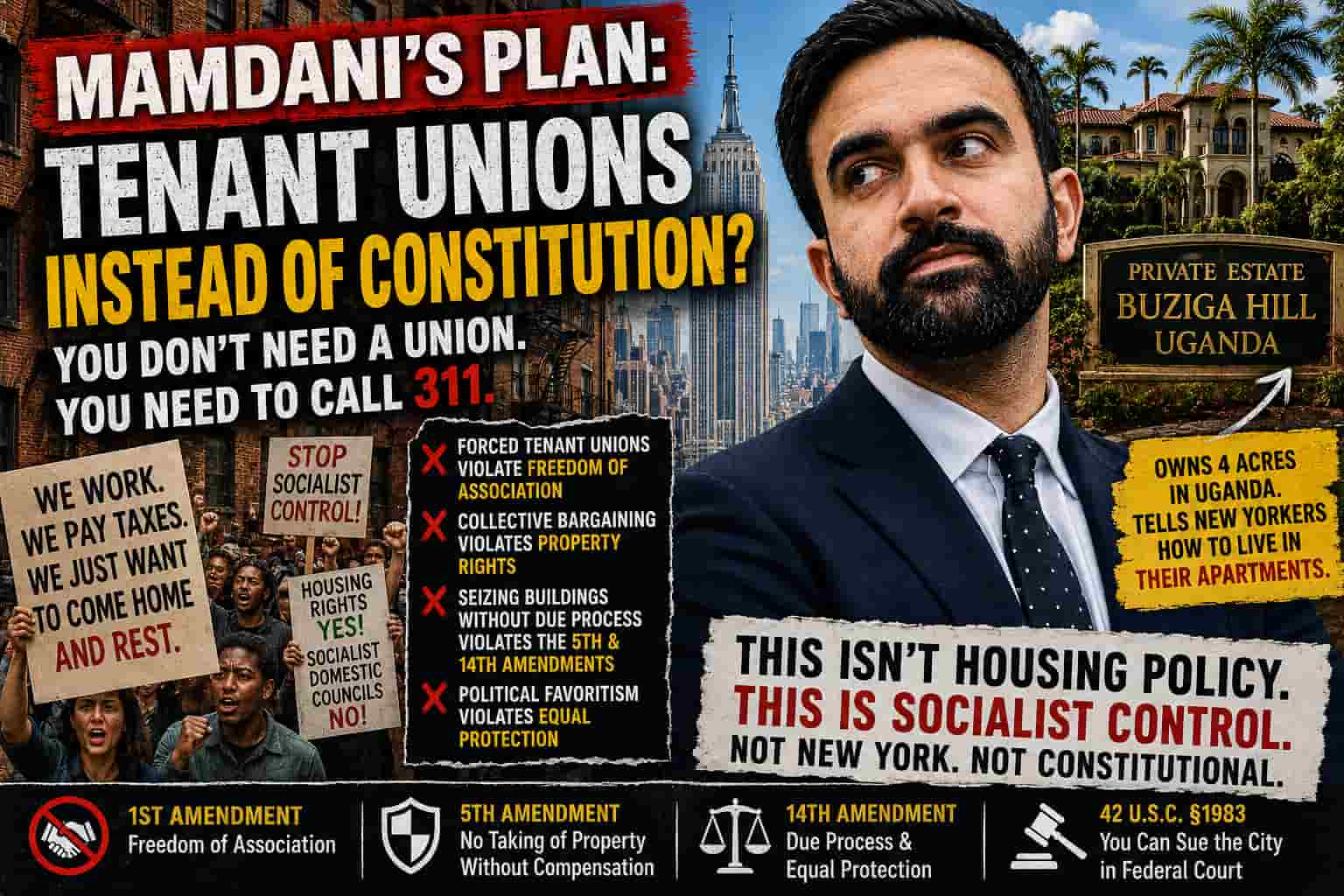
Video: Mayor Mamdani Holds a Press Conference to Make a Housing Announcement.
When a New York City apartment has no heat, mold, cockroaches, leaking pipes, or a broken elevator, the common-sense response is already clear: contact the landlord, file a complaint through 311, have HPD inspect the property, issue a violation, and take the case to Housing Court if the owner refuses to comply.
That is how the city itself describes the process. After receiving a complaint, the Department of Housing Preservation and Development can contact the property owner or managing agent, send an inspector, document violations, and impose penalties when legally required.
But Mayor Zohran Mamdani’s administration has decided that a functioning complaint and enforcement system is not enough.
Instead of simply making inspectors respond more quickly, City Hall is proposing a political superstructure: officially recognized tenant unions, collective bargaining, special enforcement operations coordinated with organized tenant groups, and even government assistance in transferring buildings to owners deemed “more responsible.”
The Mayor’s Office has explicitly proposed legally recognizing tenant unions and expanding tenants’ ability to bargain collectively over building conditions and other shared concerns.
Mamdani also said the city would work with organized tenants and, in certain cases, support “the successful transfer of their buildings to more responsible owners.”
That is where routine enforcement of the housing code begins to turn into political control over private property.
The Right to File a Complaint Is Not the Right to Control Someone Else’s Property
Tenants have every right to report violations.
Landlords must provide heat, hot water, functioning plumbing, safe electrical systems, and habitable apartments. Owners who refuse to comply with the law should face inspections, penalties, court orders, and other lawful enforcement measures.
But the right to demand enforcement of the law is not the same as a right to:
- force a landlord to negotiate with a political organization;
- impose a new party on an existing lease;
- authorize activists to represent every resident in a building;
- give organized groups privileged access to government inspections;
- participate in selecting the building’s next owner;
- pressure an owner to surrender control of private property.
A tenant and a landlord are parties to a lease.
A newly created tenant union did not sign that lease. It did not purchase the building, assume the mortgage, pay the property taxes, purchase the insurance, or accept responsibility to lenders and creditors.
The administration is attempting to import the labor-union model into a relationship where there is no employer and no employee.
First Amendment: Voluntary Association Cannot Become Compulsory Representation
The First Amendment protects the right of people to associate voluntarily.
It also limits the government’s ability to force people into political or ideological organizations, compel them to support such organizations, or assign those organizations the power to speak on their behalf.
A constitutional problem would arise if New York City:
- designated a tenant union as the exclusive representative of an entire building;
- forced dissenting tenants to accept its decisions;
- required a property owner to negotiate with that organization;
- imposed union dues or mandatory fees;
- allowed activists to speak for residents who never selected them;
- tied access to city services to participation in an organized tenant group.
A voluntary tenant association is lawful.
A government-recognized housing committee empowered to speak for everyone—including residents who do not want its representation—could implicate the First Amendment rights of freedom of speech and freedom of association.
Some tenants may disagree with the organization’s political goals. Others may not want a continuing confrontation with their landlord. Many may simply want a repair completed without being enrolled in a political movement.
The government should not automatically convert every apartment building into an ideological collective.
Fifth and Fourteenth Amendments: Government Cannot Simply Transfer a Building to the “Right” Owner
The most troubling language in Mamdani’s announcement is the promise to help transfer buildings to “more responsible owners.”
That phrase may sound benevolent, but “responsible owner” is not a constitutional legal standard.
The Constitution protects private property.
The Takings Clause of the Fifth Amendment prohibits the government from taking private property for public use without just compensation. Through the Fourteenth Amendment, state and municipal governments must also provide due process before depriving a person of protected property rights.
If a building is sold voluntarily, no extraordinary city power is necessary.
But serious constitutional questions arise if the city attempts to:
- compel an owner to sell;
- transfer control to a city-selected nonprofit organization;
- deprive the owner of effective control over the building;
- create regulatory pressure designed to force the owner to surrender the property;
- transfer private property without market compensation;
- allow politically connected groups to influence the selection of a replacement owner.
Government may use eminent domain under legally established conditions. But it must follow the law, provide due process, serve a legally recognized public use, and pay just compensation.
City officials cannot simply decide that one private owner is morally inferior to another and therefore should lose the property.
Fourteenth Amendment: Who Decides Which Landlord Is “Bad”?
The administration repeatedly uses politically convenient labels:
- “bad landlords”;
- “repeat offenders”;
- “chronically negligent landlords”;
- “more responsible owners.”
But penalties and deprivation of property require objective legal standards—not campaign slogans.
How many violations make an owner “bad”?
Do dismissed or corrected violations count? What happens when a tenant refuses access to the apartment? How long does an owner receive to perform a repair? How does the city determine that a violation was intentional? Can an owner challenge the designation before an independent tribunal?
The Fourteenth Amendment requires due process before a state or municipality deprives a person of property.
A rule may also face constitutional objections if it is so vague that ordinary people cannot determine what conduct is prohibited or if it gives officials excessive discretion to enforce it selectively.
When bureaucrats decide who is “good,” who is “bad,” and who deserves to continue owning a building, neutral code enforcement begins to resemble political allocation of property.
Fourth Amendment: Housing Inspections Do Not Eliminate Constitutional Protections
The plan includes special “Enforcement Days” and broader inspections of buildings or entire property portfolios following referrals from organized tenant associations.
However, housing-code enforcement does not automatically erase Fourth Amendment protections.
In Camara v. Municipal Court, the U.S. Supreme Court held that administrative inspections of private premises for code violations generally require consent or an administrative warrant when entry is refused.
A tenant organization’s political demand cannot replace:
- the occupant’s consent;
- a legally valid administrative warrant;
- a lawful basis for the inspection;
- appropriate limits on the areas being searched.
A complaint about heat in one apartment does not automatically authorize an unlimited government search of every apartment, storage area, office, and record associated with the property owner.
Existing Contracts Cannot Simply Be Rewritten by a Housing Committee
The Contract Clause of Article I restricts states from passing laws that substantially impair existing contractual obligations.
That protection is not absolute. States have broad authority to regulate housing, safety, and public welfare.
But a constitutional dispute could arise if “collective bargaining” allows a government-recognized tenant union to rewrite existing leases, impose substantial new obligations, or alter the owner’s contractual rights without consent.
The landlord entered into agreements with individual tenants—not with a future political committee selected or recognized by City Hall.
Calling such a committee a “union” does not automatically give it lawful authority to renegotiate private contracts.
Federal Law Provides a Mechanism to Sue the City
Under 42 U.S.C. § 1983, a person may bring a civil action when a government official, municipality, or other state actor deprives that person of rights protected by the Constitution or federal law.
Section 1983 does not itself create a new constitutional right. It provides a federal mechanism for enforcing existing rights.
If the housing program results in compelled association, unlawful inspections, deprivation of property without due process, or unconstitutional takings, affected owners or residents could attempt to challenge the city’s actions in federal court.
The Fair Housing Act may create additional legal exposure if city enforcement, government-approved organizations, or property transfers are administered differently based on race, color, religion, sex, familial status, national origin, or disability.
Tenant Committees for People With Nothing Else to Do After Lunch
One of the administration’s central political claims is that “the best-protected tenant is an organized tenant.”
Most New Yorkers protect themselves differently.
They wake up in the morning and go to work. They run businesses, manufacture products, drive trucks, treat patients, work in stores, maintain buildings, deliver food, or spend the day on construction sites.
After work, their primary goal is to come home, eat dinner, close the door, and rest.
They are not looking for another evening job involving:
- weekly building committee meetings;
- speeches by professional organizers;
- elections for the hallway chairman;
- ideological discussions about “tenant power”;
- collective campaigns to control the building;
- debates over which neighbor has insufficient revolutionary enthusiasm.
Permanent political organizing is easier for professional activists, employees of publicly funded advocacy organizations, and millionaire socialists’ privileged sons who have enough time to turn apartment buildings into ideological laboratories.
Working New Yorkers do not need a commissioner for the stairwell.
They need 311 to answer the telephone, inspectors to arrive on time, and courts capable of ordering a violator to comply with the law.
From a Family Estate in Uganda, New Yorkers Are Told How to Live in Apartments
The political irony is difficult to ignore.
Public reporting has indicated that Mamdani owns land in Uganda. News reports have also described a private family compound in the affluent Buziga Hill area near Kampala, where the family reportedly held a private wedding celebration.
Owning foreign property is not illegal, and family wealth is not itself a constitutional violation.
But it creates a striking political image.
A man whose family enjoys access to private property in Uganda is now telling New Yorkers living in small rented apartments that leases, 311 complaints, inspectors, and courts are not enough.
They are told they must organize into building collectives, participate in “tenant power,” and work with government officials to influence the future ownership of property belonging to someone else.
Socialism once again displays its traditional architecture:
private grounds, family property, and security for the political elite; tenant committees, collective meetings, and ideological supervision for everyone else.
New York Needs Inspectors, Not a New Housing Nomenklatura
When an apartment has no heat, the necessary process is straightforward:
- notify the owner or management company;
- file a complaint through 311;
- obtain an HPD inspection;
- document the violation and impose lawful penalties;
- require the repair;
- go to Housing Court if the owner refuses to comply.
None of this requires a tenant union.
It does not require a political organizer. It does not require a building committee. It certainly does not require a city official deciding who should be allowed to own a private building.
Mamdani’s plan is dangerous not because it promises to inspect heating complaints.
It is dangerous because it attempts to build a parallel political structure in which organized activists receive more influence than ordinary tenants and government officials receive more authority over private contracts and property.
The U.S. Constitution protects individuals against precisely this kind of system: compelled association, arbitrary searches, retroactive interference with contracts, and deprivation of property without due process and just compensation.
New York City is not a Soviet housing cooperative.
A resident should be able to call 311, demand enforcement of the law, and return home after work without requesting permission from the chairman of the building committee.
Legal note: The publication of a mayoral report does not by itself establish a constitutional violation. Constitutional claims would depend on the specific laws, regulations, enforcement actions, compulsory representation rules, inspection procedures, or property-transfer mechanisms ultimately adopted and applied.
Official Sources and Legal References
-
NYC Mayor’s Office — Mayor Mamdani Releases the “Rental Ripoff Report”
The city’s official announcement describing the 23 housing proposals, recognition of tenant unions, collective tenant action, expanded inspections, and enforcement against landlords classified as repeat offenders.
“`
-
NYC Mayor’s Office — Official Transcript of the July 16 Housing Announcement
The official press-conference transcript, including the mayor’s statements concerning tenant unions, coordinated enforcement, and possible transfers of buildings to “more responsible owners.” -
NYC 311 — Apartment Maintenance Complaint
The city’s existing procedure for reporting apartment maintenance problems, including leaks, plumbing defects, electrical problems, pests, and unsafe housing conditions. -
NYC 311 — Heat or Hot Water Complaint
The official process for reporting inadequate heat or hot water in a residential building. -
NYC 311 — Mold Complaint
Information on filing a mold complaint and requesting enforcement by the Department of Housing Preservation and Development. -
NYC 311 — Elevator or Escalator Complaint
The official procedure for reporting unsafe, defective, or improperly inspected elevators. -
New York State Senate — Real Property Law § 230
Existing New York law protecting tenants’ right to form and participate in voluntary tenant organizations without landlord interference or retaliation. -
Constitution Annotated — First Amendment: Freedom of Association
The Congressional Research Service’s official discussion of associational rights protected by the First Amendment. -
Constitution Annotated — Compelled Membership and Compelled Subsidization
Constitutional limits on government-compelled membership in, or financial support of, an association. -
Constitution Annotated — Union Membership, Representation, and Fees
An official overview of Supreme Court cases involving compulsory union representation, mandatory fees, speech, and associational rights. -
Constitution Annotated — Fifth Amendment Takings Clause
The constitutional rule that private property may not be taken for public use without just compensation. -
Constitution Annotated — Physical Takings
Constitutional principles governing government-authorized occupation, transfer, or destruction of private property rights. -
Constitution Annotated — Fourteenth Amendment, Section 1
The constitutional prohibition against state or municipal deprivation of life, liberty, or property without due process of law, as well as the guarantee of equal protection. -
Constitution Annotated — Property Deprivations and Due Process
The procedural protections required when a government seeks to deprive a person of a legally protected property interest. -
Constitution Annotated — Procedural Due Process in Civil Proceedings
The requirements for notice, an opportunity to be heard, and other procedural safeguards before government deprivation of protected rights. -
Constitution Annotated — Contract Clause
Constitutional limits on state laws that substantially impair obligations imposed by existing private contracts. -
U.S. Supreme Court — Camara v. Municipal Court, 387 U.S. 523 (1967)
The Supreme Court decision holding that administrative housing-code inspections generally require consent or a legally valid administrative warrant when entry is refused. -
U.S. House of Representatives — 42 U.S.C. § 1983
The federal civil-rights statute allowing lawsuits against government actors who deprive individuals of rights protected by the Constitution or federal law. -
U.S. House of Representatives — Fair Housing Act
Federal law prohibiting housing discrimination based on race, color, religion, sex, familial status, national origin, and disability.
“`
Legal clarification: The publication of a mayoral report or political proposal does not, by itself, establish a constitutional violation. A constitutional claim would depend on the specific legislation, agency rules, compulsory representation requirements, inspection practices, enforcement decisions, or property-transfer mechanisms ultimately adopted and applied. Potential challenges could arise if the city compels association, authorizes inspections without consent or a valid warrant, deprives an owner of property without due process, substantially impairs existing contracts, or takes property without just compensation.
Ask Midtown Tribune about this story
Answers are grounded first in this article. Search all Midtown Tribune reporting from the main AI Search page.
AI-generated summary. Verify important details in the linked original articles.