
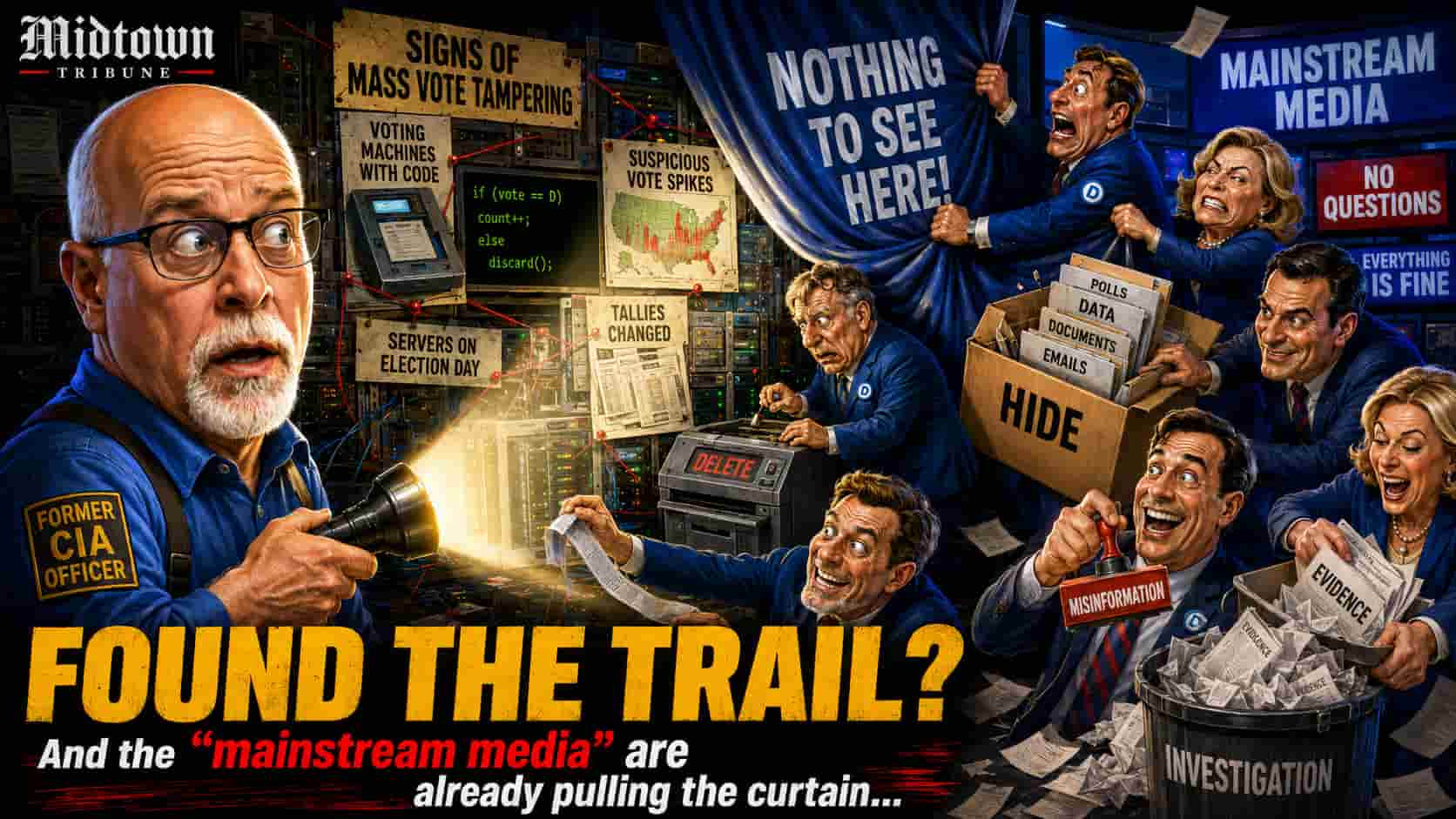
Gary Berntsen alleges that foreign engineers, election technology, and American institutional silence formed a threat to the constitutional Republic. The official response, he says, was less “investigate the evidence” and more “please investigate the investigators.”
Washington has developed a remarkably efficient system for handling politically inconvenient information.
When an allegation helps the preferred narrative, it becomes a national emergency before breakfast.
When an allegation threatens the preferred narrative, it becomes “misinformation” before anyone has finished reading it.
Former CIA officer Gary Berntsen entered that system carrying what he describes as engineers, technical findings, witnesses, and years of investigative work into possible manipulation of electronic election systems.
According to his account, the government did not immediately respond with curiosity.
It responded with the traditional bureaucratic question:
“Before we examine your evidence, could you please provide your current address?”
Berntsen’s claims are sweeping, controversial, and not established here as judicially proven facts. But the interview raises a question that should not depend on party loyalty:
When serious allegations concern the machinery used to count votes, why would any constitutional government fear an independent investigation?
A Former CIA Officer Walks Into Washington With Evidence
Berntsen is not presented in the interview as a man who recently discovered politics through an angry Facebook post.
He describes a long career in the CIA, including senior operational roles, counterterrorism work, assignments in the Middle East and Latin America, and participation in the early American campaign in Afghanistan.
He says that he and his business partner, Martin Rodil, initially investigated Venezuelan criminal and political networks.
During that work, they allegedly kept encountering election-technology companies, engineers, source code, and people connected to electronic voting infrastructure.
That discovery led to a broader investigation.
According to Berntsen, his team recruited Venezuelan engineers who had worked on relevant systems, assembled them outside Venezuela, and eventually established a computer laboratory in Switzerland.
There, he says, the engineers studied how election technology could allegedly be manipulated, remotely accessed, or altered while preserving the appearance of a legitimate count.
It sounds like the opening scene of a political thriller.
Unfortunately, the next scene reportedly takes place at a federal office, where everyone suddenly becomes too busy to answer the telephone.
The Alleged System: Never Steal a Landslide When You Can Shave a County
Berntsen describes election manipulation not as a theatrical truckload of fake ballots arriving under cover of darkness, but as something quieter and more technical.
According to his account, election results could allegedly be altered through multiple points in the system, including scanners, tabulators, digital ballot images, software, and remote infrastructure.
The objective, he says, would not necessarily be to manufacture an absurd result in one location.
That would attract attention.
The more sophisticated method would be to make small changes across many jurisdictions.
A candidate who should win a county 70–30 might instead win 68–32.
A few points disappear here.
Another fraction moves there.
Nothing dramatic enough to produce a marching band. Just enough to influence the final total.
It is less like robbing a bank and more like introducing a new administrative fee:
“Your vote has been adjusted for system efficiency.”
Berntsen further alleges that engineers understood not only how to manipulate systems, but how to defeat or complicate audits.
He describes scenarios involving digital ballot images, physical-ballot restrictions, machine-based audits, software interventions, and differing methods across neighboring counties.
Again, these are allegations made in the interview, not findings adopted by a court. But they are specific enough to be tested rather than merely shouted about on television.
The FBI Receives an Election Warning and Discovers the Real Suspects: The Whistleblowers
The most darkly comic portion of Berntsen’s story concerns his attempts to brief American authorities.
He says his team approached the FBI, the Department of Justice, intelligence officials, and political figures before the 2024 election.
According to Berntsen, the response was not a rapid technical examination of the systems.
Instead, one FBI officer allegedly warned him that supervisors might destroy the investigation and find a way to jail the investigators.
This produces the sort of dialogue that could only be written in Washington:
— We have information about possible foreign interference in American elections.
— That is extremely serious.
— When will you investigate it?
— We already are.
— The interference?
— No. You.
Berntsen says he left the United States and worked from Switzerland for approximately a year because he feared that the investigation would be disrupted.
If his account is accurate, America’s election-security strategy had evolved into an elegant three-step process:
- Demand that citizens trust the system.
- Discourage anyone from examining the system.
- Investigate anyone who notices the contradiction.
Foreign Election Interference: A National Crisis, Subject to Party Availability
For years, Democratic politicians and major media organizations warned Americans that foreign interference could threaten the country’s political system.
That concern was valid in principle.
Foreign governments do attempt to influence other nations.
Intelligence services recruit insiders.
Cyberattacks occur.
Propaganda exists.
But Washington appears to maintain two separate definitions of foreign election interference.
The first is approved foreign interference.
This version receives congressional hearings, television specials, dramatic music, bestselling books, and at least four retired officials speaking anonymously.
The second is unapproved foreign interference.
This version involves questions about voting machines, software, tabulators, ballot images, foreign technicians, or the reliability of election audits.
That version is immediately placed in a sealed container labeled:
“Dangerous Questions — Do Not Open Until After the Election.”
The constitutional Republic, we are told, can survive opaque technology, partisan election administration, foreign-made components, inaccessible code, and officials investigating themselves.
But apparently it may collapse instantly if a citizen asks to inspect the logs.
From Venezuela to American Election Technology
Berntsen alleges that the origins of the technology he investigated can be traced to Venezuela under Hugo Chávez.
In his account, Venezuelan political leaders sought reliable methods for controlling election outcomes and worked with technical specialists to develop software and acquire hardware.
He says those capabilities were later expanded, exported, and used in other countries.
The interview then draws connections among Venezuela, Cuba, China, Smartmatic, Dominion, foreign manufacturing, overseas servers, and American election infrastructure.
These are among the interview’s most explosive assertions.
They are also the assertions that most require transparent technical corroboration.
That is precisely why dismissing them through slogans is inadequate.
The proper response would be straightforward:
- Identify the engineers.
- Take sworn testimony.
- Examine the claimed source code.
- Reproduce the alleged techniques under controlled conditions.
- Compare electronic records with preserved physical ballots.
- Review network architecture and access logs.
- Allow independent experts representing competing political interests to challenge the findings.
That process could disprove the allegations.
It could partially confirm them.
It could expose exaggerations, misunderstandings, or genuine vulnerabilities.
But it would produce something increasingly rare in Washington:
an answer.
The Mainstream Media’s Emergency Curtain Department
The political press is often very brave when confronting stories already approved by every editor in the building.
The difficulty begins when a story might require reporters to question institutions they spent years defending.
Then journalism undergoes a subtle transformation.
The reporter becomes a reputation manager.
The investigator becomes a “conspiracy theorist.”
The witness becomes “controversial.”
The evidence becomes “unverified,” which is technically true because the newsroom has declined to verify it.
And the refusal to investigate becomes proof that there is nothing to investigate.
It is an impressive intellectual machine:
We did not examine the evidence because the allegation was discredited.
The allegation was discredited because no credible investigation confirmed it.
No credible investigation confirmed it because we did not examine the evidence.
That is not reporting.
That is a circular filing system.
The Most Dangerous Allegation Is One That Can Be Tested
Berntsen may be wrong about important parts of his theory.
Some witnesses may be unreliable.
Some technical interpretations may be overstated.
Connections among companies, governments, contractors, and equipment do not automatically prove that American election results were altered.
But those limitations strengthen the case for investigation rather than weakening it.
A vague accusation can be debated forever.
A technical claim can be tested.
If Berntsen’s engineers can demonstrate vulnerabilities, examine the demonstration.
If they claim remote access, inspect the relevant architecture.
If they allege digital ballot-image replacement, compare digital records with protected paper ballots.
If they identify individuals, take testimony under oath.
If the claims collapse under examination, the public should see that collapse.
But when authorities refuse meaningful scrutiny while demanding unconditional trust, they do not eliminate suspicion.
They industrialize it.
America Is a Constitutional Republic, Not a Television Opinion Poll
The United States was not designed as a system in which 51 percent of voters—or 51 percent of television commentators—could exercise unlimited power.
It is a constitutional Republic.
Its legitimacy depends on law, divided authority, institutional accountability, and the protection of individual rights.
Majorities may elect governments.
They may not suspend the Constitution.
They may not erase the rights of minorities.
They may not convert election administration into a private ritual that citizens are forbidden to examine.
The rights of Americans are not protected by a partisan majority or by a media consensus.
They are protected by a constitutional order in which public power is limited and public officials remain accountable to the people.
That is why investigating possible interference in an election is not an attack on the Republic.
The attack begins when investigations are blocked, evidence is hidden, and citizens are told to replace verification with faith.
A Republic may exist without direct democracy.
It cannot exist without law, transparency, accountability, and credible elections.
Because a Republic without transparent verification of election results eventually stops being a Republic.
And when officials declare verification itself to be dangerous, they are no longer protecting the Republic.
They are protecting themselves from it.
Editorial note
This article is a satirical commentary on claims made by Gary Berntsen in the referenced interview. Allegations involving manipulation of American election results, foreign control of election systems, or institutional suppression of evidence are presented as Berntsen’s claims and should not be treated as adjudicated facts without independent documentary, technical, or judicial confirmation.
Official Sources, Federal Laws, and Background Documents
The links below include the original interview, official Department of Justice materials, federal election-security guidance, voting-system certification standards, and relevant provisions of the United States Code.
Original Interview
-
Gary Berntsen Interview on Election Interference and Voting Systems
The video discussed in this article. Claims made in the interview should be distinguished from facts independently established in court or confirmed by official technical investigations.
Department of Justice Cases and Investigations
-
DOJ: Voting-Machine Company Charged in Philippine Bribery and Money-Laundering Scheme
A 2025 superseding indictment involving alleged payments and laundering of more than $1 million in bribes connected to contracts for the 2016 Philippine elections. -
DOJ: Four Men Charged in Philippine Bribery and Money-Laundering Scheme
The Justice Department’s 2024 announcement of the original charges involving executives of an election-technology provider and a former Philippine election official. -
DOJ: Former U.S. Ambassador Admits Secretly Acting as an Agent of Cuba
Official Justice Department account of Victor Manuel Rocha’s guilty plea for secretly acting as an agent of the Cuban government. -
DOJ: Original Charges Against Former Ambassador Victor Manuel Rocha
The original federal case announcement describing the alleged decades-long foreign-intelligence relationship. -
DOJ Election Crimes Branch
Official information about the Justice Department unit responsible for federal election-crime matters.
Federal Election-Security Resources
-
CISA Election Security
The Cybersecurity and Infrastructure Security Agency’s central resource page for protecting election infrastructure, networks, databases, and physical systems. -
CISA Cybersecurity Toolkit for Election Officials
Federal guidance addressing phishing, ransomware, denial-of-service attacks, election databases, and other cyber risks. -
CISA Joint Statement on the Security of the 2020 Election
The official 2020 statement asserting that officials had found no evidence that a voting system deleted, lost, or changed votes. -
CISA Statement on the Security of the 2024 Election
The agency director’s official post-election assessment of election infrastructure and security in 2024.
Voting-System Testing, Certification, and Standards
-
U.S. Election Assistance Commission: Testing and Certification Program
Official description of federal voting-system testing, certification, recertification, decertification, and laboratory accreditation. -
EAC List of Certified Voting Systems
The federal listing of voting equipment and software certified under the Election Assistance Commission’s program. -
EAC Voting Systems Currently Under Test
Current information about systems undergoing federal certification testing. -
EAC Voting-System Certification Process
An explanation of how voting hardware and software are tested, certified, recertified, or decertified. -
Voluntary Voting System Guidelines
Federal specifications covering voting-system functionality, accessibility, security, reliability, and audit capabilities. -
Voluntary Voting System Guidelines 2.0 — Full PDF
The full technical requirements adopted by the U.S. Election Assistance Commission.
Federal Laws Governing Voting Systems and Election Records
-
Help America Vote Act of 2002 — Public Law 107-252
The principal federal statute establishing minimum election-technology requirements and creating the U.S. Election Assistance Commission. -
52 U.S.C. § 21081 — Voting-System Standards
Federal requirements addressing voter verification, error correction, manual-audit capacity, accessibility, and voting-system accuracy. -
52 U.S.C. § 20701 — Retention of Federal Election Records
Requires election officers to preserve covered federal election records and papers for 22 months. -
52 U.S.C. § 20702 — Destruction or Alteration of Election Records
Establishes penalties for willfully stealing, destroying, concealing, mutilating, or altering federally protected election records. -
52 U.S.C. § 20703 — Attorney General Access to Election Records
Authorizes the Attorney General to demand access to covered election records for inspection, reproduction, and copying. -
52 U.S.C. § 10307 — Prohibited Acts in Voting and Vote Counting
Prohibits specified misconduct affecting voting rights and the counting or reporting of lawful votes. -
52 U.S.C. § 10308 — Civil and Criminal Sanctions
Includes penalties for certain violations of federal voting-rights law and, in covered circumstances, alteration of paper ballots or official voting records.
Federal Computer-Interference Laws
-
18 U.S.C. § 1030 — Computer Fraud and Abuse Act
The principal federal statute prohibiting specified unauthorized access, computer fraud, and damage to protected computer systems. Its definition of protected computers includes qualifying federal election systems. -
Defending the Integrity of Voting Systems Act — Public Law 116-179
The 2020 law that expressly extended federal computer-crime protections to qualifying voting-system computers used in federal elections.
The Election Assistance Commission describes its certification program as covering the testing, certification, recertification, and possible decertification of voting systems, while participation in the federal program remains voluntary for states unless state law requires it. Federal law also requires covered election records to be preserved for 22 months and penalizes their willful destruction, concealment, or alteration.
Ask Midtown Tribune about this story
Answers are grounded first in this article. Search all Midtown Tribune reporting from the main AI Search page.
AI-generated summary. Verify important details in the linked original articles.