
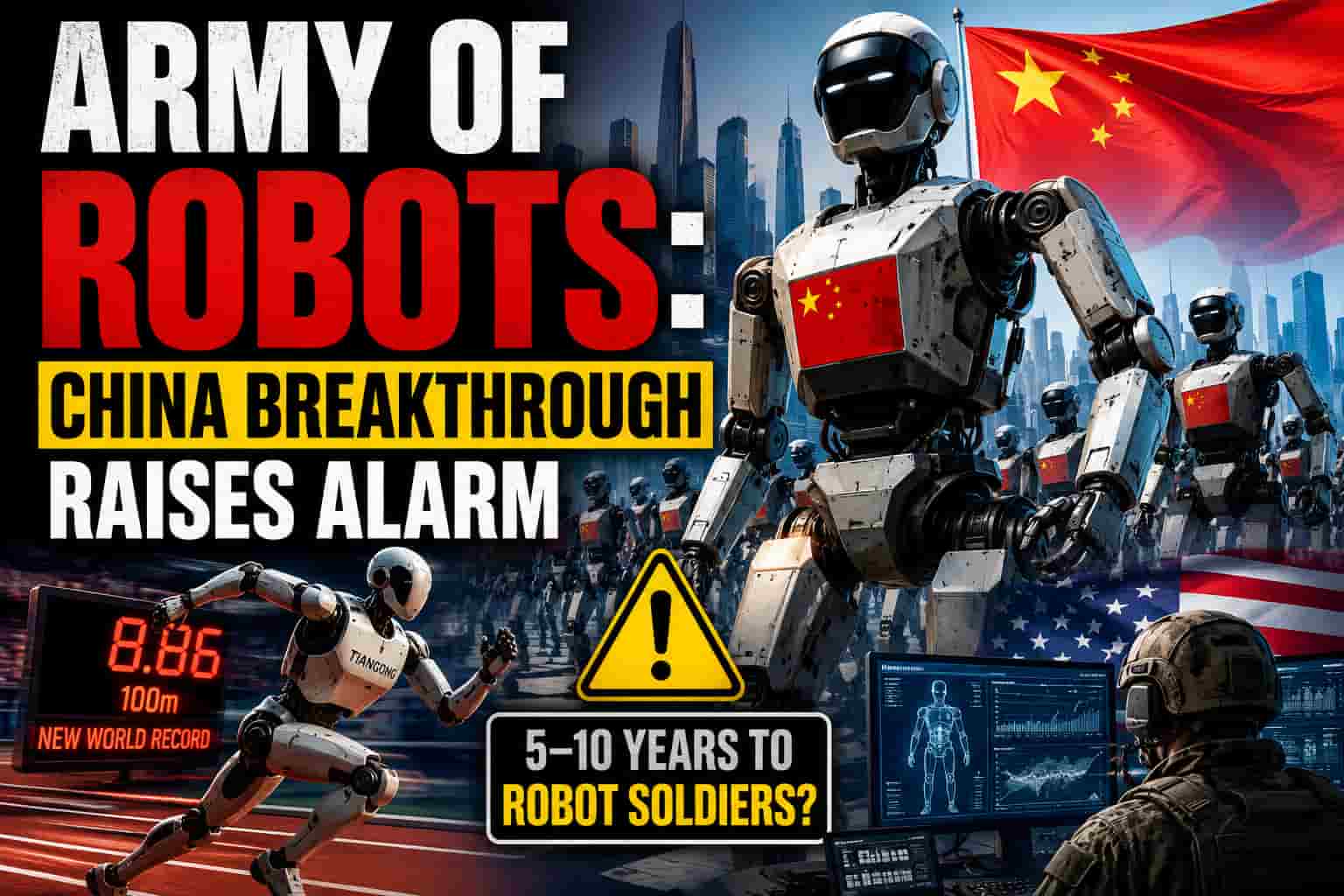
A Chinese humanoid robot has run 100 meters in 8.86 seconds — faster than Usain Bolt’s human world record. Fox Business is now asking whether the United States is falling behind China in robotics and how long it might take before highly autonomous robots move from factories and stadiums to the battlefield. The “robot army” remains a forecast, not a current reality. But the military robotics race itself is already underway.
On August 25, 2026, Fox Business aired remarkable footage from China: a humanoid robot sprinting at a speed that would have been almost unimaginable for a bipedal machine only a few years ago.
The discussion quickly moved beyond sports.
Could China’s rapid advances in humanoid robotics eventually produce robot soldiers?
And is the United States keeping pace?
RoboStore CEO Ted Haggerty, appearing on Varney & Co., described military robots as a plausible development as neural networks, robotics hardware and artificial intelligence become increasingly integrated.
Asked directly about the possibility of an “army of robots,” Haggerty responded:
“I think it’s very plausible.”
The full interview is available from Fox Business.
But before imagining armies of humanoid machines, it is important to separate what has already happened from what remains speculation.
China’s Robot Really Did Beat Usain Bolt’s Time
The most dramatic claim in the Fox Business segment is substantially correct — and the latest result is even faster than the number discussed on television.
China’s Tiangong Ultra, developed by the Beijing Humanoid Robot Innovation Center, ran the 100-meter distance in 8.86 seconds on August 25 during the World Humanoid Robot Games in Beijing.
That is considerably faster than the 9.58-second human world record set by Usain Bolt in Berlin in 2009.
Tiangong had already generated headlines earlier in the competition when it ran the distance in 9.39 seconds.
Then it lowered that time to 8.86 seconds.
The improvement is even more striking when compared with the robot’s performance one year earlier.
At the inaugural games in 2025, Tiangong’s best 100-meter time was approximately 21.5 seconds.
In roughly a year, the machine cut more than half of that time.
That rate of development is one reason the videos are attracting so much attention.
But the Robot Did Not “Beat Usain Bolt” in the Normal Athletic Sense
There is an important qualification.
A robot running 100 meters in 8.86 seconds does not mean it is currently a better athlete than Usain Bolt — much less a combat-ready soldier.
The machines compete under robot-specific conditions.
They do not have to satisfy the biological constraints faced by humans, and some of the fastest robots still struggle with basic issues such as controlled deceleration.
Tiangong completed its record-setting sprint but crashed after crossing the finish area.
Other humanoids at the Beijing competition have also fallen, collided with barriers or experienced mechanical failures.
That is a useful reminder of where the technology currently stands:
Extraordinary specialized performance does not equal general-purpose intelligence.
Running fast on a track is one problem.
Navigating a ruined building, identifying friend from foe, responding to unexpected obstacles, carrying equipment and making legally and tactically appropriate decisions under combat conditions is an entirely different problem.
China Is Building More Than a Fast Robot
The broader significance of the Beijing competition is not the 100-meter record by itself.
It is the scale of China’s robotics ecosystem.
More than 2,000 robots from 666 teams participated in the 2026 World Humanoid Robot Games, competing in 51 categories including running, football, dancing and industrial tasks.
These competitions are effectively large-scale testing environments.
Developers can test:
- locomotion;
- balance;
- machine vision;
- manipulation;
- autonomous control;
- coordination;
- durability;
- AI decision-making;
- and recovery after failure.
That creates something very different from a traditional robotics laboratory.
China is building a broad ecosystem in which machines can be tested, improved and manufactured at scale.
Is America Falling Behind?
That was one of the central questions Fox Business put to Ted Haggerty.
His answer was nuanced.
He said the United States may be behind China in certain segments, but argued that the two countries are often pursuing somewhat different strategies.
China has produced impressive machines optimized for individual performance categories.
The United States, he argued, has often focused more heavily on complete robotic solutions and software.
In other words:
A robot designed to run faster than a human is not automatically the robot that will transform a factory — or a battlefield.
Haggerty said specialized robotics may actually be the more practical near-term path.
Rather than trying to create one humanoid capable of performing every possible task, companies can deploy one robot for one specific job.
That approach is already common in manufacturing, warehousing and logistics.
The Bigger Breakthrough Is AI Meeting Robotics
Mechanical robots are not new.
Industrial robotic arms have been used for decades.
What is changing is the intelligence being attached to them.
Modern robotics increasingly combines:
advanced actuators + computer vision + neural networks + large AI models + simulation + cheaper sensors + rapidly improving processors.
Haggerty told Fox Business that robotics is advancing at a pace unlike almost any other industry he has observed.
He described seeing meaningful advances approximately every few months.
That acceleration matters.
For decades, engineers could build machines that were physically impressive but relatively inflexible.
They performed carefully programmed movements in predictable environments.
AI is beginning to attack the opposite problem:
Can the machine understand what is happening around it and adapt?
That is what makes the current robotics boom strategically important.
What About Robot Soldiers in Five to Ten Years?
Predictions about military humanoids should be treated carefully.
Statements that robot soldiers could arrive in five to ten years are forecasts from developers and industry observers — not an announced Chinese military deployment schedule.
There is currently no public evidence that China possesses a large operational army of autonomous humanoid infantry.
The distinction matters.
A humanoid machine capable of running quickly is not yet equivalent to an autonomous combat soldier.
But that does not mean military robotics is science fiction.
Quite the opposite.
America Already Has Military Robots
The United States has been developing robotic and autonomous military systems for decades.
And many of the most important military robots do not resemble humans at all.
DARPA’s Robotic Autonomy in Complex Environments with Resiliency — RACER — program developed autonomous software allowing unmanned ground vehicles to navigate difficult off-road terrain without GPS or pre-mapped routes.
DARPA says the goal is to enable unmanned ground vehicles to move through unstructured terrain at speeds comparable with human drivers.
The official RACER program page is available from DARPA.
By the program’s final phase, the technology was no longer limited to laboratory demonstrations.
An Autonomous Vehicle Was Used in a Military Breaching Demonstration
In October 2025, DARPA and the U.S. Army’s 36th Engineer Brigade tested a RACER Heavy Platform during a combat breaching demonstration.
The autonomous robotic vehicle was paired with an M58 Mine Clearing Line Charge — MICLIC.
That system is designed to create lanes through minefields.
Instead of requiring troops to drive the vehicle deep into a dangerous area, autonomous technology could eventually allow machines to perform more of that mission.
DARPA explained in January 2026 that RACER vehicles had demonstrated the ability to navigate difficult terrain without human intervention.
Read DARPA’s official RACER report.
This is already much closer to real military robotics than a humanoid running around a stadium.
An AI-Controlled F-16 Is Already Flying
The robotics and autonomy competition is not limited to the ground.
On July 16, 2026, DARPA announced that the U.S. Air Force had begun in-flight testing of an F-16 controlled by an AI agent.
The aircraft was modified through the Viper Experimentation and Next-generation Operations Model — VENOM — program.
According to DARPA, the AI can autonomously control the aircraft while a human pilot remains in the cockpit monitoring the system.
The technology is intended to accelerate development of autonomous combat aviation.
Read the official DARPA announcement.
That may ultimately matter far more militarily than whether a humanoid robot can outrun a human.
DARPA says future development could allow human pilots to command and coordinate teams of autonomous aircraft.
The Future “Robot Army” May Not Look Human
Hollywood has conditioned people to imagine military robots as metal soldiers with two arms, two legs and rifles.
That may be the wrong picture.
The future military robotic force could include:
- autonomous aircraft;
- unmanned ground vehicles;
- reconnaissance drones;
- maritime drones;
- robotic logistics systems;
- mine-clearing machines;
- quadruped robots;
- autonomous defensive systems;
- and specialized humanoids.
The important capability is not necessarily human shape.
It is autonomy.
Can the machine perceive its environment?
Can it move without constant human commands?
Can it continue operating when communications are disrupted?
Can it understand a mission?
Can it react safely when something unexpected happens?
Those are far more difficult problems than winning a sprint.
DARPA Is Explicitly Designing Robots for Hostile Environments
An April 2026 DARPA initiative provides a revealing look at where U.S. defense research is heading.
DARPA is studying what it calls “physical intelligence” — embedding sensing, adaptation and even forms of computation directly into the physical components of robots.
The agency says military robots may need to operate in:
“extreme, unpredictable, and adversarial environments”
with limited communications and little opportunity for constant human intervention.
Read DARPA’s April 2026 robotics announcement.
DARPA also makes an important point that is frequently lost in discussions about humanoids.
The best military robot may not look remotely human.
Depending on the mission, DARPA says useful systems could be smaller, larger, softer or structurally unconventional.
The priority is mission performance, not appearance.
Why Humanoids Still Matter
If non-human robots are often more efficient, why are governments and corporations spending so heavily on humanoids?
Because nearly everything humans have built was designed around the human body.
Our world contains:
- doors;
- stairs;
- ladders;
- steering wheels;
- hand tools;
- control panels;
- warehouses;
- vehicles;
- weapons;
- factories.
A sufficiently capable humanoid robot could theoretically operate inside that environment without requiring every building, vehicle and tool to be redesigned.
That is the economic promise of the humanoid.
It is also one reason defense analysts cannot simply ignore the technology.
A machine capable of using infrastructure already designed for humans could eventually become extraordinarily versatile.
But the Hardest Problem Is Still the “Brain”
The athletic demonstrations from Beijing show that robotic hardware is improving at extraordinary speed.
But military usefulness requires far more than motors and joints.
A useful autonomous robot must correctly understand complex, ambiguous and dangerous environments.
It must distinguish between:
- objects;
- people;
- threats;
- obstacles;
- orders;
- mistakes;
- changing conditions.
And it must do so reliably.
This is where modern AI could eventually produce the most important breakthrough.
The critical milestone is not when a robot runs faster than a person.
It is when a robot can reliably understand and act in the physical world.
China’s Real Strategic Advantage May Be Manufacturing
There is another dimension to the U.S.-China robotics race that may ultimately prove more important than any individual robot.
Mass production.
Robots require enormous supply chains:
- electric motors;
- precision gears;
- batteries;
- actuators;
- cameras;
- sensors;
- processors;
- wiring;
- rare-earth materials;
- precision manufacturing.
China already possesses enormous manufacturing capacity across many of these industries.
If humanoid robots become mass-market products, the strategic question will not only be who invented the best AI.
It will also be:
Who can manufacture millions of machines at an economically viable price?
America’s strength remains extraordinary software, AI research, semiconductor design and defense technology.
China’s manufacturing scale gives it a different kind of advantage.
The winner of the robotics race may ultimately need both.
Key Facts
China’s Tiangong Ultra ran 100 meters in 8.86 seconds on August 25, 2026.
Usain Bolt’s human world record remains 9.58 seconds.
More than 2,000 robots from 666 teams participated in the Beijing World Humanoid Robot Games.
RoboStore CEO Ted Haggerty told Fox Business that military robots are a plausible future development.
DARPA is already developing autonomous ground vehicles capable of navigating difficult terrain without direct human control.
DARPA and the U.S. Air Force are already flight-testing an AI-controlled F-16.
Confirmed
China has made a major breakthrough in humanoid locomotion.
The 8.86-second Tiangong sprint is real.
U.S. military autonomy is already operationally relevant.
Ground vehicles and aircraft are being tested with increasingly sophisticated autonomous capabilities.
Robotics development is accelerating alongside AI.
The convergence of AI software and increasingly capable robotic hardware is creating systems that were not practical only a few years ago.
What Is Not Confirmed
There is no evidence that China currently possesses an operational “army of humanoid robot soldiers.”
There is no confirmed timetable showing that autonomous humanoid soldiers will necessarily be deployed within five or ten years.
Industry estimates about robot soldiers remain forecasts.
And a robot that can run faster than a human is not automatically capable of performing complex combat missions.
Analysis
The most important lesson from China’s 8.86-second robot is not that machines are suddenly replacing soldiers.
They are not.
The lesson is the rate of technological improvement.
A robot that required more than 20 seconds to run 100 meters one year ago can now complete the distance in less than nine.
Meanwhile, American defense programs are demonstrating autonomous ground navigation and AI-controlled fighter aircraft.
These developments are occurring simultaneously.
That means the military robotics competition between the United States and China should not be understood as a future possibility.
The competition has already begun.
The unresolved question is which country can first combine:
advanced AI, reliable autonomy, capable hardware and mass production.
Whoever succeeds could gain an extraordinary industrial and military advantage.
FAQ
Did a Chinese robot really run faster than Usain Bolt?
Yes.
Tiangong Ultra completed 100 meters in 8.86 seconds on August 25, compared with Bolt’s human world record of 9.58 seconds.
Does China already have robot soldiers?
There is no public evidence of a large operational force of autonomous humanoid soldiers.
Could humanoid robots eventually be used by militaries?
Almost certainly in some roles.
Logistics, reconnaissance, hazardous-environment operations and other specialized military tasks are obvious potential applications.
Fully autonomous lethal decision-making raises much more difficult technical, legal and ethical questions.
Is the United States behind China?
The answer depends on the technology.
China is demonstrating impressive humanoid hardware and manufacturing scale.
The United States remains extremely strong in AI, software, advanced aerospace systems and military autonomy.
Is the U.S. military already using AI-controlled machines?
Yes, in testing and development.
DARPA has demonstrated autonomous ground-vehicle technology, and the U.S. Air Force is currently testing an AI-controlled F-16.
Sources
Fox Business
RoboStore CEO Ted Haggerty on Humanoid Robots and the Robotics Race With China — August 25, 2026
Interview discussing China, U.S. robotics capabilities and potential future military robots.
Watch the Fox Business interview
China / World Humanoid Robot Games
Tiangong Ultra — 8.86-Second 100-Meter Sprint
Report from the World Humanoid Robot Games in Beijing.
Read the report
DARPA — Autonomous Ground Vehicles
RACER — Robotic Autonomy in Complex Environments With Resiliency
DARPA program developing autonomous off-road ground-vehicle technology.
Official DARPA program page
RACER’s Finish Line — January 14, 2026
DARPA report on autonomous military ground-vehicle testing and mine-clearing demonstrations.
Official DARPA report
DARPA / U.S. Air Force
DARPA, U.S. Air Force Fly AI-Controlled F-16 — July 16, 2026
VENOM-modified F-16 undergoing in-flight testing under AI control.
Official DARPA announcement
DARPA — Future Robotics
Rethinking Robotics With Physical Intelligence — April 29, 2026
DARPA research into robotic systems capable of operating in extreme, unpredictable and adversarial environments.
Official DARPA announcement
Ask Midtown Tribune about this story
Answers are grounded first in this article. Search all Midtown Tribune reporting from the main AI Search page.
AI-generated summary. Verify important details in the linked original articles.