
Opinion / Analysis — Midtown Tribune
In New York City, the phrase “rent freeze” sounds simple. To many people, it sounds as if the city has stopped rent increases for everyone.
That is not what happened.
The 2026 rent freeze applies only to rent-stabilized apartments — a large but limited category of regulated housing. It does not automatically protect every poor renter, every immigrant family, every room renter, every month-to-month tenant, or every person paying rent without a long-term written lease.
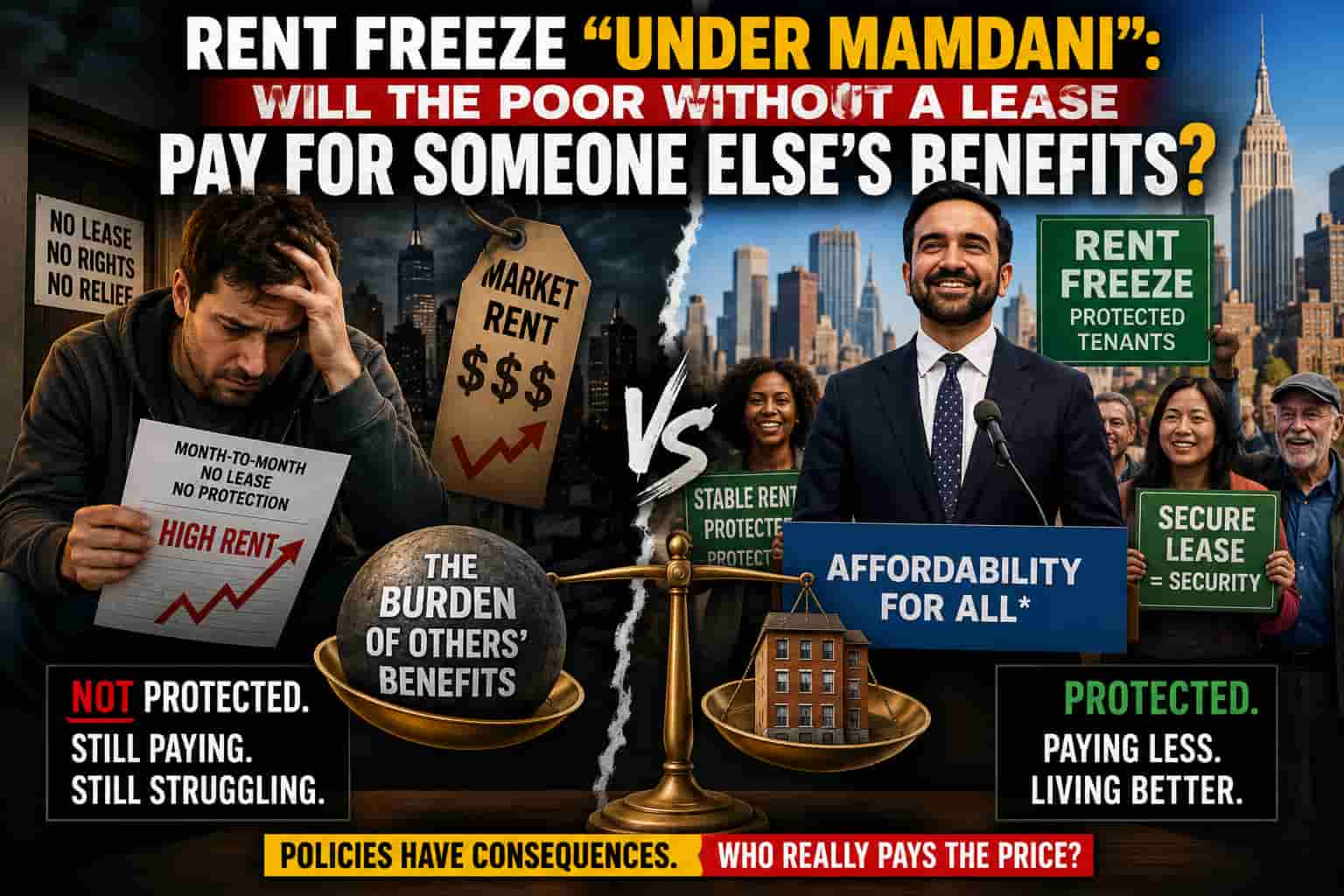
That is the central problem. New York’s rent freeze, celebrated by Mayor Zohran Mamdani as a victory for working people, may also deepen a painful divide between neighbors: one group is protected by government regulation, while another — sometimes poorer and less secure — remains outside the system.
What the Rent Freeze Actually Does
On June 25, 2026, the New York City Rent Guidelines Board adopted a 0% increase for one-year and two-year rent-stabilized apartment leases beginning on or after October 1, 2026 and on or before September 30, 2027. The Board also adopted 0% increases for rent-stabilized lofts for the same period.
This was not a general citywide freeze on all rents. It was not a universal protection for all tenants. It was a Rent Guidelines Board decision covering regulated leases.
Mayor Mamdani’s office described the vote as a freeze on one- and two-year rent-stabilized leases, and Mamdani called it a historic victory for tenants. His statement also referred to the RGB as an independent board.
That distinction matters. Politically, this is being presented as “Mamdani’s rent freeze.” Legally and administratively, the decision was made by the New York City Rent Guidelines Board.
What Is a Rent-Stabilized Apartment?
Rent stabilization is a form of rent regulation. According to NYC’s official tenant protection materials, rent-stabilized apartments are most often located in buildings with six or more units built before 1974, and tenants in those apartments receive additional protections and rights.
New York State Homes and Community Renewal explains that rent stabilization generally covers buildings built after 1947 and before 1974, apartments removed from rent control, and some buildings receiving tax benefits such as J-51, 421-a, and 421-g. HCR also states that rent stabilization protects tenants from illegal rent increases while allowing owners to maintain buildings and realize a reasonable profit.
Those protections are real. Rent-stabilized tenants have the right to lease renewals, limited rent increases, required services, DHCR complaint procedures, and legal protections against eviction except on lawful grounds.
But the protection is tied to the legal status of the apartment — not simply to the poverty, need, or vulnerability of the person living in New York.
How Much Housing Is Rent-Stabilized?
The official 2023 New York City Housing and Vacancy Survey estimated that New York City had about 996,600 rent-stabilized units. That represented about 27% of the city’s total housing stock and 41% of rental units. About 758,700 of those units were subject to rent stabilization through the Emergency Tenant Protection Act category.
The same survey identified about 1,139,000 market rental units, commonly referred to as market-rate apartments because their rents are not regulated.
In other words, rent-stabilized housing is a massive part of New York’s rental market. But it is not the whole market.
That is where the unfairness begins.
Who Benefits From the Freeze?
The direct beneficiaries are tenants whose apartments and leases fall under rent stabilization rules. If their covered lease begins during the period set by the 2026-2027 RGB order, the legal rent guideline increase is 0%.
The economic benefit is clear: a tenant in a covered apartment gets predictability, lease renewal protection, and no RGB-authorized increase for that lease cycle.
But the city’s poorest residents are not all in rent-stabilized apartments. Some rent rooms. Some live in small buildings. Some pay month-to-month. Some pay cash. Some do not have a written long-term lease. Some are immigrants who entered the housing market informally because that was the only housing they could find.
Those people may be just as poor — or poorer — than their rent-stabilized neighbors. But they do not automatically receive the rent freeze.
The Poor Without a Lease: Still Paying, Still Unprotected
New York law does recognize renters without written leases. The New York State Attorney General’s Residential Tenants’ Rights Guide explains that non-rent-regulated renters who do not have leases and pay rent monthly are called month-to-month tenants. Tenants who stay after a lease ends are treated as month-to-month tenants if the landlord accepts rent payment.
That gives them some legal status. But it does not make their apartment rent-stabilized.
A poor tenant paying month-to-month may still face market pressure. A poor family renting a room may still be outside the RGB freeze. A low-income immigrant paying rent without a long-term lease may still pay more while a neighbor in a regulated unit receives 0%.
This creates the most uncomfortable question in the debate:
Does the rent freeze help the poorest New Yorkers — or only the subset of poor and working-class New Yorkers whose apartments happen to fall into the right legal category?
Two Neighbors, Two Different New Yorks
Imagine two tenants living on the same block.
One has a rent-stabilized lease. Under the 2026 RGB decision, that tenant may receive a 0% increase for a one-year or two-year lease.
The other tenant rents a room or apartment without rent stabilization. That tenant may be poorer, less politically connected, and more vulnerable. But the freeze does not automatically apply.
This is not equality. It is category-based protection.
Legally, that may not be “discrimination” in the traditional civil-rights meaning of the word. But socially and economically, it produces a sharp division: protected tenants and unprotected tenants, regulated neighbors and market neighbors, those inside the government system and those outside it.
The 2024 Good Cause Eviction Law gives some market tenants protections against eviction or non-renewal without good cause, but it does not turn market-rate apartments into rent-stabilized apartments and does not give those tenants the same 0% RGB rent guideline.
Who Can Apply for These Protections?
A rent-stabilized apartment is not one simple city program where anyone can apply and receive a unit. If a rent-stabilized apartment becomes available, a renter may try to rent it through the owner or managing agent. But availability is limited and demand is high.
Some affordable housing units created through tax benefits or government programs may also be rent-stabilized, but those are usually accessed through specific application processes such as NYC Housing Connect, with income rules and lotteries.
There is also a separate NYC Rent Freeze Program — SCRIE and DRIE — for eligible seniors and people with disabilities. That program is different from the general RGB rent freeze. NYC’s official qualifications state that SCRIE generally requires a tenant to be at least 62 years old, have household income of $50,000 or less, spend more than one-third of monthly household income on rent, and live in an eligible apartment while being named on the lease or rental agreement. DRIE has similar income and rent-burden rules for eligible people with disabilities.
Again, the key word is eligibility. The system helps people who fit the category. It does not automatically help every poor person.
The Old New York Immigrant Experience
For many immigrants, especially those who came from countries where bureaucracy ruled daily life, old New York represented a very different idea.
A person could arrive with little money, sometimes without perfect documents, rent a room or small apartment, work, earn, save, build a life, and eventually buy property — without constantly asking the state for permission, without waiting for a government lottery, and without being classified by an agency before being allowed to live decently.
That was the American promise as many immigrants understood it: not a government that “gives life,” but a society where people can build life through work, contract, risk, and responsibility.
Today, big-government housing politics often produces the opposite result. Instead of expanding freedom, it creates new categories of eligibility. Instead of letting people rise through work and market opportunity, it makes people increasingly dependent on whether a bureaucracy places them in the right protected box.
The Moral Paradox
The rent freeze is presented as justice. For many rent-stabilized tenants, it may feel like justice.
But what about the equally poor tenant next door who does not have a rent-stabilized lease?
What about the immigrant family renting informally?
What about the working person paying market rent in a small building?
What about the tenant without a long-term lease who is still paying rent every month but receives no 0% protection?
The moral paradox is obvious: help does not necessarily go to the poorest person. It goes to the person whose apartment is legally eligible.
That is why the phrase “affordability for all” can become misleading. This is not affordability for all. It is protection for some.
Will the Unprotected Pay for the Protected?
The headline question — whether low-income renters without a lease will pay for other people’s benefits — should be understood carefully.
They are not being directly taxed to subsidize their rent-stabilized neighbors.
But housing markets respond to regulation. If owners of regulated buildings face frozen income while costs continue to rise, pressure can move elsewhere: to market-rate units, to fees, to reduced maintenance, to smaller owners leaving the market, or to fewer available apartments. Official state policy says rent regulation is supposed to protect tenants while allowing owners to maintain buildings and earn a reasonable profit.
The question is whether a 0% rent increase can preserve that balance.
If not, the burden may fall on those outside the protected system — including market renters who are not wealthy, small landlords who are not corporate giants, and poor tenants who lack the paperwork or apartment status required to receive the benefit.
That is the economic and moral issue New Yorkers should be debating.
Mamdani and the Question of His Own Housing
Public discussion has included claims about Mayor Mamdani and rent-stabilized housing. But under the standard of this article — relying on official documents — those claims should not be stated as proven facts without official documentation.
The official Mayor’s Office website confirms that Zohran Kwame Mamdani became the 112th Mayor of New York City on January 1, 2026 and previously represented the 36th Assembly District, including Astoria, Ditmars-Steinway, and Astoria Heights.
However, the official documents reviewed for this article do not establish the status of any personal apartment, the exact rent, the address, or his wife’s residence. Therefore, a careful formulation is: public claims about Mamdani’s personal housing require separate documentary proof; without official documentation, they should not be presented as established fact.
Liberty Is Not Bureaucratic Permission
Civil liberties protected by the American Constitution are not the right of elected bureaucracy to command citizens. They are protection of the individual against arbitrary power.
If “democracy” is reduced to the idea that a majority may take from some and give to others by political discretion, then it is no longer liberty. It becomes a road toward the tyranny of the majority — the very danger against which the American constitutional tradition was built.
That is why the rhetoric around the Mamdani team alarms many critics. When government speaks in the language of “justice” but divides residents into those who receive benefits and those who carry the burden, the real question becomes unavoidable:
Where is the line between protecting the needy and violating the principle of equal liberty for all?
Conclusion: A Rent Freeze for Some, Not for All
New York’s 2026 rent freeze is not a universal tenant protection. It is a targeted regulation for rent-stabilized leases.
For many protected tenants, it is a real economic benefit. For others — including poor renters without a long-term lease, room renters, month-to-month tenants, and market-rate tenants — it may be another reminder that New York’s housing system does not reward need as much as it rewards legal classification.
That is why the rent freeze debate is bigger than rent. It is about the future of New York.
Will New York remain a city of work, contract, opportunity, and upward mobility?
Or will it become a city where the most important question is not how hard you work, but whether government recognizes you as the “right” kind of tenant?
Official Sources and Documents
-
New York City Rent Guidelines Board — Adopted Rent Guidelines for 2026–2027
Official RGB decision setting a 0% increase for one-year and two-year rent-stabilized apartment leases beginning between October 1, 2026 and September 30, 2027. -
NYC Rent Guidelines Board — Rent Guidelines
Official section with current and past rent guidelines for rent-stabilized apartments, lofts, hotels, and other regulated housing categories. -
NYC Housing and Vacancy Survey 2023 — Selected Initial Findings
Official NYC HPD data on New York City’s housing stock, including rent-stabilized units, market rental units, vacancy rates, and tenant income data. -
NYC Mayor’s Public Engagement Unit — Rent Stabilization
Official New York City explanation of rent stabilization and tenant protections for rent-stabilized apartments. -
New York State Homes and Community Renewal — Fact Sheet #1: Rent Stabilization and Rent Control
Official New York State document explaining rent stabilization, rent control, tenant protections, owner obligations, legal rent increases, and regulated housing rules. -
NYS Homes and Community Renewal — Rent Laws Updates
Official New York State updates and guidance on rent laws, rent regulation, and tenant protection rules. -
New York State Attorney General — Residential Tenants’ Rights Guide
Official guide explaining tenant rights in New York State, including month-to-month tenants, rent-regulated tenants, leases, rent payments, and eviction protections. -
New York State Attorney General — Good Cause Eviction Law
Official explanation of Good Cause Eviction protections for certain market-rate tenants. The law provides some protections but does not convert market-rate apartments into rent-stabilized apartments. -
NYC Rent Freeze Program — SCRIE and DRIE Qualifications
Official eligibility requirements for New York City’s Rent Freeze Program for qualifying seniors and people with disabilities. -
NYC Housing Connect — Official Affordable Housing Portal
Official New York City portal for applying to affordable housing opportunities, including income-restricted apartments and housing lotteries. -
NYC Mayor’s Office — Mayor Mamdani’s Statement on the Rent Guidelines Board Vote
Official statement from the New York City Mayor’s Office regarding the Rent Guidelines Board’s 2026 rent-stabilized lease decision.
Ask Midtown Tribune about this story
Answers are grounded first in this article. Search all Midtown Tribune reporting from the main AI Search page.
AI-generated summary. Verify important details in the linked original articles.