
Video: The Union of Pinnacle Tenants: A Short History of NYC Housing*.
This is the story of how a group of perfectly ordinary tenants took on one of the worst landlords in NYC. And won.
Brought to you by City Hall video team.
Narrated by Morgan Spector.
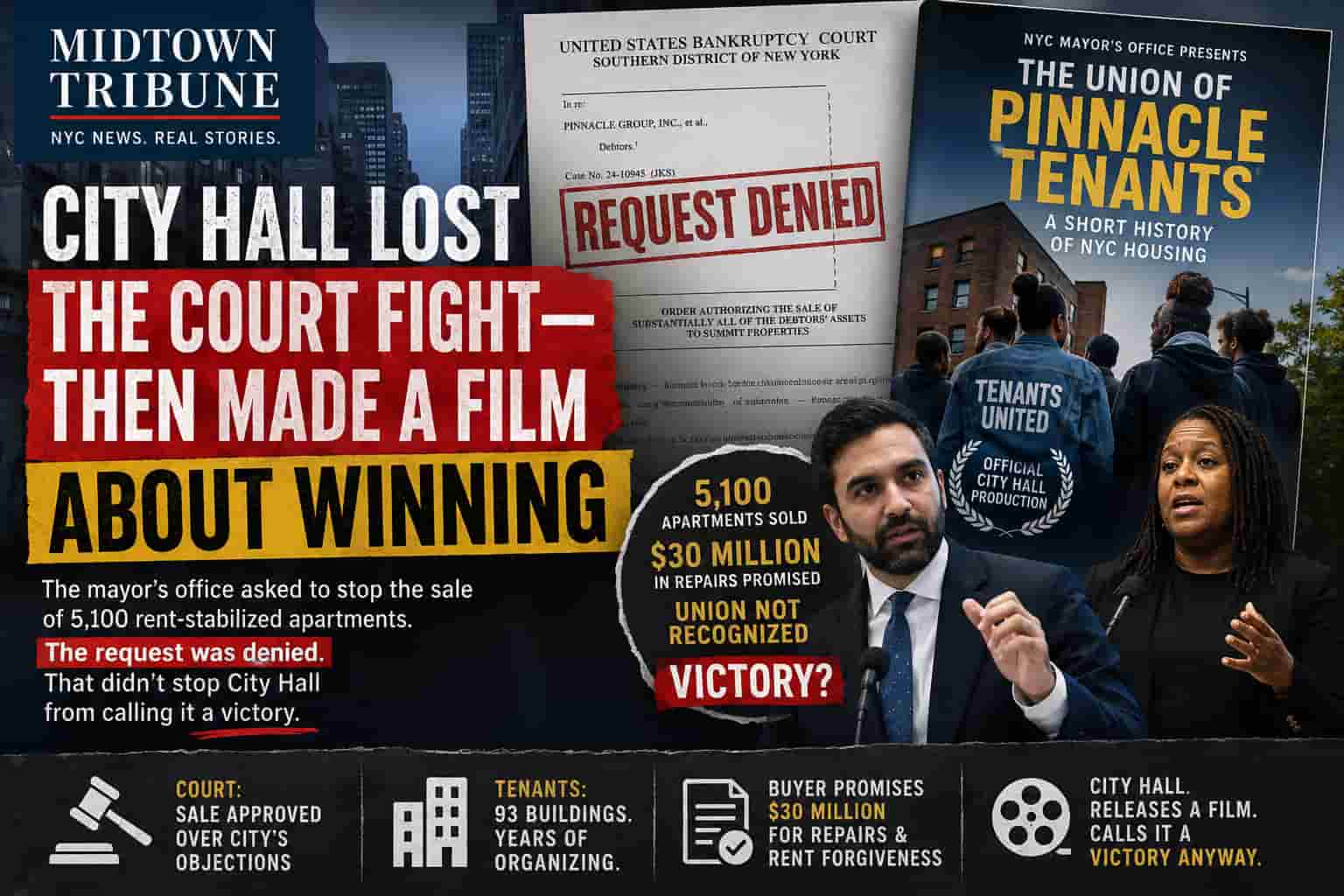
The Mayor’s Office asked for the sale of 5,100 rent-stabilized apartments to be postponed. The request was denied. That inconvenient detail did not prevent City Hall from producing its own cinematic victory celebration.
By Midtown Tribune Editorial Staff
The tenants featured in the New York City Mayor’s Office film The Union of Pinnacle Tenants: A Short History of NYC Housing have a serious and compelling story to tell.
They describe holes in floors, leaking ceilings, brown water, gas interruptions, rats, roaches and even ice forming inside a bathroom. According to the film, the buildings accumulated more than 5,000 open hazardous violations and approximately 14,000 complaints.
Residents across 93 buildings began speaking to their neighbors, organizing tenant associations and eventually forming the Union of Pinnacle Tenants.
That is a genuine grassroots story.
Naturally, City Hall decided to make itself the star.
First Came the Tenants. Then Came the Cameras.
For much of the film, viewers see residents doing the difficult work that tenant organizing actually requires: documenting dangerous conditions, questioning contractors, attending meetings and building a coalition across dozens of properties.
The movement did not begin with a mayoral executive order, a press conference or a communications strategy. It began with tenants asking why water was coming through their ceilings and why nobody seemed interested in fixing it.
Then, in the final portion of the film, the familiar political transformation occurs.
The music grows more triumphant. The mayor appears. City Hall’s intervention is presented as a dramatic turning point. The administration announces that it charted a “new course” and helped secure major commitments from the incoming owner.
It sounds like a victory.
The film itself, however, includes one rather important sentence:
The city’s request was denied.
City Hall Asked to Postpone the Sale. The Court Refused.
Pinnacle Group entered bankruptcy involving roughly 5,000 apartments in the Bronx, Brooklyn, Manhattan and Queens. Its portfolio of approximately 5,100 rent-stabilized apartments was then sold to Summit Properties.
The tenants wanted the sale stopped. The Mamdani administration asked for the transaction to be postponed, arguing that it was unclear whether the new owner would comply with rent-stabilization laws and the city’s housing-maintenance code.
The request was denied.
Summit became the owner of the Pinnacle portfolio on April 1, 2026.
In ordinary English, this means City Hall did not stop the sale it sought to delay.
In official-documentary English, however, the defeat becomes an “intervention” that produced “important commitments.”
This is an impressive new form of municipal accounting:
Request denied + sale completed = historic City Hall victory.
Apparently, all that was missing was a soundtrack.
The Private Buyer Made Promises—The Repairs Still Have to Happen
The film says Summit committed $30 million toward repairs and correcting housing violations.
That could be meaningful. Tenants living with leaks, broken floors, pests and unsafe conditions deserve actual repairs—not speeches about repairs.
But $30 million divided across 5,100 apartments works out to an average of approximately $5,882 per apartment.
Some units may need little work. Others may require major plumbing, structural, electrical or environmental repairs. The real test is therefore not whether the number looks impressive in a press release, but whether the violations are actually corrected and the apartments become safe.
The film celebrates the commitment before presenting evidence that the work has been completed.
City Hall has discovered the political advantage of holding the ribbon-cutting before the ribbon has arrived.
The “Union” in the Film Has Not Been Formally Recognized
There is another detail that interrupts the victory narrative.
The film is titled The Union of Pinnacle Tenants, yet it acknowledges that Summit Properties has not formally recognized the Union of Pinnacle Tenants as a bargaining unit.
The new owner did meet with tenant representatives, according to the film, and residents were able to present their concerns directly. Summit also reportedly agreed to forgive millions of dollars in back rent that accumulated before the sale.
Those could be important developments.
But the film does not provide the full written terms of the rent forgiveness, the number of tenants covered, the eligibility rules or a formal recognition agreement between Summit and the tenant organization.
So the current record appears to be:
- The administration’s request to postpone the sale was denied.
- The private sale proceeded.
- The new private owner promised repairs.
- The tenant union has not been formally recognized.
- The repairs still have to be completed.
- City Hall has already released the victory movie.
The government may not control the buildings, but it certainly controls the editing room.
The Real Heroes Were Organizing Before City Hall Arrived
The central weakness of the film is not that the administration supported the tenants.
The city should support residents facing hazardous conditions. It should enforce the housing code, pressure negligent owners and ensure that rent-regulated tenants are not mistreated.
The problem is the political repackaging of a tenant-led movement as an achievement of the administration.
The residents organized across 93 buildings. They held meetings. They documented conditions. They challenged contractors. They wrote to the bankruptcy judge. They created their organization because they believed they were not being heard.
They did this work before the Mayor’s Office turned their experience into a professionally produced lesson about City Hall’s housing agenda.
Even the film describes the movement as a grassroots effort built through the “grit and determination” of residents advocating for themselves and their neighbors.
That should have been the main story.
Instead, the tenants’ struggle gradually becomes a promotional bridge to speeches about the mayor’s broader housing plans, executive orders and policy announcements.
The residents brought the evidence.
City Hall brought the closing credits.
A More Accurate Title
A more precise title for the film might have been:
Pinnacle Tenants Organized for Years, the Court Rejected City Hall’s Request, a Private Buyer Purchased the Buildings—and the Mayor’s Office Declared Victory Anyway
Admittedly, that is not very cinematic.
But it is closer to what the official film itself describes.
The Union of Pinnacle Tenants deserves attention and respect. Residents who organize against neglect should receive credit for their work, and Summit Properties should be held publicly accountable for every repair and financial commitment it has made.
City Hall may also deserve some credit for supporting the tenants and pressing the buyer for commitments.
But support is not ownership of the story.
The administration did not stop the sale. Its request was denied. The buildings passed to a private buyer. The union remains without formal recognition, and the promised repairs still have to be delivered.
That is not nothing.
It is simply not the sweeping triumph portrayed by the film.
In New York politics, however, a partial result can become a complete victory—provided the cameras are positioned correctly.
Sources and Supporting Documents
Official New York City materials and independent reporting concerning the Pinnacle Group bankruptcy, the court-approved sale to Summit Properties, tenant organizing and the Mayor’s Office documentary.
Official New York City Sources
-
NYC Mayor’s Office — The Union of Pinnacle Tenants: A Short History of NYC Housing
The official 13-minute City Hall documentary examined in this article. The film presents the Pinnacle tenants’ organizing campaign, the bankruptcy sale and commitments made by the new owner. -
NYC Mayor’s Office — Official announcement of the Pinnacle documentary
The August 4, 2026 release describes organizing across 93 buildings and says the new owner committed $30 million for repairs and agreed to forgive tenants’ rent arrears. -
NYC Mayor’s Office — Administration announces intervention in the Pinnacle bankruptcy
The January 1, 2026 announcement says Pinnacle properties had accumulated more than 5,000 housing violations and approximately 14,000 complaints. It also describes the city’s decision to intervene in bankruptcy court. -
Mayor’s Office to Protect Tenants — Updates for Pinnacle tenants
The city’s official information page for residents of buildings formerly controlled by Pinnacle Group. -
NYC Department of Housing Preservation and Development — HPD Online
New York City’s official database for checking housing-code violations, complaints, litigation, property registration and building ownership information by address. -
New York State Homes and Community Renewal — Rent law updates
Official state information about rent stabilization, rent control and the Housing Stability and Tenant Protection Act of 2019. -
NYC Rent Guidelines Board — Official rent-stabilization information
Official information about New York City’s rent-stabilized housing system and the approximately one million units subject to its rules.
Independent Reporting
-
City Limits — Judge approves sale of more than 5,000 Pinnacle apartments
City Limits reported that the bankruptcy judge approved the sale to Summit Properties over the city’s objections. The report also details the buyer’s repair commitments, financing assurances and projected $30 million investment. -
City Limits — Pinnacle tenants demand city intervention before the sale
A November 2025 report on the organizing campaign across 93 buildings, tenant concerns about the bankruptcy auction and demands for a voice in selecting the portfolio’s next owner. -
New York Post — Criticism of City Hall’s production of the documentary
Coverage of the film’s production, its political presentation and criticism over City Hall’s use of government video resources for the project.
Editorial note: Statements from the Mayor’s Office represent the administration’s account of the case. The court’s approval of the sale over the city’s objections is documented separately in the independent reporting linked above.
Ask Midtown Tribune about this story
Answers are grounded first in this article. Search all Midtown Tribune reporting from the main AI Search page.
AI-generated summary. Verify important details in the linked original articles.