
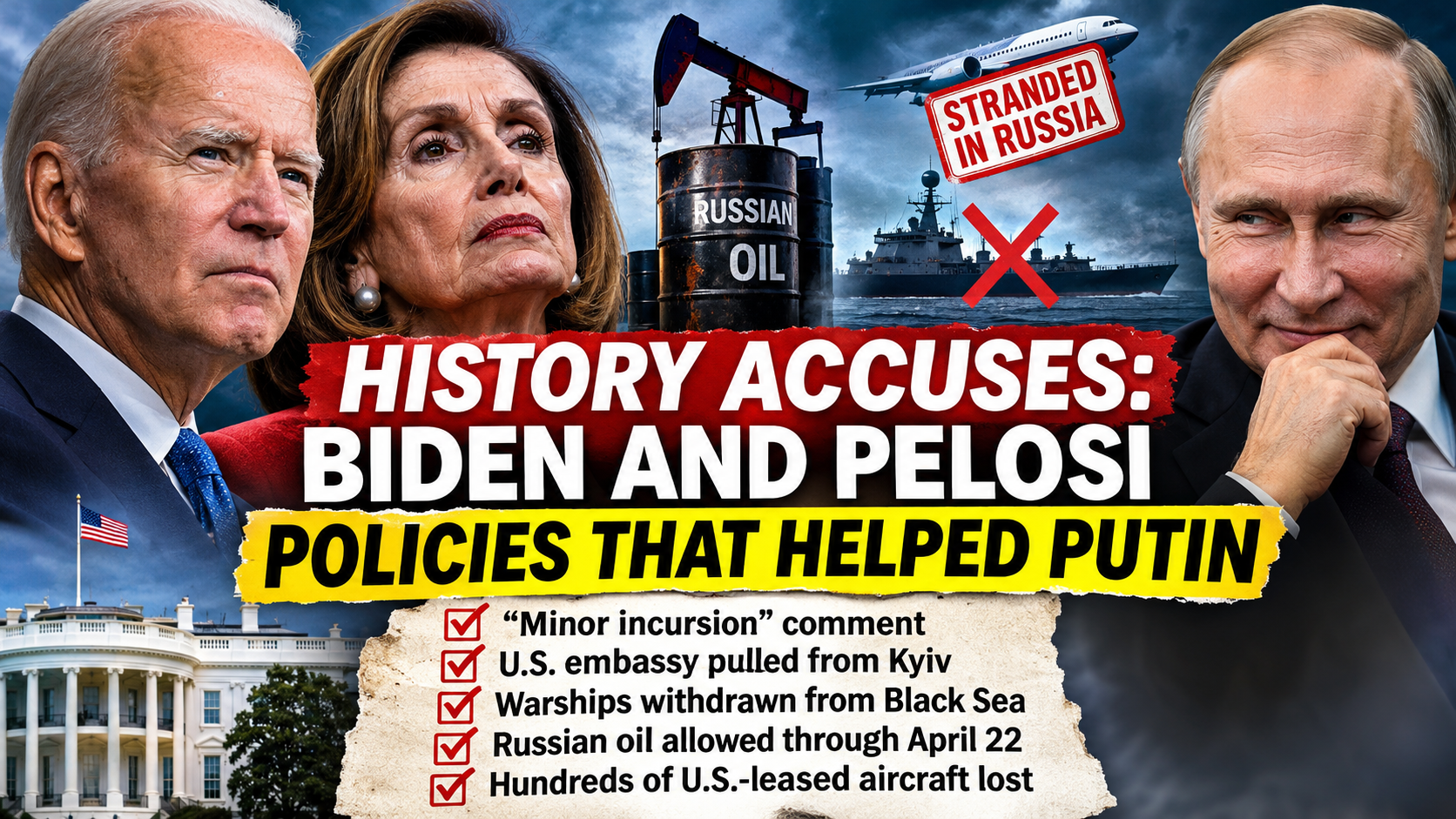
Five documented decisions and developments in 2022 raise serious questions about American deterrence, energy independence, Russian oil revenues and the protection of Western assets. The historical record deserves scrutiny. War in Ukraine and Zelenski.
Midtown Tribune | Investigative Analysis | November 2026
History Does Not Judge Political Speeches. It Examines Decisions.
In the weeks before Russia’s full-scale invasion of Ukraine on February 24, 2022, President Joe Biden’s administration made several decisions that deserve renewed historical examination.
The president publicly discussed the possibility of a “minor incursion” into Ukraine. American diplomatic operations were relocated from Kyiv. U.S. Navy destroyers had departed the Black Sea.
After the invasion, Washington announced a ban on Russian energy imports but allowed certain previously contracted shipments to continue through April 22, 2022.
Meanwhile, Western aircraft leasing companies lost control of billions of dollars in aviation assets remaining in Russia.
These events are documented through official U.S. government records and corporate disclosures filed with the Securities and Exchange Commission.
The central question is not merely what the Biden administration intended. It is whether its decisions weakened deterrence, reduced American strategic leverage or produced unintended advantages for Vladimir Putin.
The Five-Point Historical Record
| Date | Documented event | Official evidence |
|---|---|---|
| January 19, 2022 | Biden publicly used the phrase “minor incursion” when discussing potential Russian aggression. | Presidential transcript — GovInfo.gov |
| February 14–21, 2022 | The United States relocated embassy operations from Kyiv to Lviv; personnel later spent nights in Poland. | State Department, Feb. 14 · Feb. 21 |
| Before February 24, 2022 | American destroyers departed the Black Sea ahead of Russia’s invasion. | Pentagon briefing, March 30 |
| March 8–April 22, 2022 | The Treasury Department permitted specified Russian energy imports under pre-existing written contracts. | Treasury General License 16 |
| March–September 2022 | International aircraft lessors lost control of aircraft remaining in Russia. | AerCap SEC filing |
Billions in Western Assets: How Russia Benefited From the 2022 Crisis
Russia retained control of billions of dollars in Western-owned assets following its invasion of Ukraine in 2022.
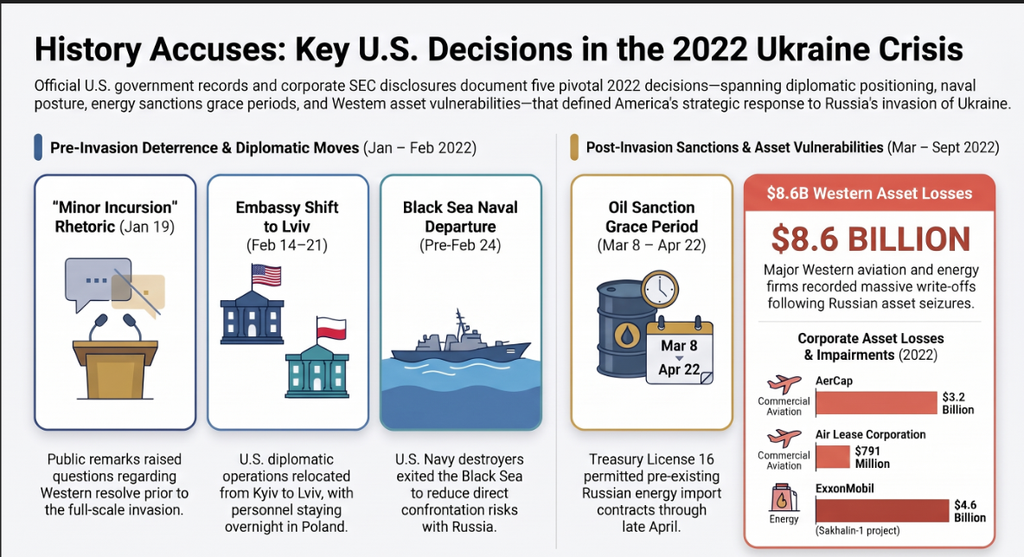
Aircraft: AerCap recorded $3.2 billion in aircraft and engine write-offs and impairments related to the conflict, while U.S.-based Air Lease Corporation initially wrote off $791 million after Russian operators retained its aircraft. Together, these companies recorded approximately $4 billion in initial asset losses. Both subsequently received substantial insurance recoveries.
Sources: AerCap SEC Report | Air Lease SEC Report.
Oil and Industrial Assets: Russia also took control of ExxonMobil’s interests in the Sakhalin-1 energy project in October 2022. ExxonMobil reported $4.6 billion in pre-tax impairment charges associated with its planned exit, followed by the Russian government’s unilateral termination of its interests.
Source: ExxonMobil 2022 Annual Report — SEC.
The Financial Consequences: These three companies alone reported approximately $8.6 billion in initial aircraft-related write-offs and Sakhalin-related impairments. This is not a verified estimate of Russia’s net financial gain. Other Western businesses also faced forced transfers, restricted exits and losses involving industrial facilities and investments, but no comprehensive, independently verified dollar total is established by these filings.
The figures raise a serious question about the consequences of the Biden administration’s sanctions strategy and the ability of Western governments to protect assets exposed to Russian retaliation. Russia’s retention and expropriation of the assets, however, resulted from actions by Russian authorities and operators—not a documented voluntary transfer by the Biden administration.
1. January 19, 2022: Biden’s “Minor Incursion” Statement
Five weeks before Russia launched its full-scale invasion, President Biden addressed the crisis during a White House news conference.
Discussing possible Russian actions, he said:
“It’s one thing if it’s a minor incursion…”
He went on to suggest that the nature of Russia’s actions could influence how the United States and its allies responded.
When a reporter questioned whether the statement could be interpreted as permitting a limited Russian military operation, Biden acknowledged how his wording could sound.
The administration subsequently clarified that any movement of Russian military forces across Ukraine’s border would constitute a renewed invasion and trigger a severe response.
Nevertheless, the original statement raised an important question about strategic messaging.
At a moment when Moscow was assessing Western resolve, did the president’s public distinction between a minor incursion and a major invasion introduce unnecessary ambiguity?
The official transcript establishes exactly what Biden said. It does not establish how Putin interpreted those remarks.
Official source: U.S. Government Publishing Office — The President’s News Conference, January 19, 2022.
2. February 14–21: America Relocates Its Embassy Operations From Kyiv
On February 14, 2022, Secretary of State Antony Blinken announced that the United States was temporarily relocating embassy operations from Kyiv to Lviv.
The reason given was the rapidly deteriorating security situation surrounding Ukraine.
One week later, on February 21, the State Department announced that personnel in Lviv would spend the night in Poland while continuing diplomatic work in Ukraine.
These actions were presented as necessary precautions to protect American personnel.
They did not constitute the termination of diplomatic relations or the abandonment of U.S. support for Ukraine.
Nevertheless, the visible relocation of American diplomatic operations shortly before the invasion raises a legitimate historical question:
Did the reduction of America’s physical presence in Kyiv affect Moscow’s perception of Washington’s willingness to confront a Russian attack?
A responsible examination must compare the potential signaling effects against the obligation to protect American diplomats from an anticipated military assault.
Official sources:
U.S. Department of State — Operations at U.S. Embassy Kyiv, February 14, 2022
U.S. Department of State — Department of State Presence in Ukraine, February 21, 2022
3. American Warships Departed the Black Sea Before the Invasion
During a Pentagon briefing on March 30, 2022, Press Secretary John Kirby was questioned about the withdrawal of U.S. Navy destroyers from the Black Sea before Russia’s invasion.
The administration sought to avoid developments that could lead to direct military confrontation between American and Russian forces.
The decision raises a difficult strategic issue.
Would keeping American warships in the Black Sea have strengthened deterrence, or would it have increased the risk of a confrontation between two nuclear powers?
A military withdrawal does not automatically constitute political surrender. But decisions affecting the forward presence of American forces warrant examination when evaluating the credibility of deterrence.
The historical record confirms the withdrawal. Whether that withdrawal materially influenced Russian decision-making remains a separate question requiring evidence from military and intelligence assessments.
Official source: U.S. Department of Defense — Pentagon Press Secretary John F. Kirby Holds a Press Briefing, March 30, 2022.
4. March 8: Biden Banned Russian Oil — But Existing Contracts Received a Grace Period
On March 8, 2022, President Biden announced restrictions on imports of Russian crude oil, petroleum products, liquefied natural gas and coal.
The announcement was presented as a major effort to reduce America’s economic relationship with Russia after the invasion.
However, Treasury Department records demonstrate that the restriction included a transition period.
Under Office of Foreign Assets Control General License No. 16, certain transactions necessary to import Russian energy products under written agreements entered into before March 8 remained authorized until 12:01 a.m. Eastern Daylight Time on April 22, 2022.
In other words, the announcement of the ban did not immediately end every legally permitted Russian energy shipment to the United States.
The difference between announcing sanctions and implementing them matters.
At a time when the White House argued that Russia’s energy revenues helped sustain its government, the administration permitted a limited period for existing contracts to be completed.
This authorization does not by itself establish how much Russian oil actually entered the United States during that period, or how much revenue those shipments generated.
Nevertheless, it raises an important policy question: Was the transition period necessary to manage existing commercial commitments and supply disruptions, or did it unnecessarily delay the economic impact of the restrictions?
Official sources:
U.S. Treasury — General License No. 16, March 8, 2022
OFAC FAQ 1015 — Authorization for Pre-Existing Energy Contracts
OFAC FAQ 1016 — Shipments Contracted Before March 8
5. Western Aircraft Remained in Russia: What Happened to the Assets?
The Russian invasion created another major problem for international aviation companies.
Hundreds of commercial aircraft operated by Russian airlines were owned by foreign leasing companies.
After sanctions were imposed, those companies faced enormous difficulties recovering their aircraft.
One of the clearest documentary examples comes from AerCap, a major international aircraft lessor.
According to its SEC filing, before the conflict AerCap had 135 owned aircraft and 14 owned engines leased to Russian airlines.
By September 30, 2022, the company had recovered only 22 aircraft and three engines outside Russia.
AerCap reported terminating its Russian leasing arrangements in March 2022 in compliance with sanctions.
The company also disclosed that it continued to hold legal title to the aircraft remaining in Russia, while considering repossession unlikely.
These were private commercial assets, not a U.S. government aircraft fleet voluntarily transferred by President Biden.
Still, the episode reveals a serious vulnerability in international sanctions enforcement and asset protection.
How could Western governments impose aviation restrictions while so many valuable assets remained beyond the practical reach of their lawful owners?
Could stronger advance planning, additional diplomatic measures or different sequencing have reduced the losses?
Those questions deserve examination without confusing Russian actions to retain the aircraft with a voluntary transfer by the United States.
Official source: U.S. Securities and Exchange Commission — AerCap Holdings N.V., September 2022 Filing.
6. Nancy Pelosi, American Oil and the Political Battle Over Inflation
The debate extended beyond foreign policy.
On May 12, 2022, Fox Business featured Republican Congressman Lee Zeldin and economic commentator Liz Peek in a segment titled Nancy Pelosi and Biden Are Running Out of Scapegoats: Business Analyst.
The discussion criticized the administration’s energy policy, inflation management and efforts by Democratic leaders to attribute gasoline prices to oil companies and external factors.
Zeldin argued that the United States should increase domestic energy production rather than rely more heavily on foreign producers.
Peek similarly criticized the administration’s approach to fossil fuels and warned against price-control measures.
Their criticisms reflected an important economic argument: expanding domestic energy supply could strengthen American energy security and, over time, reduce vulnerability to international supply disruptions.
But historical accuracy requires distinguishing restrictions on certain drilling leases from a complete prohibition on American oil production.
The Biden administration did not ban all U.S. oil production.
According to the Energy Information Administration, American crude oil production reached record levels in 2023 and again in 2024.
That does not settle the separate question of whether a different leasing and permitting policy could have encouraged even greater investment or production.
Official source: U.S. Energy Information Administration — U.S. Crude Oil Production Record.
Pelosi’s Gasoline Price-Gouging Legislation
On May 19, 2022, the Democratic-controlled House of Representatives passed H.R. 7688, the Consumer Fuel Price Gouging Prevention Act, by a vote of 217–207.
The legislation sought to address excessive fuel pricing under specified emergency conditions.
Republican critics warned that government intervention in fuel prices could harm supply and discourage investment.
Supporters argued that consumers needed stronger protection against abusive pricing practices.
The proposal was not a universal gasoline price freeze, and it did not become federal law.
Official source: Congress.gov — H.R. 7688, Consumer Fuel Price Gouging Prevention Act.
7. What History Can Establish — and What Remains Unproven
The five episodes show that the administration made decisions involving military posture, diplomatic safety, energy sanctions and international commercial interests during an extraordinary geopolitical crisis.
They establish a record that can be questioned and evaluated.
They do not, however, establish that Biden or Pelosi deliberately assisted Putin.
Other significant facts must also remain part of the historical assessment.
The Biden administration imposed sanctions on Russia, supported Ukraine militarily and participated in international measures targeting Russian energy revenue.
American domestic oil production continued and ultimately reached new records.
These developments complicate any simple accusation that the administration uniformly acted in Russia’s interests.
Yet they do not eliminate questions about the effectiveness, timing or consistency of particular decisions.
A decision can be legally justified, politically defended and still deserve criticism for its strategic consequences.
Conclusion: History Accuses — and the Documentary Record Demands Answers
Historical accountability requires more than repeating the political explanations offered at the time.
It requires examining what officials knew, what decisions they made, which alternatives they considered and what consequences followed.
President Biden’s January 19 remarks, the relocation of American diplomatic personnel, the departure of warships from the Black Sea, the Russian energy-import transition period and the loss of control over Western aviation assets all deserve careful scrutiny.
The record raises five enduring questions:
- Did Biden’s public language create unnecessary ambiguity about American deterrence?
- Could the withdrawal of diplomatic and naval assets have affected perceptions of U.S. resolve?
- Did the Russian energy-import transition period appropriately balance commercial obligations against sanctions objectives?
- Could international coordination have better protected aircraft owned by Western leasing companies?
- Did American energy policy sufficiently prioritize domestic production and strategic resilience during a major international crisis?
These are legitimate questions for historians, economists, national security analysts and members of Congress.
History does not require proof of secret political cooperation to hold government leaders accountable for their decisions.
But it does require evidence before attributing deliberate assistance to an adversary.
The Russian government bears responsibility for launching the full-scale invasion of Ukraine. American policymakers must be evaluated separately for the decisions they made before and after that event.
The documents are public.
The dates are established.
The policy choices can be examined.
History accuses where the evidence supports criticism. History judges only when the full record has been considered.
Midtown Tribune — Independent analysis based on official U.S. government records and publicly filed corporate disclosures.
Reader discussion
Discuss the reporting. Links in comments are automatically removed.
Be the first to comment.
To comment, sign in with an enabled social account or sign in / register.
Ask Midtown Tribune about this story
Answers are grounded first in this article. Search all Midtown Tribune reporting from the main AI Search page.
AI-generated summary. Verify important details in the linked original articles.