
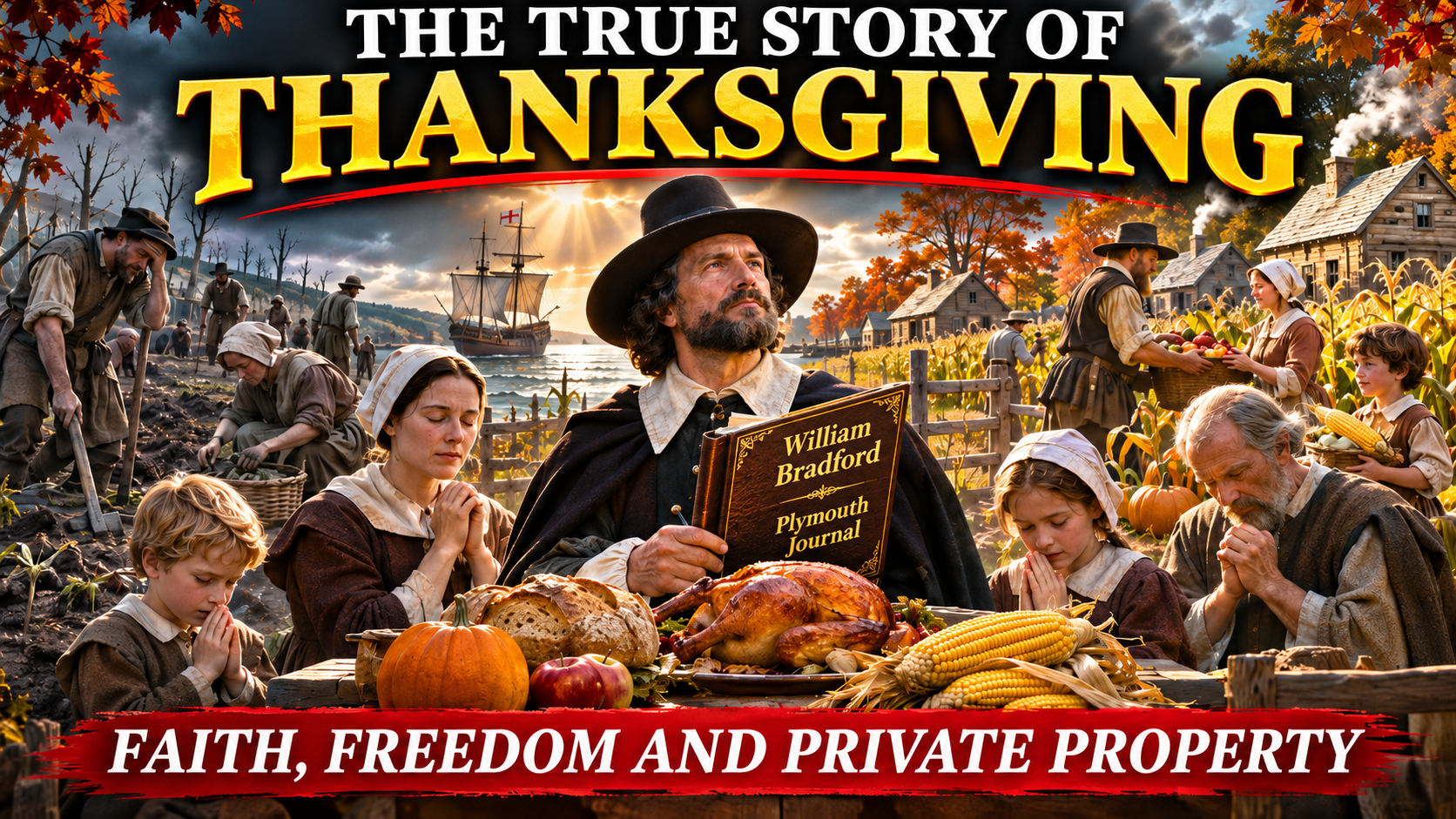
What the original historical documents reveal about the Pilgrims, their faith, the failure of communal farming, and the economic reforms that helped Plymouth Colony survive.
The Pilgrims’ Search for Religious Freedom
The story of the Pilgrims begins in the early seventeenth century, during the reign of King James I of England.
Religious Separatists who rejected the authority of the Church of England faced persecution, imprisonment, and restrictions on their freedom of worship.
A group of Separatists fled to the Netherlands, eventually establishing a community in Leiden. After approximately eleven years there, members of the congregation decided to undertake a perilous journey to North America, where they hoped to establish a community and worship God according to their religious convictions.
On September 6, 1620, according to the calendar then used in England, the Mayflower departed Plymouth on its final transatlantic voyage.
The ship carried 102 passengers, including members of the Separatist congregation and other settlers. Among their leaders was William Bradford, who would later become governor of Plymouth Colony.
Historical sources:
- State Library of Massachusetts — William Bradford’s original manuscript, Of Plimoth Plantation
- Plimoth Patuxet Museums — Mayflower and Mayflower Compact
The Mayflower Compact: Government by Agreement
Before establishing their settlement, the passengers confronted a fundamental question: how would their new community be governed?
On November 11, 1620, forty-one male passengers signed what became known as the Mayflower Compact.
The document established a civil political community empowered to enact:
Such just and equal laws
The agreement expressly invoked God, the advancement of the Christian faith, and the general welfare of the colony.
It represented an important early example of government founded upon mutual agreement rather than solely upon inherited political authority.
The Pilgrims’ understanding of collective obligations, covenant, moral responsibility, and government was deeply influenced by their religious beliefs and their reading of Scripture.
Although the Mayflower Compact did not establish religious equality in the modern constitutional sense, it became an important document in the development of American self-government.
Read the historical documents:
- Massachusetts State Library — The Mayflower Compact
- Library of Congress — The Mayflower Compact
- Library of Congress — The 400th Anniversary of the Mayflower Compact
The First Winter: The Price of Freedom
The voyage to North America was long and dangerous.
When the Pilgrims arrived in New England in November 1620, they faced conditions for which they were poorly prepared.
Bradford later described the absence of familiar accommodations, established European settlements, and friends who could provide immediate assistance.
The settlers confronted severe weather, disease, inadequate shelter, and food shortages.
Approximately half of the Mayflower passengers died during the first winter and the early months of 1621. Bradford himself lost his wife, Dorothy, who drowned while the ship was anchored off Cape Cod.
The following spring, relations with Indigenous peoples became essential to the settlement’s survival.
Tisquantum, commonly known as Squanto, helped the colonists adapt to local agricultural conditions. The settlers also established an alliance with the Wampanoag leader Ousamequin, commonly known as Massasoit.
Their assistance was an important part of Plymouth’s early survival.
The Thanksgiving Celebration of 1621
In the autumn of 1621, the settlers celebrated their harvest together with approximately ninety Wampanoag men.
Edward Winslow, who participated in the event, recorded the gathering in an account subsequently published in 1622 as Mourt’s Relation.
The celebration lasted three days.
The surviving documents establish that the settlers and Indigenous participants shared food and that the Wampanoag contributed deer to the gathering.
Religious gratitude was fundamental to the Pilgrims’ worldview. However, the historical record also establishes the importance of Indigenous assistance and cooperation.
These two elements of the story are not mutually exclusive.
What is less frequently discussed in popular accounts of Thanksgiving is the economic system under which the settlement initially operated and the changes Bradford introduced two years later.
Original historical accounts:
- Edward Winslow — Eyewitness Account of the 1621 Harvest Celebration
- Library of Congress — Historical Origins of Thanksgiving
- Library of Congress — Bradford’s and Winslow’s Accounts of the 1621 Celebration
Plymouth’s Economic Experiment: The Common Stock System
Before leaving Europe, the Pilgrims entered into a financial agreement with English merchant investors who helped finance their expedition.
The agreement established a joint-stock arrangement intended to continue for seven years.
Under its terms, the proceeds of the settlers’ labor, trade, fishing, and other economic activities were to be placed in a common stock.
The arrangement limited the settlers’ ability to benefit individually from their own productive efforts.
This was not modern Marxist socialism, which did not yet exist. It was a commercial partnership incorporating extensive communal labor and shared economic returns.
Nevertheless, its practical difficulties raise economic questions that remain relevant today: What happens when individual effort is disconnected from individual reward? How does collective production affect personal responsibility and motivation?
The original contractual provisions are preserved in Bradford’s historical account.
Primary source: William Bradford — Of Plimoth Plantation, Chapter 6: Agreement with the Merchant Adventurers.
William Bradford’s Economic Reform of 1623
By 1623, Plymouth continued to struggle with food insecurity and shortages of supplies.
Bradford and the colony’s leadership decided to change the organization of agricultural production.
Instead of requiring everyone to cultivate crops collectively, they assigned individual families their own plots of land on which to grow corn.
The initial allocation granted families the use of the land rather than permanent hereditary ownership. Other aspects of the colony’s economic arrangements initially continued.
The reform nevertheless introduced a crucial economic principle: families could benefit more directly from their own agricultural labor.
Bradford recorded that the change substantially improved participation and increased the amount of corn planted.
His historical account also describes resentment under the previous system, particularly among younger and more productive workers who felt that their efforts were not being fairly rewarded.
Bradford regarded the experience as a practical argument against eliminating individual property interests in favor of compulsory communal arrangements.
This was more than two centuries before Karl Marx published The Communist Manifesto in 1848.
Plymouth’s experience therefore provides an early American historical example of the economic importance of personal incentives, individual responsibility, and the relationship between labor and reward.
Read Bradford’s original account:
- William Bradford — Of Plimoth Plantation, Anno Domini 1623
- University of Chicago — The Founders’ Constitution: William Bradford on Property
What William Bradford Actually Wrote
Describing the results of the agricultural reforms, Bradford recorded:
This had very good success; for it made all hands very industrious.
The governor explained that the new arrangement resulted in substantially more corn being planted and greater satisfaction among the settlers.
His account is particularly significant because it is not a modern political commentary. It is the testimony of a leader who participated directly in the events and recorded the early history of Plymouth Colony.
Bradford’s criticism of communal economic arrangements was based on his observations of human behavior, incentives, and the practical difficulties of organizing collective labor.
For modern readers, the episode offers a historical basis for discussing the economic advantages of individual initiative.
It does not, by itself, establish that every form of collective economic organization must fail. Nor does it establish that the original economic arrangement was the sole cause of Plymouth’s food shortages.
Disease, supply disruptions, environmental conditions, and limited resources also played important roles.
Faith, Personal Responsibility, and the Biblical Tradition
The Pilgrims were deeply religious people whose understanding of work, responsibility, government, and prosperity was shaped by Scripture.
Bradford’s writings repeatedly interpret historical events through the concept of divine providence.
For the Pilgrims, gratitude to God was not limited to religious ceremonies. It was part of their understanding of everyday life, survival, and community.
The biblical account of Joseph in Genesis 41 also illustrates the importance of preparing for future scarcity during years of agricultural abundance.
Joseph advised Pharaoh to collect one-fifth of Egypt’s produce during seven prosperous years and store it against the coming famine.
The passage describes preparation and resource management. It does not describe a reduction of an existing tax rate.
The Pilgrims’ economic reforms can be examined alongside these broader religious ideas about stewardship, responsibility, and productive labor.
The Development of Private Property and Commerce
Plymouth’s economic transformation did not occur in a single year.
Further land allocations, commercial agreements, and changes to the relationship with the English merchant investors followed.
By 1627, additional land was being divided among settlers, and new arrangements were established to assume responsibility for the colony’s outstanding financial obligations.
Trade, including commerce with Indigenous communities, became important to Plymouth’s economic development.
These developments illustrate the gradual emergence of an economy in which individual enterprise, family production, commercial exchange, and collective obligations existed alongside one another.
Bradford’s account documents the difficulties of this transition and the importance of adapting economic institutions to practical experience.
Original documents:
- William Bradford — Of Plimoth Plantation, Anno Domini 1627
- William Bradford — Of Plimoth Plantation, Anno Domini 1641
George Washington’s Thanksgiving Proclamation of 1789
The religious significance of Thanksgiving is also unmistakable in the founding era of the United States.
On October 3, 1789, President George Washington issued a proclamation recommending Thursday, November 26, 1789, as a national day of thanksgiving and prayer.
Washington called upon Americans to thank God for the protection of the country, the establishment of constitutional government, peace, prosperity, and the blessings of civil and religious liberty.
His proclamation explicitly acknowledged divine providence.
Although Washington did not specifically refer to Bradford’s agricultural reforms or the Plymouth celebration of 1621, his proclamation established a clear connection between national thanksgiving, religious gratitude, constitutional government, and freedom.
Read the official documents:
- George Washington’s Thanksgiving Proclamation — Official White House Archive
- National Archives — Congress Establishes Thanksgiving
Abraham Lincoln and the National Thanksgiving Tradition
On October 3, 1863, during the American Civil War, President Abraham Lincoln issued a proclamation calling for a national day of thanksgiving.
Lincoln emphasized gratitude to God, national unity, compassion for those suffering from the war, and the restoration of peace.
In 1941, Congress established Thanksgiving as an annual federal holiday observed on the fourth Thursday of November.
The American Thanksgiving tradition therefore developed through several historical stages, combining harvest celebrations, religious gratitude, national reflection, and the country’s constitutional development.
Official sources:
- National Archives — Abraham Lincoln’s Thanksgiving Day Proclamation
- National Archives — Congressional Establishment of Thanksgiving
Thanksgiving: The Historical Timeline
| Year | Historical event |
|---|---|
| 1609 | Separatists establish their community in Leiden |
| 1620 | The Mayflower crosses the Atlantic |
| 1620 | The Mayflower Compact is signed |
| 1621 | Plymouth settlers establish an alliance with the Wampanoag |
| 1621 | The famous harvest celebration takes place |
| 1623 | Bradford introduces family-based agricultural production |
| 1627 | Additional land allocations and financial restructuring |
| 1789 | George Washington issues his Thanksgiving proclamation |
| 1863 | Abraham Lincoln establishes a national Thanksgiving observance |
| 1941 | Congress establishes the fourth Thursday of November as Thanksgiving |
The Economic Lesson of Thanksgiving
The traditional story of Thanksgiving often focuses on the Mayflower, the first winter, Indigenous assistance, and the harvest celebration of 1621.
These events are historically important.
But Plymouth’s subsequent economic transformation also deserves attention.
William Bradford’s decision to give families greater control over their agricultural production provides an early historical example of how personal incentives and responsibility can influence productivity.
His account offers a valuable contribution to discussions about individual enterprise, private property, and economic freedom.
The Pilgrims’ story cannot be reduced to a single political or economic explanation. Their survival involved faith, cooperation, Indigenous knowledge, adaptation, hard work, and institutional reform.
Thanksgiving is an opportunity to remember all these elements — including the religious convictions that inspired the Pilgrims and the economic lessons they recorded for future generations.
Frequently Asked Questions
Did the Pilgrims experiment with socialism?
They operated under a commercial joint-stock agreement involving communal labor and shared economic returns. Although it differed from modern socialism, Bradford’s criticism of the system is relevant to debates about collectivism and individual economic incentives.
When did William Bradford introduce private farming?
In 1623, two years after the famous harvest celebration of 1621, families received individual plots for agricultural use.
Did the reform increase production?
Bradford reported that the new arrangement increased participation in agricultural labor and resulted in more corn being planted.
Did the Pilgrims give thanks to God?
Religious gratitude and belief in divine providence were central to their worldview, as documented in Bradford’s historical account.
Did Native Americans help the Pilgrims survive?
Yes. Indigenous agricultural knowledge, cooperation, and the alliance with the Wampanoag contributed substantially to the settlement’s early survival.
Did George Washington establish Thanksgiving as a religious observance?
His 1789 proclamation expressly recommended a day of thanksgiving and prayer to God. It was a presidential recommendation, not a requirement that every American participate in religious worship.
Original Historical Documents and Primary Sources
- William Bradford’s original manuscript — State Library of Massachusetts
- The original economic agreement of 1620 — Bradford’s manuscript
- The Mayflower Compact — Library of Congress
- Edward Winslow’s eyewitness account of the 1621 harvest
- William Bradford’s economic reforms of 1623
- William Bradford on property — University of Chicago
- Plymouth’s economic arrangements in 1627
- George Washington’s Thanksgiving Proclamation of 1789
- Abraham Lincoln’s Thanksgiving Proclamation of 1863
- National Archives — Congress Establishes Thanksgiving
Editorial verification — November 27, 2026
This article draws upon original seventeenth-century historical accounts, government archives, presidential proclamations, and scholarly editions of William Bradford’s manuscript. Documented historical events are distinguished from modern economic interpretations.
Reader discussion
Discuss the reporting. Links in comments are automatically removed.
Be the first to comment.
To comment, sign in with an enabled social account or sign in / register.
Ask Midtown Tribune about this story
Answers are grounded first in this article. Search all Midtown Tribune reporting from the main AI Search page.
AI-generated summary. Verify important details in the linked original articles.