
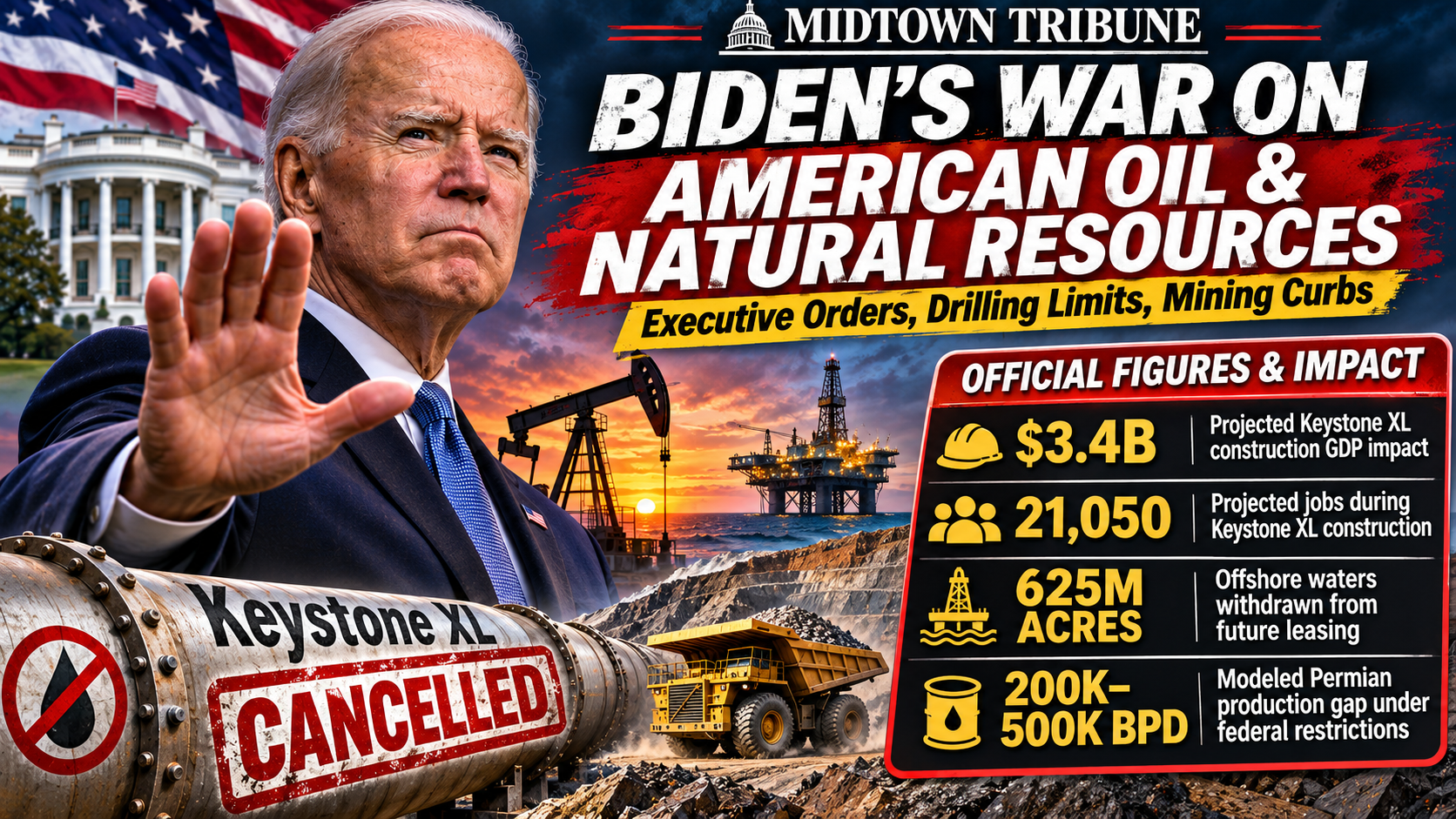
From Keystone XL to the withdrawal of more than 625 million offshore acres: A comprehensive examination of Biden administration energy and mineral policies, using official federal documents, production statistics, employment figures, and economic assessments.
Midtown Tribune | Special Investigative Report | January 20, 2021 – January 20, 2025
Introduction: Four Years of Federal Energy Policy
On January 20, 2021, President Joe Biden revoked the presidential permit for the Keystone XL pipeline. Seven days later, he directed the Department of the Interior to pause new federal oil and natural gas leasing while conducting a review.
Those decisions marked the beginning of a broader shift in American energy policy.
Over the following four years, the Biden administration restricted new leasing in parts of Alaska, reduced the number of scheduled offshore oil and gas auctions, increased financial obligations for federal drilling, tightened methane regulations, adopted new requirements for coal-fired power plants, temporarily paused certain liquefied natural gas export approvals, and withdrew large federal offshore areas from future petroleum leasing.
The administration also took actions affecting hardrock mining, including copper, nickel, gold, and other mineral resources.
Critics characterized these policies as a “war on American energy,” arguing that they limited domestic resource development and increased uncertainty for investors.
The Biden administration defended its decisions as measures to protect public lands and water, address climate change, reduce pollution, and ensure that companies bore the costs of their operations.
The essential economic question is whether these government decisions reduced American investment and resource-development opportunities compared with what the country could have achieved under the same market conditions without those restrictions.
This investigation distinguishes documented government actions, actual economic outcomes, and hypothetical estimates of lost opportunities.
PART I. 2021 — The First Executive Orders and Federal Restrictions
January 20, 2021 — Executive Order 13990: Keystone XL and Arctic Energy
Biden’s Executive Order 13990 introduced several important changes.
Section 6 — Keystone XL: Revoked the March 2019 presidential permit authorizing the pipeline’s facilities at the U.S.–Canada border.
Section 4(a) — Arctic National Wildlife Refuge: Directed a temporary moratorium on federal activities implementing the Coastal Plain oil and gas leasing program, pending review.
Section 4(b) — Arctic and Bering Sea: Restored earlier offshore leasing withdrawals.
Section 2 — Regulatory reviews: Directed agencies to review Trump-era regulations, including energy-related environmental rules.
Section 5 — Social Cost of Greenhouse Gases: Reestablished a federal process for assigning monetary values to estimated damages associated with greenhouse gas emissions, for use in government decision-making.
The executive order also revoked several Trump-era directives supporting energy development and infrastructure permitting.
Official source: Executive Order 13990 — Federal Register.
January 27, 2021 — Executive Order 14008: Federal Leasing and Fossil-Fuel Financing
Executive Order 14008 established additional administration-wide energy priorities.
Its relevant provisions included:
| Section | Action |
|---|---|
| §102(h) | Directed identification of steps to promote ending international financing of carbon-intensive fossil-fuel energy |
| §205 | Directed federal clean-electricity and vehicle procurement planning |
| §207 | Directed review of renewable-energy permitting on federal lands and waters |
| §208 | Directed a pause in new federal oil and natural gas leases, consistent with applicable law, pending review |
| §209 | Directed identification and review of federal fossil-fuel subsidies |
| §210 | Prioritized federal clean-energy investments |
| §213 | Directed consideration of climate impacts in infrastructure decisions |
| §§217–218 | Established policies and interagency coordination for communities affected by the energy transition |
Section 208 did not prohibit all existing drilling. The immediate focus was new federal leasing.
Similarly, provisions concerning international financing did not prohibit American private banks from lending to domestic oil and gas companies.
Official source: Executive Order 14008 — GovInfo.
Additional Federal Actions in 2021
During the same year:
- Interior Secretarial Order 3395 temporarily centralized approval of numerous federal energy authorizations.
- The Bureau of Land Management deferred several federal oil and gas lease auctions.
- BOEM rescinded its earlier decision concerning Gulf of Mexico Lease Sale 257, which was subsequently conducted in November 2021.
- Interior suspended implementation of the Arctic Refuge oil and gas leasing program, affecting nine leases covering more than 430,000 acres.
- Biden signed congressional legislation reversing a Trump-era methane regulatory rollback.
- The Treasury Department issued guidance restricting U.S. support for most fossil-fuel energy projects through multilateral development banks, with exceptions.
- EPA proposed expanded methane regulations for the petroleum and natural gas sector.
- Interior recommended changes to federal royalty rates, bonding requirements, and leasing practices.
These actions did not all have identical legal effects. Some were final decisions, others were temporary restrictions or proposed rules.
Sources: Department of the Interior, BLM, EPA, BOEM, and U.S. Treasury.
PART II. 2022 — Federal Leasing Reform and Restrictions on Mineral Development
January 26, 2022 — Twin Metals Mineral Leases Canceled
The Department of the Interior canceled two mineral leases held by Twin Metals Minnesota.
The department concluded that the leases had been improperly renewed in 2019.
The decision affected a proposed copper-nickel mining development near the Boundary Waters Canoe Area Wilderness.
The government argued that the previous renewals were legally deficient. The company disputed that interpretation.
Economic significance: The decision affected the legal basis for a proposed domestic mineral development project. However, the leases were not supporting an operating mine, so the action should not be described as an immediate loss of existing mineral production.
Official source: Department of the Interior — Twin Metals Mineral Lease Decision, January 26, 2022.
February 2022 — Federal Mining Law Reform Initiative
Interior established an interagency working group to examine reforms to U.S. mining laws, regulations, and permitting processes.
The initiative concerned hardrock minerals, including copper, gold, silver, lithium, uranium, and other resources.
The administration described its objective as encouraging environmentally responsible domestic mineral production.
Mining companies and critics raised broader concerns about regulatory complexity and the costs of obtaining approvals.
The creation of the working group was not itself a prohibition on mining.
Official source: Department of the Interior — Mining Reform Working Group.
August 16, 2022 — Inflation Reduction Act
President Biden signed the Inflation Reduction Act, which changed several financial conditions affecting fossil-fuel development.
Among its provisions:
- The minimum royalty rate for new federal onshore oil and gas leases increased from 12.5% to 16.67%.
- Minimum bids and rental charges increased.
- Noncompetitive federal oil and gas leasing was eliminated.
- A statutory methane waste emissions charge was established for covered facilities exceeding specified thresholds.
- Substantial federal tax incentives were created for cleaner energy technologies.
These changes increased certain costs associated with acquiring or operating federal oil and gas resources.
However, the legislation also required specific federal oil and gas lease sales and linked offshore renewable-energy leasing to offshore oil and gas leasing.
It was therefore not a comprehensive statutory prohibition on fossil-fuel development.
Official source: Congress.gov — Inflation Reduction Act, Public Law 117-169.
September 12, 2022 — Executive Order 14082
Biden issued Executive Order 14082 to coordinate implementation of the energy and infrastructure provisions of the Inflation Reduction Act.
The order supported federal clean-energy investment priorities and implementation of the new legislation.
It was not itself a direct drilling ban.
Official source: Federal Register — Executive Order 14082.
PART III. 2023 — New Arctic, Offshore, and Mineral Restrictions
January 26, 2023 — 225,504 Acres Withdrawn from Mineral Leasing in Minnesota
Interior Secretary Deb Haaland signed Public Land Order 7917.
The order withdrew approximately 225,504 acres in the Superior National Forest in northeastern Minnesota from specified mineral and geothermal leasing activities for 20 years, subject to valid existing rights.
The decision affected future mineral development opportunities in the Boundary Waters watershed.
The administration cited water quality, wildlife, tribal rights, and the regional recreation economy.
The withdrawal did not establish that all 225,504 acres contained commercially recoverable mineral deposits.
Official source: Interior — Boundary Waters Mineral Withdrawal.
January 30, 2023 — EPA Restricts Pebble Mine Development in Alaska
EPA issued a final determination under Section 404(c) of the Clean Water Act limiting the use of specified Bristol Bay watershed waters for discharges associated with mining the Pebble deposit.
The proposed project involved a major copper-gold-molybdenum resource.
The decision presented a substantial regulatory obstacle to the proposed mine.
EPA cited potential adverse effects on aquatic resources and the Bristol Bay salmon ecosystem.
Economic distinction: The action restricted a proposed project. It did not close an operating mine, and the value of mineral resources in the ground cannot automatically be treated as the amount of economic damage.
Official source: EPA — Pebble Deposit Final Determination.
March 2023 — Beaufort Sea Offshore Oil Leasing Withdrawal
President Biden withdrew approximately 2.8 million acres of the Beaufort Sea from future oil and gas leasing.
The action was taken under the Outer Continental Shelf Lands Act.
It was part of broader Arctic conservation measures and did not terminate existing production elsewhere in Alaska.
Official source: Department of the Interior — Arctic Offshore Protections.
June 2, 2023 — Chaco Canyon Mineral Withdrawal
Interior established a 20-year withdrawal affecting federal mineral development within approximately ten miles of Chaco Culture National Historical Park in New Mexico.
The action restricted new federal oil and gas leasing and new mining claims within the designated area, subject to valid existing rights.
Interior stated that new oil and gas leases had not been issued inside the buffer for approximately a decade.
The department also estimated that the withdrawal could reduce San Juan Basin oil production by approximately 2.5%, with a smaller effect on natural gas production.
That was an agency estimate of future effects, not an observed production loss.
Official source: Department of the Interior — Chaco Region Protections.
September 6, 2023 — Seven Arctic Refuge Oil and Gas Leases Canceled
The Interior Department authorized cancellation of the seven remaining leases originating from the January 2021 Arctic Refuge sale.
Two other leases had previously been canceled at the request of their holders.
The administration cited alleged legal deficiencies in the earlier leasing process, including the environmental review.
This decision went further than the original temporary suspension in 2021.
It canceled the remaining previously issued leases.
Official source: Department of the Interior — Arctic Refuge Lease Cancellations.
December 2, 2023 — EPA Finalizes Expanded Methane Rules
EPA finalized regulations addressing methane and other emissions from new and existing oil and natural gas sources.
The rule introduced or strengthened requirements involving:
- Methane leak detection and repair;
- Equipment standards;
- Venting and flaring;
- Emissions monitoring;
- Existing oil and gas facilities through the applicable regulatory framework.
These requirements affected operational practices and compliance costs for covered facilities.
EPA also projected environmental and health benefits, which belong in a complete net-benefit analysis.
Official source: EPA — Final Methane Standards.
December 2023 — Fewest Offshore Oil and Gas Lease Sales in a Five-Year Program
Interior finalized the National Outer Continental Shelf Oil and Gas Leasing Program for 2024–2029.
The program scheduled only three potential offshore oil and gas lease sales, all in the Gulf of Mexico:
- 2025;
- 2027;
-
Interior described this as the fewest scheduled lease sales in the history of the federal five-year offshore program.
The earlier draft proposal under the Trump administration had considered as many as 47 offshore lease sales, although that draft was never a finalized 47-sale program.
The reduction in scheduled future auctions represented a change in federal offshore development opportunities.
Official source: Interior — Final Offshore Leasing Program 2024–2029.
PART IV. 2024 — LNG, Federal Drilling Costs, Coal Power, and Mining Access
January 26, 2024 — Pause on Certain LNG Export Approvals
The Biden administration announced a temporary pause in pending decisions on applications to export liquefied natural gas to countries without U.S. free-trade agreements.
The Department of Energy said it needed to update economic and environmental analyses used in its approval process.
Existing export authorizations remained in effect.
The pause did not prohibit all LNG exports, nor did it automatically stop domestic natural gas production.
Nevertheless, it created regulatory uncertainty for some proposed LNG export projects seeking new authorizations.
Economic consequence: The action could affect investment timing in export infrastructure and anticipated demand for natural gas. The precise investment losses attributable to the pause require project-level analysis.
Official source: Department of Energy — LNG Export Approval Pause.
April 2024 — BLM Waste Prevention Rule
The Bureau of Land Management finalized the Waste Prevention, Production Subject to Royalties, and Resource Conservation Rule.
The regulation addressed the loss of natural gas through venting, flaring, and leaks from federal and tribal oil and gas operations.
It established requirements intended to reduce wasted gas and associated environmental effects.
For operators, compliance could involve equipment upgrades, operational changes, and reporting obligations.
Official source: BLM — Waste Prevention Rule.
April 12, 2024 — Higher Federal Oil and Gas Leasing Costs
Interior finalized major changes to BLM’s federal onshore oil and gas leasing regulations.
The changes included increased bonding requirements and implementation of statutory leasing reforms.
The minimum individual lease bond rose from $10,000 to $150,000, while the minimum statewide bond increased to $500,000.
The administration argued that higher bonding would reduce the risk of taxpayers paying to clean up abandoned wells.
For companies, the changes increased certain financial-assurance obligations associated with federal resource development.
These bond amounts should not be interpreted as equivalent to immediate cash losses, since financial assurance can be provided through qualifying instruments rather than necessarily tying up the entire amount in cash.
Official source: Department of the Interior — Federal Oil and Gas Leasing Rule.
April 15, 2024 — Offshore Financial Assurance Requirements Increased
The Bureau of Ocean Energy Management finalized new requirements addressing financial responsibility for decommissioning offshore oil and gas infrastructure.
The objective was to reduce potential taxpayer exposure if operators failed to meet their obligations.
The new requirements could increase bonding and related costs for affected offshore companies.
A subsequent Interior Department announcement estimated that the 2024 rule could require approximately $6.9 billion in additional financial assurance, with approximately $665 million in annual premiums.
These figures describe estimated bonding exposure and recurring financial costs, not proven lost production or a direct taxpayer expenditure.
Sources:
DOI — Offshore Financial Assurance Rule, April 2024
DOI — Subsequent Review of the 2024 Financial Assurance Rule.
April 18, 2024 — Public Lands Rule
BLM finalized the Conservation and Landscape Health Rule.
The regulation clarified the role of conservation, restoration, land health, and designated Areas of Critical Environmental Concern in federal land management.
The rule could influence decisions involving mineral extraction and other uses of public lands.
It did not create a universal prohibition on mining or oil and gas development.
Official source: Department of the Interior — Public Lands Rule.
April 19, 2024 — New Restrictions in Alaska’s National Petroleum Reserve
Interior finalized regulations providing stronger protections for approximately 13.3 million acres of Special Areas within the National Petroleum Reserve–Alaska.
The regulation limited future oil and gas leasing and industrial development in designated areas.
The protected areas included habitats important to wildlife and Alaska Native subsistence activities.
Although the protected acreage was substantial, it was not equivalent to removing 13.3 million acres of active oil production.
Official source: Interior — National Petroleum Reserve–Alaska Rule.
April 25, 2024 — Major EPA Rules for Coal- and Gas-Fired Power Plants
EPA finalized a package of environmental standards affecting fossil-fuel electricity generation.
The package included new greenhouse gas standards for existing coal-fired power plants and certain new gas-fired generating units.
For long-running existing coal plants and covered new baseload natural gas plants, the rules incorporated a standard based on achieving approximately 90% carbon dioxide capture.
The package also included additional requirements involving mercury, hazardous air pollutants, coal ash, and wastewater.
These regulations could significantly influence the future economics of fossil-fuel power generation.
They regulated power plants rather than directly prohibiting coal mining or natural gas extraction.
The economic effects on mining and gas production would therefore arise primarily through electricity-sector demand, plant investment decisions, and compliance costs.
Official sources:
EPA — Fossil Fuel Power Plant Greenhouse Gas Standards
EPA — April 2024 Power Plant Regulatory Package.
June 27, 2024 — Ambler Road Mining Access Project Rejected
The Department of the Interior selected the No Action Alternative for the proposed Ambler Road in Alaska.
The proposed 211-mile industrial access road would have provided access to the Ambler Mining District.
The region contains substantial mineral resources, including copper and other metals.
The administration cited environmental impacts and concerns affecting Alaska Native communities.
Economic consequence: The decision prevented the proposed road from proceeding under that federal approval, limiting the planned infrastructure route for future mineral development.
There were no active mines in the area at the time. The decision therefore should not be described as shutting down an operating mining district.
Official source: Department of the Interior — Ambler Road Decision.
2024 — Thompson Divide Mineral Withdrawal, Colorado
Interior signed Public Land Order 7939, withdrawing approximately 221,898 acres from specified mining and mineral leasing activities for 20 years, subject to valid existing rights.
The measure covered portions of the Thompson Divide region.
Interior stated that the area had already been unavailable for oil and gas leasing for several years and that existing leases were not affected.
Consequently, the economic effect should be assessed as a restriction on certain future opportunities, not a closure of existing production.
Official source: Department of the Interior — Thompson Divide Protections.
November 2024 — Federal Coal Leasing Plans in Wyoming and Montana
BLM approved amendments affecting federal coal leasing within the Buffalo Field Office in Wyoming and the Miles City Field Office in Montana.
The Buffalo amendment made no federal coal available for new leasing under the approved planning framework.
The Miles City amendment also restricted future leasing, although its treatment of pending applications and particular areas differed.
These planning decisions affected future federal coal leasing opportunities rather than immediately terminating all existing mines.
Both amendments were subsequently disapproved under the Congressional Review Act in December 2025. That later reversal does not change the fact that the Biden administration adopted the original decisions in November 2024.
Official records:
BLM — Buffalo Field Office Record of Decision
BLM — Miles City Field Office Record of Decision.
November 2024 — Methane Waste Emissions Charge
EPA finalized implementation rules for the methane waste emissions charge established by the Inflation Reduction Act.
The statutory framework established charges for covered emissions exceeding specified thresholds.
The initial statutory rate was $900 per metric ton for 2024 emissions, rising to $1,200 for 2025 and $1,500 for 2026 and subsequent years, subject to the program’s conditions and exemptions.
The charge affected covered petroleum and natural gas facilities, rather than every producer or every ton of natural gas extracted.
Official source: EPA — Methane Emissions Reduction Program.
PART V. January 2025 — Biden’s Final Offshore Oil and Gas Withdrawal
January 6, 2025 — More Than 625 Million Offshore Acres Withdrawn
Two weeks before leaving office, President Biden announced withdrawals covering more than 625 million acres of U.S. offshore waters from future oil and natural gas leasing.
The withdrawals covered extensive areas of the Atlantic and Pacific coasts, portions of the eastern Gulf of Mexico, and other waters.
The actions used presidential authority under Section 12(a) of the Outer Continental Shelf Lands Act.
The administration presented the withdrawals as protection against future offshore drilling risks.
These actions did not terminate existing offshore production or remove the three potential Gulf of Mexico lease sales included in the 2024–2029 program.
Nevertheless, their geographic extent made them among the largest federal offshore leasing withdrawals in American history.
625 million acres represent the geographic scope of the withdrawal, not 625 million acres of proven economically recoverable oil and gas reserves.
Official source: Department of the Interior — January 6, 2025 Offshore Withdrawal.
January 2025 — Arctic Refuge Lease Sale Received No Bids
Interior announced that the congressionally required Arctic Refuge lease sale received no bids.
This outcome must be distinguished from an order canceling the sale.
It illustrates the importance of separating federal leasing restrictions from the commercial willingness of companies to acquire leases under prevailing conditions.
Official source: Department of the Interior — Arctic Refuge Lease Sale Results.
PART VI. Economic Consequences: What Can Be Established from Official Data?
Keystone XL — $3.4 Billion in Forecast Construction GDP Contribution
The Department of Energy’s retrospective report included earlier government estimates of:
- $3.4 billion in projected U.S. GDP contribution from construction;
- $2.05 billion in projected labor income;
- 3,900 direct construction jobs;
- 21,050 total direct, indirect, and induced jobs annually during the projected two-year construction period.
These are official project estimates, not a verified net national loss of $3.4 billion.
The permit revocation and subsequent termination of the project are documented.
Source: DOE — Keystone XL Economic and Employment Assessment.
Federal Drilling Restrictions — Dallas Fed’s Production Scenarios
In March 2021, economists at the Federal Reserve Bank of Dallas examined possible consequences of federal leasing restrictions in the Permian Basin.
Their scenarios indicated that continued restrictions could result in approximately 200,000 to 500,000 fewer barrels of daily production by late 2025 compared with specified baselines.
These were conditional modeling results, not measured losses in 2021 or final estimates of actual Biden administration policy impacts.
At an illustrative price of $70 per barrel, those modeled production differences would represent approximately $5.11 billion to $12.78 billion in annual gross oil value.
They would not represent equivalent profits or verified damages.
Source: Dallas Fed — Anticipated Federal Restrictions Would Slow Permian Basin Production.
Offshore Bonding Requirements — Estimated Financial Burden
The 2024 BOEM financial-assurance rule was later described by Interior as imposing an estimated $6.9 billion in additional bonding requirements and $665 million in annual premiums.
These values are relevant when investigating changes in the cost of offshore development.
However, bond requirements are not equivalent to lost production, and the estimate does not establish that every dollar of additional financial assurance reduced drilling investment dollar for dollar.
Source: Interior — Review of Offshore Financial Assurance.
Oil Production Increased During Biden’s Presidency
Despite the restrictions documented above, U.S. crude oil production increased and reached an annual record of approximately 13.2 million barrels per day in 2024, according to EIA.
This is an important factual counterpoint.
It demonstrates that the administration did not prohibit domestic oil production nationwide.
It does not, by itself, establish whether output would have been higher or lower under a different set of federal policies.
Market recovery, shale productivity, existing leases, private-land drilling, investment decisions, and global prices all contributed to actual production trends.
Source: EIA — U.S. Crude Oil Production Statistics.
Coal Production and Employment
Coal output recovered in 2021 after the pandemic-related decline, but the industry continued facing long-term structural pressures.
Coal mining employment declined during the first year of Biden’s presidency, even as output increased.
Subsequent federal coal leasing and power-plant regulations changed the environment for future coal development and electricity generation.
The extent to which those policies contributed to employment losses or mine closures requires separate causal analysis.
Sources: EIA Coal Statistics and BLS Employment Statistics.
PART VII. The Cumulative Scale of Federal Resource Restrictions
Selected Biden administration actions covered large geographic areas:
| Action | Acreage affected | Primary effect |
|---|---|---|
| January 2025 offshore withdrawals | More than 625 million acres | Restriction on future offshore oil and gas leasing |
| April 2024 NPR–Alaska Special Areas rule | 13.3 million acres | Additional protections limiting future leasing and development |
| March 2023 Beaufort Sea withdrawal | Approximately 2.8 million acres | Future offshore oil and gas leasing withdrawal |
| January 2023 Boundary Waters withdrawal | 225,504 acres | Twenty-year mineral and geothermal leasing withdrawal |
| 2024 Thompson Divide withdrawal | 221,898 acres | Twenty-year restrictions on specified mineral activities |
| January 2021 Arctic Refuge leases | More than 430,000 acres | Suspended in 2021; remaining seven leases canceled in 2023 |
These acreage figures should not be added together to claim a unique total of economically recoverable resources lost.
Some geographic areas overlap, different legal restrictions apply, and the extent of economically viable mineral deposits varies substantially.
The figures document the geographic reach of federal decisions, not the value of proven reserves or actual damages.
PART VIII. Was Biden’s Policy Responsible for Lost Economic Growth?
The evidence supports several distinct findings.
First, the federal government directly revoked or canceled certain project authorizations and mineral leases.
Second, regulations and leasing decisions changed future development opportunities and financial requirements for oil, gas, coal, and mineral companies.
Third, some energy executives reported that federal policy uncertainty negatively influenced their investment planning.
Fourth, U.S. oil production nevertheless increased during the Biden years, demonstrating that market conditions and private-sector development continued to support substantial production.
A rigorous damage calculation would require comparing observed investment and production with a credible counterfactual scenario, controlling for commodity prices, financing conditions, geological productivity, equipment availability, and the long-term effects of earlier development decisions.
A dollar value assigned to a forecast production gap cannot automatically be characterized as economic damage already suffered.
Likewise, higher compliance costs may be partly offset by reduced pollution, recovered gas, lower environmental liabilities, or other economic benefits that must be considered in a net-impact calculation.
A complete economic investigation must measure both costs and benefits rather than assume one from the existence of a regulation.
Conclusion: Four Years of Restrictions and Their Economic Significance
Between January 20, 2021, and January 20, 2025, the Biden administration adopted numerous executive, regulatory, and administrative measures that changed the conditions for American energy and mineral development.
The measures included the Keystone XL permit revocation, restrictions on new federal oil and gas leasing, the cancellation of Arctic Refuge leases, new limits on mining opportunities, additional environmental regulations, increased financial-assurance requirements, a temporary pause on certain LNG export approvals, and the withdrawal of more than 625 million offshore acres from future leasing.
Those policies formed part of a larger federal strategy emphasizing climate objectives, conservation, and clean-energy investment.
Their consequences were not uniform.
Some eliminated or delayed identifiable projects. Others raised compliance costs or changed future investment opportunities. Several applied only to specific regions, facilities, or categories of leases.
At the same time, American crude oil production reached record levels in 2024, and substantial fossil-fuel development continued.
The official record therefore establishes an extensive sequence of federal restrictions and regulatory changes, but it does not establish a single verified dollar total for nationwide losses attributable to those policies.
The critical unresolved economic question is how much additional American energy and mineral development could have occurred under the same market conditions without these specific federal restrictions.
Answering it requires project-level financial evidence and a credible comparison with alternative policy scenarios.
That distinction between documented decisions, measurable costs, and potential lost opportunities is essential to evaluating the full economic legacy of the Biden administration’s energy policies.
Primary U.S. Government Sources
Presidential orders and federal leasing
- Executive Order 13990 — Federal Register
- Executive Order 14008 — GovInfo
- Executive Order 14082 — Federal Register
- Interior — 2024–2029 Offshore Oil and Gas Leasing Program
- Interior — January 2025 Offshore Withdrawal
Oil, gas, Alaska, and LNG
- DOE — Keystone XL Economic Report
- Interior — Arctic Refuge Lease Cancellations
- Interior — Alaska NPR–A Rule
- DOE — January 2024 LNG Pause
- Interior — 2024 Onshore Leasing Rule
- Interior — 2024 Offshore Financial Assurance Rule
Coal and environmental regulation
- EPA — Methane Regulations
- EPA — Fossil Fuel Power Plant Greenhouse Gas Standards
- EPA — Methane Emissions Reduction Program
Mining and minerals
- Interior — Twin Metals Leases
- Interior — Boundary Waters Withdrawal
- EPA — Pebble Mine Final Determination
- Interior — Thompson Divide Withdrawal
- Interior — Ambler Road Decision
- BLM — Buffalo Coal Leasing Amendment
Economic and statistical evidence
- Federal Reserve Bank of Dallas — Federal Leasing Economic Scenarios
- Dallas Fed — Fourth Quarter 2021 Energy Survey
- EIA — Crude Oil Production
- EIA — Coal Statistics
- Bureau of Labor Statistics — Employment Data
Editorial note: The report documents Biden-era decisions as originally adopted. Several were modified, challenged, reversed, or rescinded during subsequent administrations. Projected economic impacts and regulatory compliance estimates are identified separately from observed production and employment data.
Reader discussion
Discuss the reporting. Links in comments are automatically removed.
Be the first to comment.
To comment, sign in with an enabled social account or sign in / register.
Ask Midtown Tribune about this story
Answers are grounded first in this article. Search all Midtown Tribune reporting from the main AI Search page.
AI-generated summary. Verify important details in the linked original articles.