
November 22, 2026 | Midtown Tribune | International Affairs
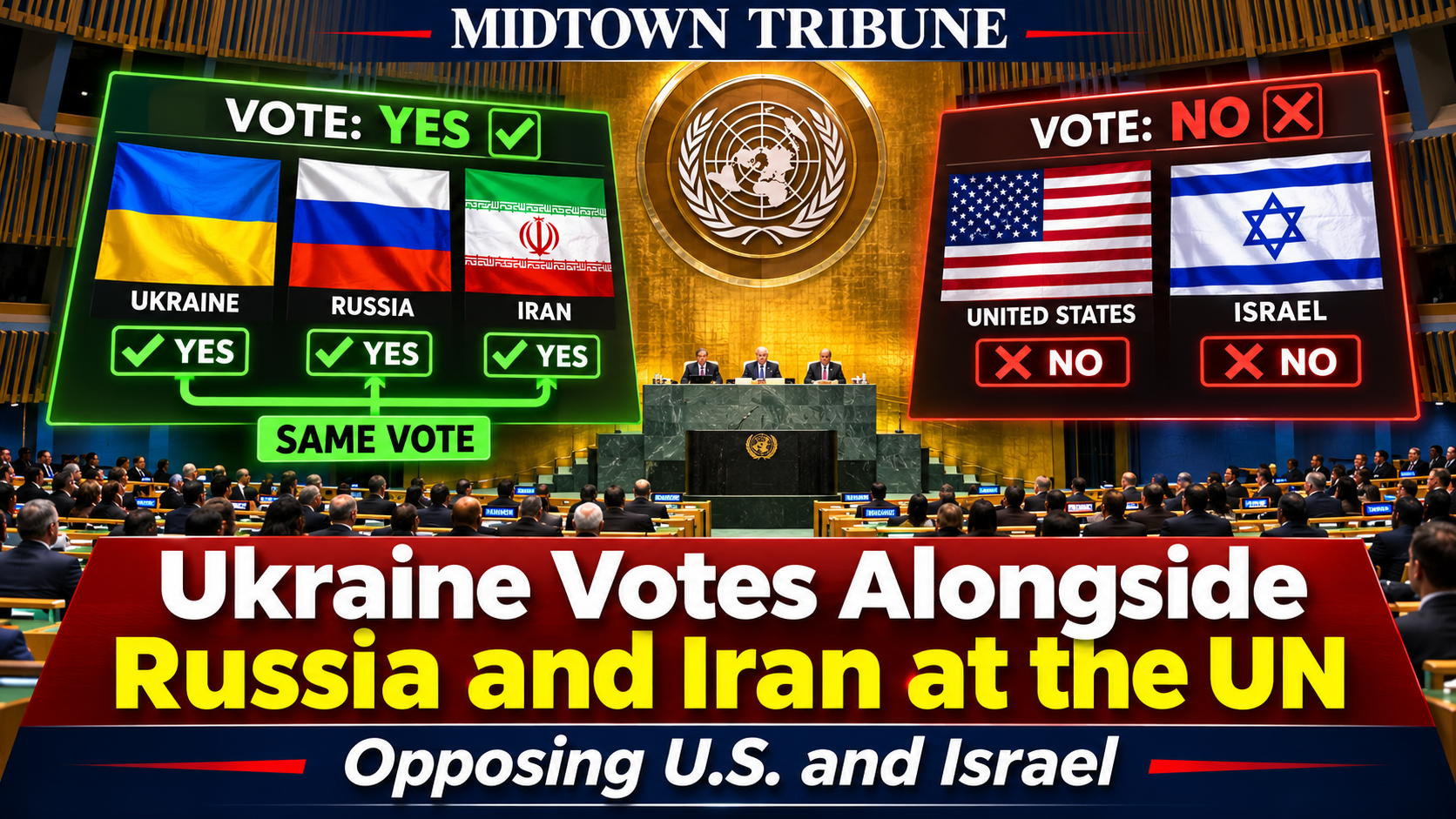
Ukraine’s reported vote alongside Russia and Iran on Palestinian self-determination highlights a disagreement with Washington and Jerusalem, reviving President Donald Trump’s warnings about American assistance to countries that oppose U.S. positions at the United Nations.
Ukraine, Russia and Iran on the Same Side of a UN Vote
NEW YORK — On November 19, 2026, the United Nations General Assembly’s Third Committee approved a draft resolution reaffirming the Palestinian people’s right to self-determination, including the establishment of an independent Palestinian state.
The resolution, identified as A/C.3/81/L.21, passed by 162 votes in favor, eight against and eight abstentions.
The United States and Israel voted against the measure.
Ukraine, Russia and Iran were reported among the countries supporting it.
The result places Ukraine on the same side of a significant diplomatic vote as Russia, the country conducting a war against it, and Iran, which has provided military support to Moscow.
However, the resolution also received overwhelming international support. Agreement on this particular issue does not establish a broader political alliance between those governments.
According to the official United Nations announcement of November 19, 2026, the eight countries voting against the resolution were Argentina, Israel, Micronesia, Nauru, Palau, Papua New Guinea, Paraguay and the United States.
The eight abstaining countries were Cameroon, Colombia, Ecuador, Fiji, the Marshall Islands, Panama, Samoa and Togo.
The resolution was approved by the Third Committee and had not, at that stage, received final adoption by the full General Assembly.
The reported alignment raises an important question about the foreign policy of President Volodymyr Zelensky’s administration: how does Ukraine reconcile its diplomatic decisions with its continued requests for American military, financial and political support?
Trump Warned That Countries Opposing America Should Not Expect Unconditional Aid
The November vote recalls an explicit warning delivered by President Donald Trump during his first administration.
In his January 30, 2018, State of the Union Address, Trump criticized countries that had opposed the American decision to recognize Jerusalem as Israel’s capital while receiving substantial U.S. assistance.
He asked Congress to pursue legislation connecting American foreign assistance more closely to national interests.
His statement was direct:
“American foreign-assistance dollars always serve American interests.”
Trump argued that taxpayers should not be expected to finance governments whose conduct consistently conflicts with American priorities.
The full statement is preserved in the official White House archive of the 2018 State of the Union address.
Trump repeated the principle on September 25, 2018, before the United Nations General Assembly.
He declared:
“Moving forward, we are only going to give foreign aid to those who respect us and, frankly, are our friends.”
The statement appears in the official transcript of Trump’s address to the 73rd United Nations General Assembly.
These statements reflected a political doctrine, not an automatic legal prohibition on helping countries that occasionally disagree with Washington.
Nevertheless, they establish that Trump has previously identified voting behavior at international institutions as a legitimate consideration in American foreign-assistance policy.
For Ukraine, the relevance is immediate.
If Washington places greater emphasis on diplomatic reciprocity, Kyiv’s record at the United Nations could become one factor in decisions concerning future cooperation and assistance.
Whether any particular vote should affect military assistance is a separate question involving American national-security priorities and applicable law.
What Did Ukraine Support?
The November 19 draft addressed the Palestinian people’s right to self-determination and the establishment of an independent state.
The measure follows a long series of United Nations resolutions concerning Palestinian statehood and the Israeli-Palestinian territorial dispute.
The preceding resolution adopted by the General Assembly in December 2025 explicitly addressed ending Israeli occupation that began in 1967.
That text is available through the United Nations document A/RES/80/195.
The November 2026 draft can be accessed under UN document A/C.3/81/L.21.
The territorial question extends beyond contemporary politics.
It concerns lands known in Jewish history as Judea and Samaria, territories that were under Jordanian control from 1948 until Israel took control during the Six-Day War in June 1967.
Israel’s historical interpretation differs substantially from the language generally used in United Nations resolutions.
Judea and Samaria: Territories Recovered From Jordanian Control in 1967
The West Bank is known in Hebrew and Jewish historical tradition as Judea and Samaria.
These names long predate the creation of the modern State of Israel.
Following the 1948 Arab-Israeli War, Jordan gained control of the West Bank and East Jerusalem.
Jordan formally annexed the West Bank in 1950, although the annexation received extremely limited international recognition.
For approximately nineteen years, the territories remained under Jordanian administration.
Jewish communities, including those in the Gush Etzion area, had been displaced during the 1948 war.
Access to Jewish holy sites in East Jerusalem was severely restricted under Jordanian rule.
In 1967, an escalating military confrontation involving Egypt, Syria, Jordan and Israel developed into the Six-Day War.
Egypt had mobilized forces in the Sinai Peninsula, requested the departure of UN peacekeeping forces and closed the Straits of Tiran to Israeli shipping.
Israel launched a preemptive air attack against Egypt on June 5, 1967.
Jordan subsequently entered the fighting, and Israeli forces gained control of the West Bank and East Jerusalem.
The Israeli Ministry of Foreign Affairs describes these events in its official historical account, 1967: The Six-Day War and the Historic Reunification of Jerusalem.
From Israel’s national and historical perspective, the war brought the liberation of Jerusalem and territories previously controlled by Jordan.
That interpretation emphasizes the historical relationship between the Jewish people and the biblical regions of Judea and Samaria.
The Israeli government also sets out its legal arguments in Legal Aspects: Legal Status of the Land.
International legal institutions have reached different conclusions concerning the territory’s contemporary status.
The United Nations and International Court of Justice regard the West Bank, including East Jerusalem, as occupied Palestinian territory.
The disagreement therefore involves both historical claims and modern international law.
Recognizing the historical character of Judea and Samaria does not by itself resolve competing claims to sovereignty or the right of Palestinian self-determination.
An Historical Comparison: Lviv, Transcarpathia, Kaliningrad and the Kuril Islands
The discussion of territories acquired through war raises another historical question.
How did some of Europe’s present borders emerge, and what role did the Soviet Union under Joseph Stalin play in shaping them?
Several regions now belonging to Ukraine and Russia were incorporated into Soviet territory during or after World War II.
These examples do not have identical legal histories, but they illustrate the importance of distinguishing historical possession from internationally recognized modern borders.
Lviv: From Poland to Soviet Ukraine
Before World War II, Lviv — known in Polish as Lwów — was part of Poland.
In September 1939, Nazi Germany invaded Poland from the west while the Soviet Union invaded from the east.
The Soviet occupation followed the secret territorial arrangements associated with the Molotov–Ribbentrop Pact.
Eastern Polish territories, including Lviv, were subsequently incorporated into Soviet Ukraine.
Following World War II, the altered Polish-Soviet border left Lviv within the Ukrainian Soviet Socialist Republic.
When Ukraine became independent in 1991, Lviv became part of the sovereign Ukrainian state.
The history of these territorial changes is documented in the U.S. Department of State’s diplomatic records concerning the partition of Poland in 1939.
The key distinction is that Lviv’s modern internationally recognized status does not depend on approval of Stalin’s actions in 1939.
Transcarpathia: From Czechoslovakia to the Soviet Union
Modern Ukraine’s Transcarpathian region also has a complex twentieth-century history.
Much of the territory belonged to Czechoslovakia during the interwar period.
Hungary gained control in 1939.
Following World War II, Czechoslovakia agreed to transfer the region to the Soviet Union.
The agreement was signed on June 29, 1945.
The territory was incorporated into Soviet Ukraine and remained part of Ukraine following independence.
The negotiations are documented in the U.S. State Department’s Foreign Relations of the United States, 1945, Volume IV.
Kaliningrad: The Former German City of Königsberg
The modern Russian city of Kaliningrad was historically Königsberg, a major city of East Prussia.
Following Germany’s defeat in 1945, the Soviet Union obtained control of northern East Prussia.
At the Potsdam Conference, the Allied powers agreed in principle to the proposed transfer of Königsberg and the surrounding area to the Soviet Union, subject to the relevant territorial arrangements.
The city’s name was changed to Kaliningrad in 1946.
The former German territory remains part of the Russian Federation.
The arrangements are documented in the U.S. State Department’s official records of the Potsdam Conference.
The Kuril Islands: A Continuing Dispute Between Japan and Russia
In August 1945, the Soviet Union entered the war against Japan.
Soviet forces subsequently occupied the Kuril Islands.
The Yalta arrangements had contemplated transferring the Kurils to the Soviet Union.
However, Japan continues to dispute Russian sovereignty over the four southernmost islands, known in Japan as the Northern Territories.
The dispute remains unresolved.
The American diplomatic record is preserved in the U.S. State Department’s 1946 documents concerning the Kuril Islands.
Manchuria: Military Occupation Without Permanent Annexation
The Soviet Union also launched a major military operation in Japanese-controlled Manchuria in August 1945.
Soviet forces defeated the Japanese Kwantung Army and established temporary military control over much of the region.
Moscow secured important strategic arrangements involving ports and railways in northeastern China.
However, Manchuria was not permanently incorporated into Soviet sovereign territory.
It therefore cannot be treated as an identical example to Kaliningrad or the Kuril Islands.
What These Historical Comparisons Reveal
Lviv, Transcarpathia, Kaliningrad and the Kuril Islands demonstrate how wars and postwar settlements can fundamentally alter political geography.
But history does not provide a single legal formula applicable to every territorial dispute.
The Soviet acquisition of eastern Polish territory in 1939 occurred under circumstances different from the 1945 transfer of Transcarpathia by treaty.
Kaliningrad’s postwar settlement differs from Japan’s unresolved claims concerning the southern Kurils.
Israel’s control of Judea and Samaria presents still another set of historical and legal questions.
In the Israeli account, the 1967 war ended nineteen years of Jordanian control over territories possessing profound Jewish historical significance.
In the prevailing UN legal framework, those territories are regarded as occupied Palestinian territory.
Ukraine’s own territorial position emphasizes internationally recognized borders and opposition to territorial acquisition by military force.
The relevant analytical question is how states reconcile historical claims, the circumstances of military conflict, existing international agreements and the rights of populations living in disputed regions.
Is the Zelensky Administration Applying a Consistent Principle?
Ukraine’s position on Palestinian self-determination is not necessarily inconsistent with its insistence on its own territorial integrity.
Both positions may be understood through the principles of self-determination and opposition to territorial acquisition by force.
Nevertheless, Kyiv’s decision to support a resolution opposed by Israel invites scrutiny of its broader diplomatic relationship with Jerusalem.
The Ukrainian government has repeatedly requested international solidarity in defending its sovereignty.
Israel has its own historical claims, security concerns and disputes over the interpretation of international law.
A meaningful assessment of Ukraine’s policy therefore requires examining its positions on Israel, Palestine and territorial sovereignty together, rather than interpreting one UN vote as proof of a comprehensive alliance with Russia or Iran.
How Should Washington Respond?
The immediate significance for the United States lies in foreign-assistance policy.
Trump’s previous statements make clear that he has regarded international diplomatic behavior as relevant when evaluating American aid.
But U.S. assistance to Ukraine also involves broader questions about Russia, European security, military deterrence and American strategic priorities.
The November 19 vote cannot, by itself, determine those priorities.
It can, however, contribute to a broader congressional and executive-branch examination of Ukraine’s diplomatic positions.
Such an examination might consider whether Kyiv’s UN voting record reflects an occasional disagreement with Washington or a more sustained divergence on issues important to American foreign policy.
It would also need to distinguish between supporting Palestinian self-determination and endorsing the policies of Russia or Iran.
These are not equivalent propositions.
Conclusion: A Common Vote With Different Political Implications
The November 19, 2026, vote placed the United States and Israel among eight countries opposing a Palestinian self-determination resolution supported by 162 nations.
Ukraine, Russia and Iran were reported among its supporters.
For the Zelensky administration, the vote highlights the challenges of pursuing an independent diplomatic policy while seeking continued American support.
For Washington, it revives the question Trump raised in 2018: should foreign assistance be conditioned more closely on diplomatic reciprocity and support for American interests?
For Israel, the controversy involves a longer historical and legal dispute concerning Judea and Samaria, the consequences of the 1967 war and the requirements of national security.
The historical examples of Lviv, Transcarpathia, Kaliningrad and the Kuril Islands show how profoundly military events and international agreements have shaped modern territorial boundaries.
The central issue is not whether Ukraine, Russia and Iran agree on every question. They plainly do not. It is whether their reported agreement on this particular UN resolution should have any significance for U.S. foreign policy — and, if so, how that significance should be measured.
Official Sources and Documents
- United Nations — Third Committee meeting, November 19, 2026
- United Nations — Draft Resolution A/C.3/81/L.21
- United Nations — Palestinian Self-Determination Resolution, December 2025
- White House Archives — Trump’s 2018 State of the Union Address
- White House Archives — Trump’s 2018 United Nations General Assembly Address
- Israeli Ministry of Foreign Affairs — The Six-Day War and Jerusalem
- Israeli Ministry of Foreign Affairs — Legal Status of the Land
- U.S. Department of State — Partition of Poland, 1939
- U.S. Department of State — Transcarpathia, 1945
- U.S. Department of State — Königsberg and the Potsdam Conference
- U.S. Department of State — The Kuril Islands, 1946
Midtown Tribune Independent USA news from New York
Reader discussion
Discuss the reporting. Links in comments are automatically removed.
Be the first to comment.
To comment, sign in with an enabled social account or sign in / register.
Ask Midtown Tribune about this story
Answers are grounded first in this article. Search all Midtown Tribune reporting from the main AI Search page.
AI-generated summary. Verify important details in the linked original articles.