
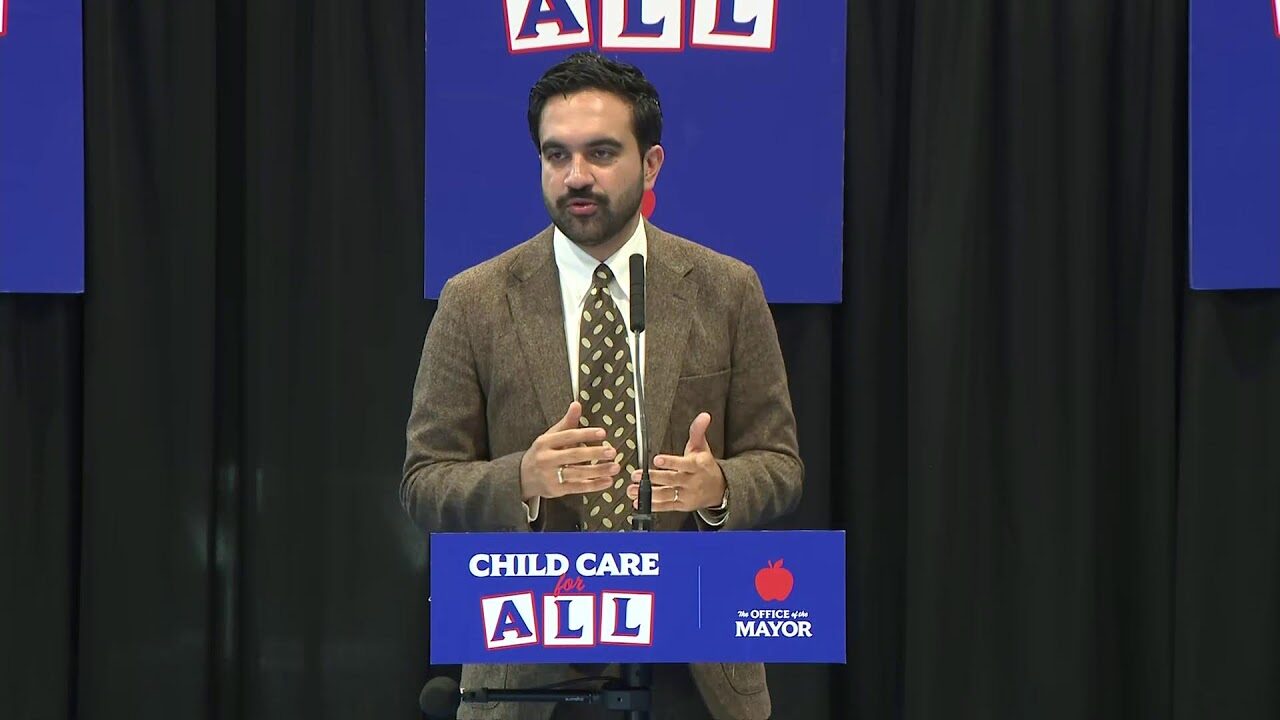
New York City says more than 10,000 low-income children will gain access to child care assistance, but roughly 29,000 children were on the voucher waiting list when the announcement was made.
NEW YORK — October 5, 2026 — Mayor Zohran Mamdani announced Monday that New York City will begin moving more than 10,000 children off the Child Care Assistance Program voucher waiting list, reopening access to subsidized child care for thousands of families after more than a year of constrained enrollment.
The announcement was made at BronxWorks, 1109 Carroll Place in the Bronx, alongside child care providers, advocates and city and state officials.
The Mayor’s Office says the expansion is supported by Governor Kathy Hochul’s $1.2 billion investment in New York City child care programs, including $475 million designated for the child care voucher system.
But the announcement does not eliminate the waiting list.
Mamdani said during the press conference that more than 29,000 children were on the list and that the city would begin taking children off it on a rolling basis.
Key Facts
- More than 10,000 children are expected to be moved off the Child Care Assistance Program, or CCAP, waiting list.
- The program generally serves eligible children from 6 weeks through age 13, and up to age 19 for children with special needs.
- Approximately 29,000 children remained on the waiting list at the time of the announcement.
- ACS will invite families to apply on a rolling basis rather than automatically issuing vouchers to every child on the list.
- Families must still meet program eligibility requirements.
- The state funding package includes $475 million for child care vouchers as part of a broader $1.2 billion New York City child care investment.
- NYC has also added a voucher filter to its online Child Care Map so parents can identify participating providers.
- The Mamdani administration separately allocated $5.2 million annually to cover family copayments associated with subsidized child care.
What Actually Changes
The most immediate change is that ACS can begin contacting families who have been waiting for assistance.
According to the city’s current guidance, invitation letters will be sent on a rolling basis. Families receiving an invitation must submit the required eligibility or recertification information before a voucher is issued.
The city says invitations will generally follow the order in which children were added to the waiting list, while certain federally required priority categories will also apply.
This distinction matters.
The October 5 announcement is not simply a declaration that 10,000 families now possess vouchers. It authorizes and funds the process of moving thousands of eligible children through the application and voucher system over the coming months.
During the press conference, Mamdani explained that the city had spent time reviewing available state funding, voucher utilization and attrition rates because the administration wanted to avoid offering assistance that could not subsequently be sustained.
“Once we offer a voucher to a family,” Mamdani said, the city wants to be confident that it can continue providing that care.
His answer came after a reporter questioned why it had taken months to begin reducing the waiting list.
Why There Was a 29,000-Child Waiting List
Demand for subsidized child care grew substantially after New York expanded eligibility for the Child Care Assistance Program.
Mamdani said that by May 2025 the number of children needing vouchers had exceeded available program capacity, forcing the city to place new applicants on a waiting list.
By October 2026, according to the mayor, that list had grown beyond 29,000 children.
State Senator Jabari Brisport said during the event that previous state budgets expanded eligibility and increased financial assistance per child but did not provide enough funding to meet all of the additional demand.
He characterized the current expansion as enough to help approximately 10,000 children while acknowledging that thousands more would remain without vouchers.
That is the central limitation of Monday’s announcement.
More than 10,000 children gaining access is a significant expansion, but it does not yet create universal access to child care vouchers.
Is the Child Care Really “Free”?
Mamdani repeatedly described the expanded care as free.
During the event, he said that calling it merely “affordable” understated the administration’s policy because the city had previously committed $5.2 million to covering the family copayments traditionally associated with the voucher program.
The city’s August announcement confirms that beginning in September 2026 New York City would cover approximately $5.2 million in annual family fees for households receiving subsidized care. The policy was expected to affect about 22,000 low-income families already participating in voucher and contracted-care programs.
There is, however, an important qualification.
NYC311 says eliminating the required family copay does not necessarily guarantee that every participating family will pay absolutely nothing. If a provider’s regular tuition exceeds the amount reimbursed by the city, a provider may under some circumstances charge the family the difference.
For that reason, “free child care” accurately describes the elimination of the city-assessed family copayment, but individual families should confirm whether a chosen provider charges anything beyond the voucher reimbursement.
New Tool for Finding Voucher Providers
The city also announced a practical change to its online child care system.
NYC’s Child Care Map now allows parents to filter licensed providers according to whether they accept child care vouchers.
Mamdani said the change was intended to solve a basic problem: having a voucher does little good if a family cannot easily determine which nearby providers accept it.
The city says thousands of home-based and center-based providers participate in the voucher system.
Available Seats May Not Be the Main Constraint
One reporter asked an important question during Monday’s press conference: if approximately 10,000 children become eligible for vouchers, are there enough child care providers to absorb them?
Administration officials argued that at least some capacity already exists.
They said many providers currently have vacancies because families who need care cannot afford to pay privately while waiting for vouchers. Removing families from the voucher waiting list, the administration argues, could therefore simultaneously help parents and increase enrollment and revenue for child care providers.
Whether the existing provider network can accommodate all of the newly funded children — particularly in neighborhoods with limited child care capacity — will be one of the most important measures of the program’s success.
From Campaign Promise to Measurable Result
Mamdani has made universal child care one of the central affordability policies of his administration.
New York City has already launched its first 2-K program for two-year-olds. More than 5,700 families applied for roughly 2,000 seats during the program’s first application cycle, illustrating demand well above initial capacity.
The voucher expansion is different from 2-K.
CCAP vouchers allow eligible families to choose among qualifying providers rather than receiving a seat through the city’s 2-K admissions system.
The October 5 announcement therefore expands one part of a much larger child care system rather than establishing universal child care by itself.
For accountability purposes, the next numbers will matter more than the announcement:
How many families actually receive vouchers, how quickly they receive them, how many children successfully enroll with providers, how much the 29,000-child waiting list declines, and whether funding is sufficient to prevent another backlog.
What Is Confirmed
The Mayor’s Office and ACS have officially confirmed that funding is available to begin moving more than 10,000 children from the voucher waiting list.
The city has also confirmed that families will be contacted on a rolling basis and must complete the required eligibility process.
The $5.2 million policy eliminating city child care copayments was announced separately in August and took effect beginning in September.
What Is Not Yet Clear
Several questions cannot yet be answered from the October 5 announcement alone.
The city has not demonstrated that all remaining children on the approximately 29,000-person waiting list can be funded.
It is also too early to measure how many of the newly invited families will successfully complete eligibility requirements and enroll with providers.
And while officials say providers have unused capacity, citywide numbers do not necessarily establish that an appropriate seat is available in every neighborhood or for every family’s schedule and needs.
The announcement should therefore be measured as a funded expansion of access, not yet as proof that New York City’s child care shortage has been solved.
How Families Can Apply
Families seeking child care assistance can use New York City’s MyCity system to apply for low-income child care assistance.
Current city guidance says eligibility depends on factors including family income, residency and having an approved reason for care, such as employment, education or vocational training.
ACS currently states that a family may qualify if income is below 85% of State Median Income and other eligibility requirements are satisfied.
Families already on the waiting list should watch for an ACS invitation and follow the instructions in that notice.
The Bottom Line
Monday’s announcement represents a concrete expansion of New York City’s child care voucher program: state and city money is now being used to begin reducing a waiting list that had grown to roughly 29,000 children.
More than 10,000 children are expected to benefit.
But the numbers also demonstrate the scale of the unfinished problem.
Even after those children are processed, thousands of eligible New York families could remain waiting for assistance.
For the Mamdani administration, the real test will therefore come after the press conference: whether vouchers are actually issued, whether families can find participating providers, whether the remaining waiting list continues to fall, and whether the city and state can sustain the funding necessary to turn a targeted expansion into the universal child care system the mayor has promised.
The October 5 press conference was streamed by the NYC Mayor’s Office from BronxWorks in the Bronx. The working transcript used in preparing this report was generated through speech-to-text and should not be treated as an official verbatim transcript. The source video was published by the NYC Mayor’s Office on October 5, 2026.
Sources
NYC Mayor’s Office — October 5, 2026:
“Mayor Mamdani to Deliver Free Child Care to More Than 10,000 Low-Income Children.”
Official NYC announcement
NYC Child Care / ACS:
Current application and voucher-waitlist guidance.
NYC Child Care application information
NYC Administration for Children’s Services:
Child Care Voucher eligibility and application information.
ACS Child Care information
NYC311:
Child Care Financial Assistance and family-fee guidance.
NYC311 Child Care Financial Assistance
NYC Mayor’s Office — August 13, 2026:
City announcement covering child care voucher and contracted-care family copayments.
Official August child care announcement
Source Video — NYC Mayor’s Office:
“Mayor Zohran Mamdani Holds Press Conference to Make Child Care Announcement,” October 5, 2026.
https://www.youtube.com/watch?v=IynOVW4wc3k
Questions and Answers
How many children will receive new child care assistance?
The city says more than 10,000 children currently on the CCAP waiting list will be invited to apply for vouchers.
Does this eliminate the entire child care voucher waiting list?
No. Mayor Mamdani said approximately 29,000 children were on the list at the time of the announcement. The new funding addresses a substantial portion of the backlog but not all of it.
Will families automatically receive a voucher?
No. ACS will contact families on a rolling basis. Families must complete the required eligibility or recertification process before receiving a voucher.
Does “free child care” mean parents can never be charged anything?
The city is covering the normal family copayment for subsidized care. However, NYC311 warns that a voucher provider whose tuition exceeds the amount paid by the city may in some circumstances charge the family the difference.
Is this the same program as NYC’s new 2-K program?
No. The Child Care Assistance Program provides subsidies or vouchers that eligible families can use with qualifying providers. The city’s 2-K initiative is a separate publicly funded program designed specifically for two-year-olds.
Ask Midtown Tribune about this story
Answers are grounded first in this article. Search all Midtown Tribune reporting from the main AI Search page.
AI-generated summary. Verify important details in the linked original articles.