
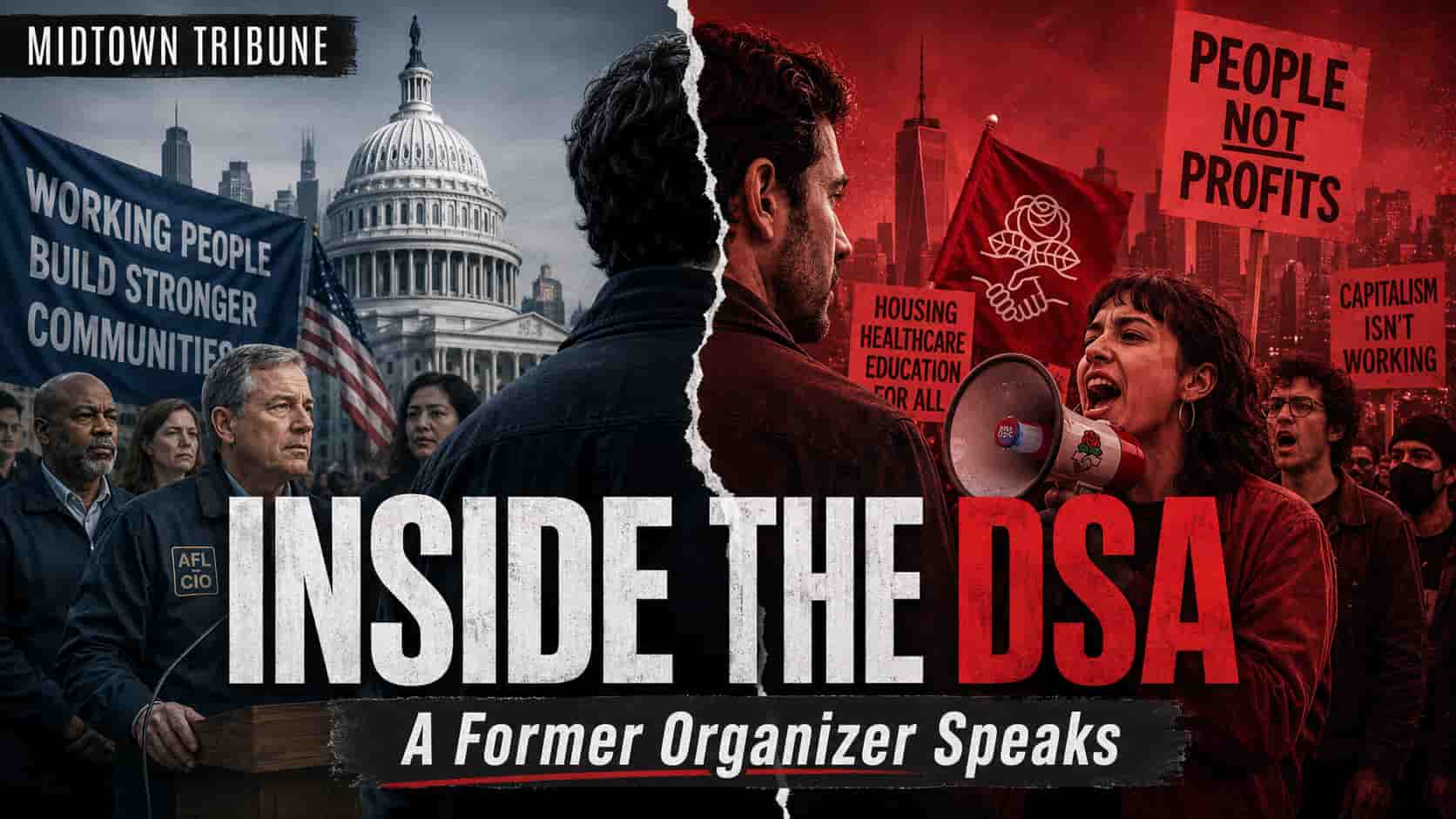
Jake Altman says the Democratic Socialists of America he joined in 2013 was a very different organization from the DSA of 2026. A review of DSA’s own platform supports some of his most important claims — while correcting others. But the interview leaves out a remarkable historical parallel: when East Germany’s ruling communist party was collapsing in 1989, it preserved itself and soon adopted the name “Party of Democratic Socialism.”
The word “democratic” can make a political label sound reassuring.
But history suggests that labels are less useful than programs, institutions and political behavior.
That is one of the most important lessons to emerge from a new interview published by The Free Press with former Democratic Socialists of America organizer Jake Altman.
Altman says he joined DSA in 2013 because at the time he considered it a relatively pragmatic socialist organization, closer to European social democracy than to the revolutionary groups he had encountered elsewhere on the American left.
He says that over the following decade the organization changed dramatically: younger and more radical activists gained influence, anti-communism became increasingly unwelcome, attitudes toward Israel hardened, and revolutionary socialists became far more important inside the organization.
Some of Altman’s statements are personal judgments or recollections that cannot be independently verified.
Others can.
And in several cases, DSA’s own documents are more important than Altman’s testimony.
What does DSA officially want in 2026?
The organization’s new national program, “Workers Deserve More,” makes clear that DSA is not simply campaigning for higher taxes, stronger unions or a larger European-style welfare state.
Among other changes, the program calls for replacing America’s two-party system with a multiparty system, expanding the House of Representatives, introducing proportional representation — and abolishing the U.S. Senate.
The program also proposes major changes to the presidency and judiciary and seeks much greater public control over economic life.
That distinction matters.
A voter may support Medicare for All, stronger labor protections or lower housing costs without supporting a fundamental reconstruction of the constitutional or economic system of the United States.
The new DSA program moves that debate beyond ordinary social welfare policy.
Public ownership, a new political system and the 32-hour week
Altman argues in the interview that the activist core of modern DSA is considerably more radical than casual supporters who simply like Bernie Sanders or Alexandria Ocasio-Cortez.
He describes what DSA itself sometimes distinguishes as ordinary “paper members” and the activist cadre doing the organization’s political work. According to Altman, it is the latter group that should receive greater scrutiny.
The 2026 platform gives that argument substance.
DSA advocates far-reaching structural changes involving political representation, ownership and the organization of economic life. Its current program includes abolition of the Senate and proposes a fundamentally different institutional arrangement from the existing American constitutional order.
The organization also advocates a 32-hour workweek with full compensation, along with major expansions of public provision and public ownership.
Supporters describe this as economic democracy.
Critics describe it as socialism moving beyond a regulated market economy.
The important point is that voters do not have to rely on either description.
They can read DSA’s program themselves.
One number in the interview is wrong: 27% Communist, not 36%
Altman recalls that approximately 36% of respondents to a 2021 DSA membership survey identified as Communist.
That is not what the survey says.
The 2021 survey received 12,971 responses, about 14% of DSA’s membership at the time.
Among respondents:
38% identified as Marxist.
27% identified as Communist.
Those categories were not mutually exclusive. Respondents could select more than one ideological identity.
So the percentages cannot simply be added together.
A respondent could simultaneously describe himself or herself as a socialist, Marxist, communist and democratic socialist.
Altman appears to have confused the approximately 38% Marxist figure with the 27% Communist figure. In the interview he acknowledges that he is recalling the number from memory.
But the correction does not eliminate the larger question raised by the survey.
If significant portions of an organization identify with Marxist and communist traditions, voters may reasonably want to know what those terms mean in practice.
And again, the best answer is not the label.
It is the program.
What the Free Press Interview Leaves Out: “Democratic Socialism” and the Communist Party of East Germany
There is a historical episode worth adding to this discussion because it demonstrates why political labels alone can be misleading.
It does not establish that American DSA descended from East Germany’s ruling party.
It did not.
DSA was formed in the United States in March 1982, when the Democratic Socialist Organizing Committee and the New American Movement merged. DSA’s own historical account describes the organization as emerging from an American democratic-socialist tradition that explicitly rejected authoritarian versions of socialism.
The East German story happened later.
But the parallel is remarkable.
The communist ruling party did not disappear. It changed its name.
For four decades, East Germany was dominated by the Socialist Unity Party of Germany — SED.
The German Federal Archives describes the SED as the party that governed the German Democratic Republic without democratic electoral legitimacy and maintained its authority with the assistance of an enormous security apparatus.
When the East German regime began collapsing in late 1989, the SED faced an existential problem.
Its political monopoly was disappearing.
Its reputation was devastated.
Members were leaving.
The population was demanding free elections.
One possibility was to dissolve the party completely and create a genuinely new organization.
That did not happen.
Instead, the SED survived organizationally.
A German Bundestag report records the sequence explicitly:
December 17, 1989 — SED renamed SED/PDS.
February 4, 1990 — renamed PDS.
PDS stood for Partei des Demokratischen Sozialismus — Party of Democratic Socialism.
The Bundestag document does not describe PDS as an unrelated new organization.
Its heading is extraordinarily direct:
“Socialist Unity Party of Germany (SED), now: Party of Democratic Socialism (PDS).”
That is an important historical fact.
Was this a political attempt to erase the old tracks?
“Covering its tracks” is a political characterization rather than the language of the official records.
But the documented circumstances explain why that characterization arises.
German historical reporting describes reformers around Hans Modrow and Gregor Gysi as determined to prevent dissolution of the SED.
They had enormous reasons to preserve organizational continuity: party assets, real estate, publishing operations, employees and an existing political machine.
NDR’s historical account describes Modrow and Gysi as developing a strategy to save both the party and, at the time, the continued existence of a socialist East German state. Gysi warned delegates that dissolution threatened party property and approximately 44,000 full-time party employees.
The German Federal Agency for Civic Education has described the process even more explicitly: proposals to dissolve and refound the organization were defeated, while the SED was transformed into SED-PDS with members, personnel and assets carried into the successor organization.
So it would be inaccurate to describe December 1989 as simply the birth of an entirely new democratic-socialist party unrelated to the communist state party.
It was a transformation and rebranding of the existing organization.
Whether one chooses the phrase “reform,” “political survival,” “rebranding,” or “sweeping away the old label” is interpretation.
The continuity itself is documented.
And then there was the Stasi
The organization being rebranded was not an ordinary governing party that had simply lost an election.
The SED had controlled one of the most intrusive surveillance states in modern European history.
The German Federal Archives says East Germany’s Ministry for State Security — the Stasi — was answerable only to the SED leadership and considered itself the party’s “shield and sword.”
By 1989, the Stasi had approximately 91,000 full-time employees.
It also had approximately 189,000 unofficial collaborators, or roughly one informant for every 89–90 East German citizens. Those informants infiltrated opposition groups, workplaces, schools, churches and private relationships.
Relative to the size of East Germany’s population, Federal Archives educational material describes the MfS as probably the world’s largest state-security service of its kind.
And its reach did not stop at the Berlin Wall.
Markus Wolf: the man who spied on the West
One of the most famous figures associated with the East German intelligence system was Markus Wolf.
Wolf headed East Germany’s foreign intelligence operation from 1952 until 1986.
The Federal Archives says the service he led operated under strict Soviet supervision in its formative years and later became the Stasi’s powerful Hauptverwaltung Aufklärung, or Main Directorate for Reconnaissance.
Its principal target was West Germany and West Berlin.
Its agents penetrated political parties, government offices, companies and other institutions in the West.
By 1989, the foreign-intelligence branch had roughly 4,600 full-time employees, approximately 13,400 unofficial collaborators inside East Germany, and another 1,500 unofficial collaborators in West Germany.
Wolf therefore was not merely an abstract Marxist intellectual.
He had spent decades at the center of one of the Soviet bloc’s most sophisticated espionage systems.
And during the upheaval of 1989, Wolf was associated with the reform-oriented SED circles trying to shape what came next.
German historical research describes the emerging Modrow camp — which included figures such as Gregor Gysi and Markus Wolf — as the group that would help form the leadership environment from which the PDS emerged.
Where was Moscow?
This is where the history becomes especially interesting — but also where precision matters.
There is substantial evidence of Soviet political and intelligence influence over East Germany.
The German Federal Archives states that the Stasi itself was originally created under the direct guidance of Soviet secret police and maintained close operational relationships with Soviet intelligence throughout the Cold War.
The Federal Archives also notes that Markus Wolf’s foreign intelligence organization began under strict Soviet supervision.
And the German Federal Agency for Civic Education describes Hans Modrow — one of the central reform figures during the regime’s collapse — as having the support and confidence of Moscow. The political grouping around him included Gysi and Wolf and later became central to the PDS leadership.
The language of “democratic socialism” was also circulating through the reform communist world of the Gorbachev period.
In a July 1989 discussion with Mikhail Gorbachev, Hungarian communist reformers explicitly described their political concept as democratic socialism, parliamentary democracy and economic democracy. The declassified record shows Gorbachev engaging with those reforms rather than treating them as an abandonment of socialism.
By early 1990, Gorbachev’s own Communist Party leadership was preparing a platform explicitly framed around “humane, democratic socialism.”
This makes the timing noteworthy.
The ruling East German communist party was changing its name to the Party of Democratic Socialism at precisely the moment when reform communists across the Soviet bloc were searching for language that could preserve socialism while abandoning the most discredited features of the old system.
But did the Kremlin order the name change?
Here the evidence stops.
Midtown Tribune found evidence of Soviet influence, Moscow’s support for Modrow’s reform camp, longstanding Soviet intelligence ties and the wider Gorbachev-era language of “democratic socialism.”
But we have not found a published Kremlin order, Soviet Communist Party directive, KGB instruction or meeting transcript telling the SED: rename yourselves “Party of Democratic Socialism.”
The immediate proposal can instead be traced to the SED’s own temporary working committee.
A record of its December 6, 1989 meeting states that the party congress would be presented with the proposed new name:
SED — Party of Democratic Socialism.
So the strongest defensible conclusion is not that Moscow invented the name for the East Germans.
It is this:
The SED’s rebranding occurred inside the political universe of Gorbachev-era reform communism, under leaders with deep Soviet connections, and preserved the old ruling party rather than dissolving it.
That distinction matters.
There really was an attempt to destroy the tracks — literally
There is an additional historical irony.
While the party was changing its name, parts of the Stasi apparatus were actually destroying records.
The German Federal Archives says Stasi personnel destroyed documents during the 1989–90 collapse under orders intended, among other purposes, to erase evidence of unlawful actions and information identifying people involved.
Citizens occupied Stasi offices and stopped much of the destruction, leaving approximately 16,000 bags of torn documents that archivists are still reconstructing today.
This should not be confused with proof that the PDS renaming itself was ordered as an intelligence operation.
But historically the two processes occurred during the same collapse:
the security apparatus was trying to dispose of compromising records, while the ruling political organization was trying to survive under a new identity.
That is why the words “democratic socialism” deserve historical scrutiny rather than automatic acceptance as proof of political moderation.
Historical Sources: East Germany and “Democratic Socialism”
-
German Bundestag — SED / PDS
Official Bundestag documentation showing the continuity from East Germany’s ruling Socialist Unity Party (SED) to SED-PDS and then the Party of Democratic Socialism (PDS).
German Bundestag — Official PDF -
German Federal Archives — The Stasi
Official history of East Germany’s Ministry for State Security, its relationship to the SED leadership, its approximately 91,000 full-time employees and extensive informer network.
Bundesarchiv — Stasi Records Archive -
German Federal Archives — Markus Wolf and East German Foreign Intelligence
Official archival history of Markus Wolf and the Stasi’s foreign intelligence service, including its Soviet connections and operations directed primarily against West Germany and West Berlin.
Bundesarchiv — Markus Wolf -
Federal Agency for Civic Education — Transformation of the SED
Historical analysis of the SED’s transformation during the collapse of East Germany and the political continuity leading to the PDS.
Bundeszentrale für politische Bildung -
National Security Archive — Gorbachev-Era “Democratic Socialism”
Declassified material documenting discussions of “democratic socialism” within the reform communist movement during the Gorbachev period.
National Security Archive
Historical note: These sources document the transformation of the SED into the Party of Democratic Socialism, the Soviet-linked security system surrounding the East German regime, and the use of “democratic socialism” in the Gorbachev-era reform communist vocabulary. They do not establish that Moscow directly ordered the SED to adopt that specific party name.
An important warning: DSA did not get its name from the East German communists
The chronology must be clear.
American DSA was founded in 1982.
The SED adopted “Party of Democratic Socialism” in 1989–90.
Therefore, the East German communist party is not the source of DSA’s name, and the shared terminology does not demonstrate an organizational relationship between DSA and PDS.
“Democratic socialism” is an older and broader political term that has been used by anti-communist social democrats, socialist reformers, dissidents and, later, former ruling communists attempting to redefine themselves.
That actually makes the lesson more important.
A name does not tell you enough.
A party calling itself “democratic socialist” may be a Scandinavian-style reform movement.
It may be an American democratic-left organization.
Or, historically, it may even be the successor to the ruling Marxist-Leninist party of East Germany.
The useful question is not:
What does the organization call itself?
It is:
What does it actually propose to do?
That brings the question back to DSA
This is where Altman’s interview deserves attention.
He argues that Americans often hear “democratic socialism” and imagine Bernie Sanders, universal health care and a larger welfare state, while the activist organization itself has moved much further left.
In 2026, Americans do not need to accept Altman’s characterization on faith.
DSA has published its own program.
It calls for abolition of the Senate and a major reconstruction of American political institutions.
The organization says it reached an all-time high of 120,000 members on July 4, 2026, describing itself as the largest socialist organization in American history by absolute membership.
And its electoral activity is increasingly significant.
That makes understanding the distinction between a comforting political label and a concrete institutional program more than an academic exercise.
Altman and Ukraine: another fact-check
Altman says one of his final breaking points came in 2022, when DSA responded to Vladimir Putin’s invasion of Ukraine by emphasizing the role of the United States and NATO.
That recollection captures an important part of the DSA statement, but not all of it.
DSA’s February 26, 2022 statement explicitly condemned Russia’s invasion, called it illegal under the United Nations Charter and demanded the total withdrawal of Russian forces from Ukraine.
But in the same statement DSA also reaffirmed its demand that the United States leave NATO and blamed what it called American “imperialist expansionism” for helping set the stage for the conflict.
Therefore, saying simply that DSA “supported Putin” would be inaccurate.
Saying that DSA condemned Putin’s invasion while simultaneously advancing an interpretation assigning substantial responsibility to NATO and U.S. policy is accurate.
Altman calls that “Putin apologism.”
That is his judgment.
Readers can examine DSA’s words and decide for themselves.
The larger lesson
The most valuable part of the Free Press interview may ultimately be the question it raises rather than every answer Altman gives.
Political organizations change.
Political language changes.
And political labels can survive transformations that would make earlier members barely recognize the organization carrying them.
East Germany provides an especially striking historical example.
The SED went from the ruling communist party of a one-party-dominated state, protected by the Stasi, to SED-PDS, and then to the Party of Democratic Socialism — without first disappearing and creating an entirely unrelated organization.
That history does not prove that DSA is the SED.
It does not prove that democratic socialism equals Stalinism.
And it does not establish that American democratic socialists inherited their name from East Germany.
What it proves is something simpler:
“Democratic” in a political name is not evidence by itself.
History, organizational continuity and — above all — the actual program matter more.
And when judging the modern Democratic Socialists of America, there is no need to speculate.
Their program is public.
Read it.
Then decide what the name means.
Editor’s Note: This article distinguishes between statements made by former DSA organizer Jake Altman and positions that can be independently verified through official DSA documents. Altman’s descriptions of internal culture and individual motivations represent his personal account. Midtown Tribune reviewed DSA’s 2026 program, membership survey, official statements and related organizational materials.
Sources & Primary Documents
Midtown Tribune reviewed the original interview together with official DSA, NYC-DSA and New York City government materials. Statements attributed to Jake Altman represent his views unless independently confirmed below.
-
The Free Press — “Confessions of a Former DSA Organizer”
Interview with former DSA organizer Jake Altman and Maya Sulkin, published August 8, 2026.
Watch on YouTube -
The Free Press — Jake Altman: “I Was in the DSA. Here’s What They Really Believe.”
Altman’s earlier analysis of the Democratic Socialists of America and its new program.
The Free Press -
Democratic Socialists of America — Workers Deserve More
DSA’s official 2026 national program, including proposals concerning the Senate, presidency, Supreme Court, public ownership, ICE, policing, prisons, Israel and the 32-hour workweek.
Official DSA Program -
Democratic Left / DSA — DSA Launches New Program
DSA’s explanation of how the 2026 program was developed and how it will be used in the national candidate endorsement process.
Democratic Left — DSA -
Democratic Socialists of America — July 2026 National Political Committee Newsletter
DSA states that membership reached an all-time high of 120,000 on July 4, 2026.
DSA National Political Committee -
DSA 2021 Member Survey Report
Membership demographics, age, education, income and political self-identification. The report records 27% identifying as “Communist” and 38% as “Marxist,” correcting a figure cited in the Free Press interview.
2021 DSA Member Survey — PDF -
Democratic Socialists of America — On Russia’s Invasion of Ukraine
Official February 26, 2022 statement condemning Russia’s invasion, calling for withdrawal of Russian forces, while also criticizing NATO expansion and U.S. foreign policy.
Official DSA Statement -
Democratic Socialists of America — DSA, BDS and Palestine Solidarity
Official DSA material confirming the organization adopted a resolution supporting the BDS movement in 2017 and reaffirmed its commitment in 2019.
DSA Official Website -
New York City Democratic Socialists of America — Zohran Mamdani
NYC-DSA identifies Zohran Mamdani as a DSA member and documents the organization’s support for his mayoral campaign.
NYC-DSA — Zohran Mamdani -
Democratic Socialists of America — Zohran Mamdani Victory Statement
National DSA statement describing Mamdani’s 2025 mayoral victory and the role played by DSA members and volunteers.
Official DSA Statement -
NYC Mayor’s Office — Mayor Zohran Mamdani
Official New York City government information and statements from the Mamdani administration.
NYC.gov — Office of the Mayor
Source note: Political characterizations and descriptions of DSA’s internal culture made by Jake Altman are presented as his account. Policy descriptions in this article were checked against DSA’s published documents and official organizational materials.
Ask Midtown Tribune about this story
Answers are grounded first in this article. Search all Midtown Tribune reporting from the main AI Search page.
AI-generated summary. Verify important details in the linked original articles.